
Interviewed by Soraya
Yesemin Pekyusal
Please introduce yourself here:
I’m Yasemin, co-founder of Snob Collector by Pg Art Gallery alongside my aunt, Pırıl Arıkonmaz. I grew up in İstanbul in a family where art and culture were always present in different ways. My mother has worked in the management of an arts & culture centre for many years, my father was a huge music lover, and my grandfather was a businessman with a passion for collecting. He had several collections, including a collection of around 5,500 seashells, which I grew up seeing him build with incredible patience and dedication.
My aunt Pırıl was naturally another big influence. She co-founded Pg Art Gallery with my grandmother in 1993, and they built and ran the gallery together for its first ten years before my aunt continued independently. In that sense, I grew up around something that had already been part of my family for two generations. I went to exhibition openings from a young age and later spent my high school internships at the gallery and working at art fairs, getting to see what happens behind the scenes. I was always very curious, so being around so many different people, artists and ideas was something I loved.
I studied Psychology at McGill University alongside Art History and Behavioral Science, and after graduating moved to London to work in digital marketing. Art was always somewhere in the back of my mind, and when I returned to İstanbul, my aunt suggested we finally bring to life an idea she had been thinking about for some time. That became Snob Collector, which we co-founded in 2024. Today, I lead the artist collaborations and creative direction and manage the day-to-day running of Snob Collector.
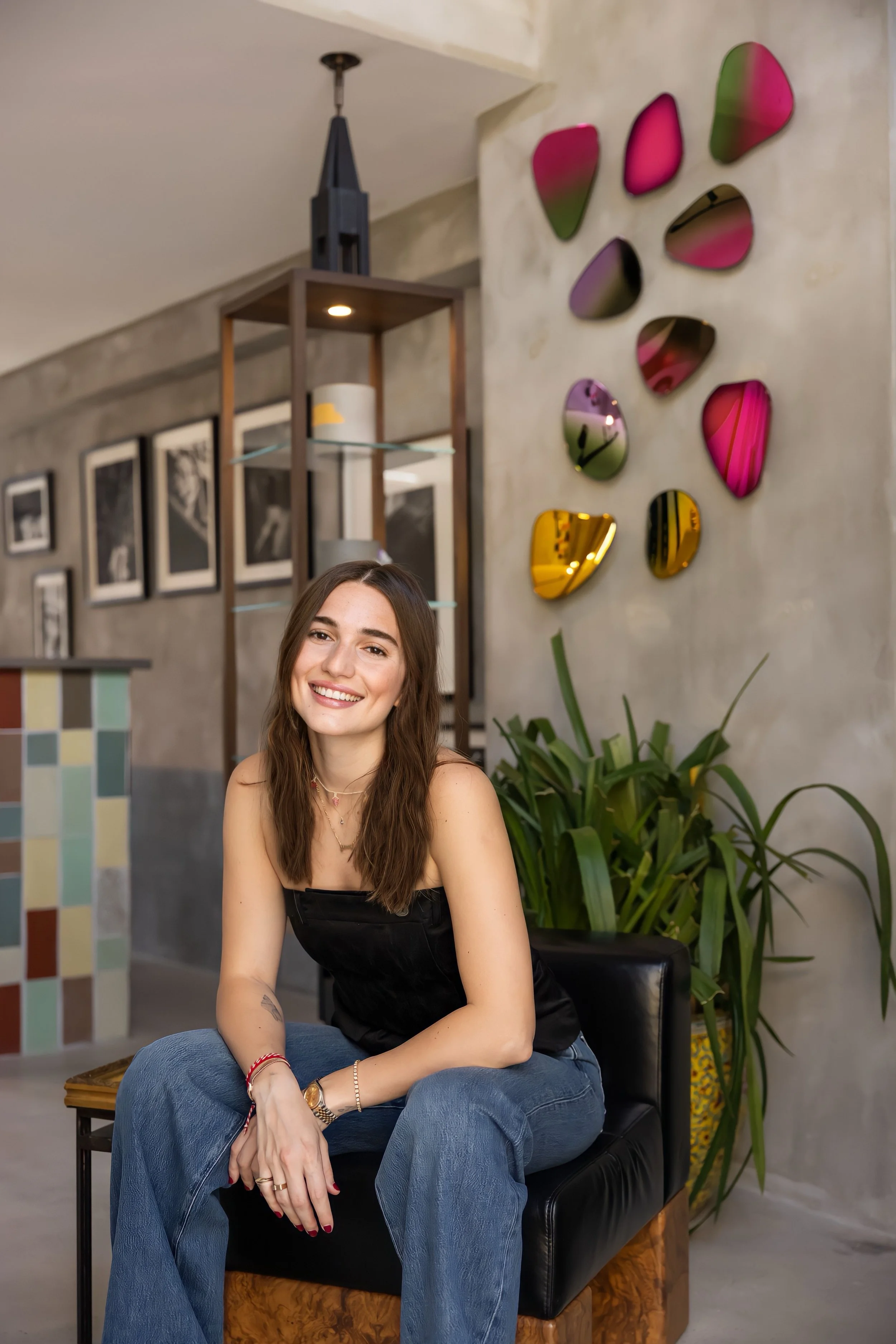
1. You grew up adjacent to a gallery that has been a part of Istanbul’s contemporary art scene since 1993. When did that stop being family context and start being your own work - and how would you describe Snob Collector to someone who’s never bought a piece of art in their life?
Growing up, the gallery was always part of my world. I loved going to my aunt’s openings, and took every opportunity to intern at the gallery and work at art fairs, gradually learning about artists, their practices, and how a gallery operates.
After graduating from McGill University, I moved to London and started working at a digital marketing agency. It didn’t take long for me to realise that what I really wanted was to be back in İstanbul, working in art. Whenever I visited my aunt’s new space in the auto-repair district, I was struck by how alive it felt. It was constantly changing with new works by artists who also happened to have their studios on the same street. A living environment rather than a conventional art gallery. A couple of months into living in İstanbul, I came home for New Years, and told my dad how I wanted to work with my aunt and he told me that the right time would come. Within a few weeks, I had to pack and return to İstanbul, which coincided with my aunt finding a new space for an idea that she had been developing for years: a place dedicated to artist collaborations, editions, publications, functional pieces, things that could exist somewhere between art, design and the everyday. I became involved in shaping that idea into Snob Collector, and that was really when the gallery stopped being simply something I had grown up around and became my own work as well.
For someone who has never bought art, I would describe Snob Collector as an entry point. You don’t need to know anything about contemporary art or think of yourself as a collector. It’s a place to encounter something you connect with and want to live with, whether that’s an artwork, an edition, a necklace or a functional piece.
2. The name is a joke at its own expense: everything about the project argues that art should be lived with rather than guarded. Where did ‘Snob Collector’ come from, and what were you pushing against when you named it?
The name is intentionally ironic. The art world can sometimes feel exclusive or intimidating, especially if you don’t already know its language or see yourself as a collector. ‘Snob Collector’ plays with that perception. We wanted to create a space that felt like the opposite: approachable, curious and not too serious about the rules of what belongs in a gallery or what qualifies as something worth collecting. Calling it ‘Snob Collector’ while questioning the exclusivity traditionally associated with collecting was part of the joke. The name pokes fun at that world, while also celebrating the pleasure of being particular about the things you choose to surround yourself with.
3. Mini works, editions, tableware, scarves, charms - you’ve built a ladder into collecting rather than a single entry point. Who is actually buying, and has that changed since you started? Are you seeing a genuinely new generation of Turkish collectors, or are you making them?
We see a real mix. Some people who come to Snob Collector are already art collectors, while for others it might be their first experience with a gallery. What has been interesting is seeing people enter through very different pieces like someone might first buy a scarf, or a candle, and then later become interested in an edition or an original. We are ‘making’ a generation of collectors feels like too big of a claim, but I wholeheartedly believe that we’re making collecting feel more approachable. There can be a sense that you need a certain level of knowledge or budget before you can call yourself a collector and we wanted Snob Collector to move away from that strict understanding. You can start wherever you want, whether it’s a piece of jewelry, a pillow, or even a pair of socks, and develop your relationship with art from there.
Since opening, we started to understand our audience much better, although it is always an ongoing observation. There is definitely a younger group who are curious about art in new forms, but who don’t necessarily identify themselves as collectors yet. A significant amount of people come in with preconceived ideas of what art or collecting should look like, often shaped by what they’ve grown up around, and we love challenging those ideas through the perspective Snob Collector has inherited from Pg Art Gallery and the 30+ years of experience behind it.
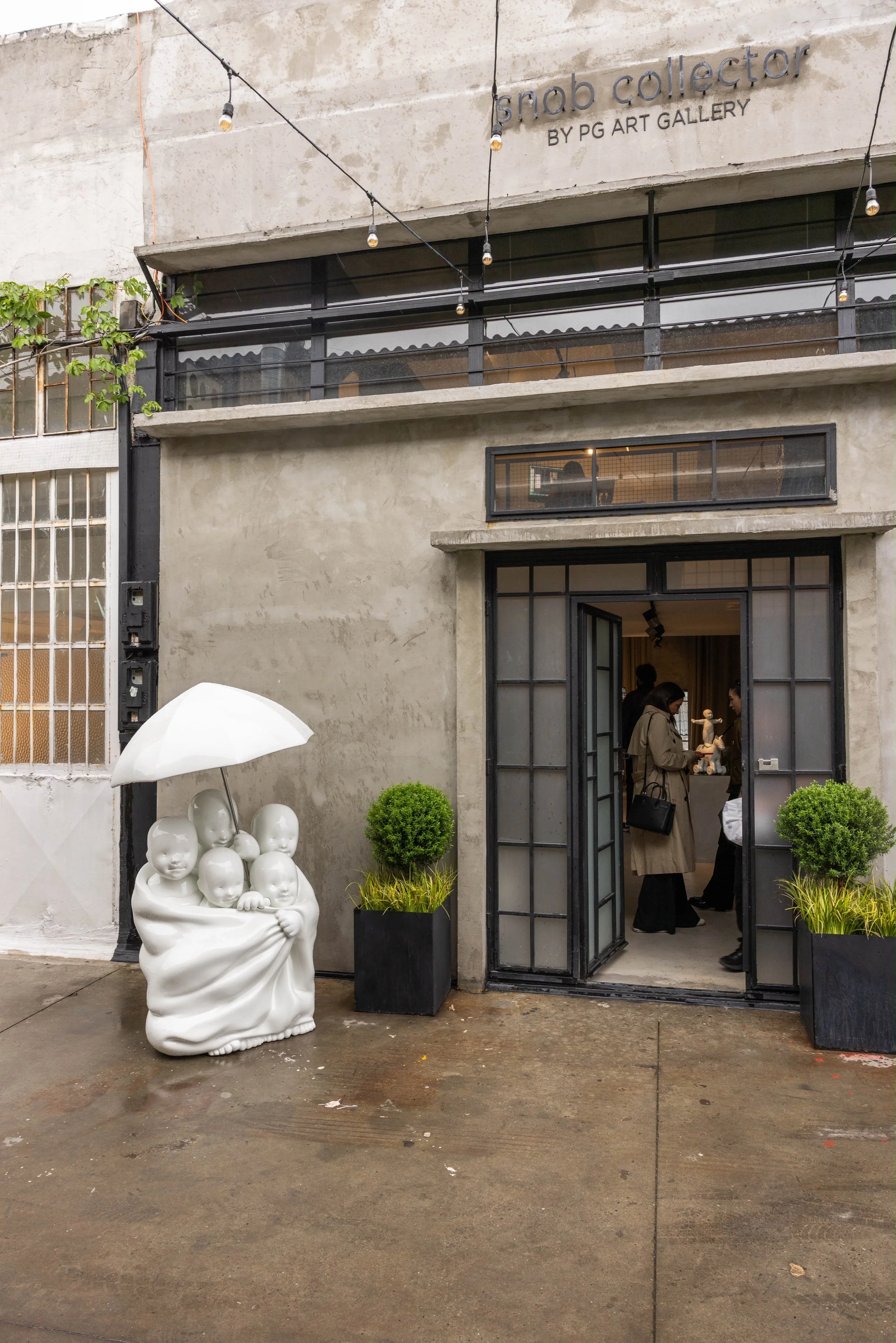
Street View. Ayla Turan Sculpture
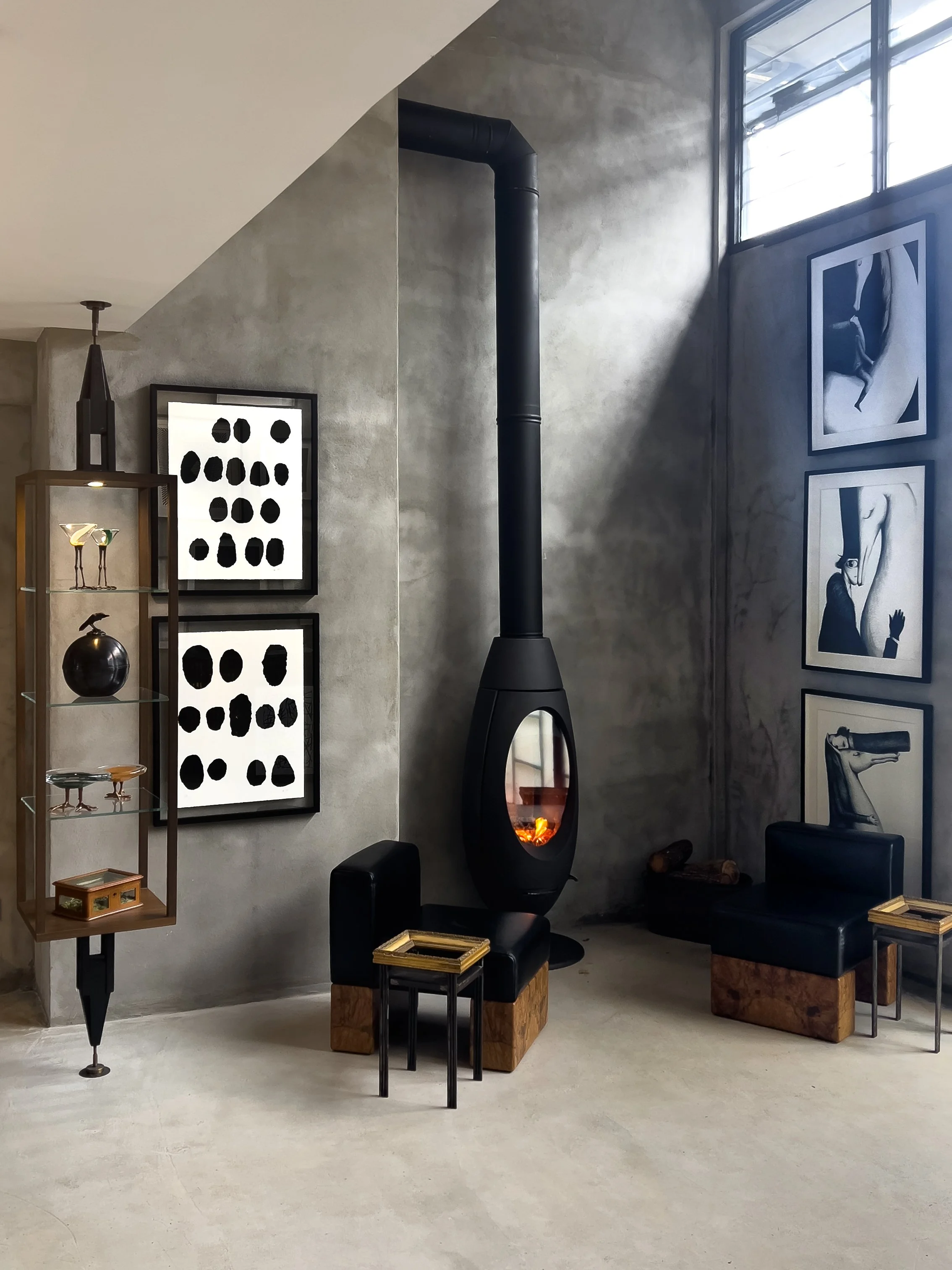
Snob Collector interior
4. From outside, İstanbul in 2026 looks like a scene running at full speed - biennial, fair week, new spaces, international attention. From the inside, what’s the harder story? What does it actually take to run an art business in Turkey right now.
İstanbul’s art scene really is dynamic. From the inside, that energy means it’s very high-intensity and fast-paced. It’s an industry where you constantly have to be online and communicating, and the social aspect of the art world is very much part of the job. Running a gallery today goes far beyond exhibitions. You have to stay in close contact with artists and collectors, attend fairs and make studio visits, on top of all the day-to-day work happening behind the scenes. There is always something moving, and you have to keep up with it. I think the İstanbul art scene is very relationship-driven, so being present is a really important part of it. All of this movement is also happening against a backdrop where costs and conditions can change very quickly, which pushes galleries to be resourceful and find creative solutions. The challenge is keeping up with the pace and adapting to changing conditions while still giving artists, exhibitions and ideas the attention they need. This intensity is also what makes the scene feel so alive.
5. When Turkish artists get picked up internationally, there’s often a lens waiting for them - geography, politics, East-meets-West. What do you think gets flattened in that translation, and what’s happening in the studios here that nobody abroad is looking at yet?
I think there can be an expectation internationally that Turkish artists must make a statement about where they come from, culturally or politically, or through this idea of being between East and West. What feels particular to Turkey is how many different visual histories coexist in everyday life. You can be surrounded by Ottoman architecture, traditional crafts, modernist buildings and completely contemporary global culture without experiencing them as contradictions.That doesn’t mean Turkish artists need to represent Turkey, combine East and West, or make work about identity. These layers can simply be part of the visual environment an artist comes from, shaping their perspective without needing to appear directly in the work. I would like Turkish artists to be seen for what each artist is doing, rather than always looking for what their work says about where they come from.
6. Pg Art has a name that took three decades to build - Bebek to Tophane, close to 300 exhibitions. From where you sit, what were the decisions that made that reputation? Was it the program, the timing, the artists, or something less visible?
From what I witnessed growing up around the gallery, and my three year experience working with my aunt I think openness and adaptability have been critical to Pg Art Gallery’s longevity. The gallery has constantly evolved without losing its core value of supporting young and emerging artists, staying curious about new production, and being open to different ways of exhibiting and experiencing art.
I wasn’t working alongside my aunt through those years, so I can only speak from what I saw growing up around it. I watched the gallery move between very different neighbourhoods in İstanbul, from Bebek to Tophane and then Çukurcuma, while its model continued to change as well. There were traditional exhibitions, but also collaborations with architects, jewellery designers and different brands. There was always an openness to trying something that didn't necessarily fit within the conventional idea of what a gallery should do.
Then she made the decision to move to the auto-repair district, away from most of İstanbul’s contemporary galleries at the time. Many artists already had their studios in the area, so the gallery became much closer to where things were actually being made. Alongside the main white-cube gallery, she opened Pg Pop Up. It was initially supposed to be temporary, hence the name, but it stayed and developed into something completely different.
Pg Pop Up became almost like a home that was constantly changing. New works would come in from artists’ studios, furniture would move, wall colours would change and the way things were displayed was never really fixed. You could visit three days in a row and see something different each time. It was very fast-paced and alive, and I think that environment reflected her own curiosity.
Looking back, I think my aunt gradually created a gallery model that worked for her rather than feeling the need to follow an existing one. She brought together different approaches, experimented with them and allowed the gallery to evolve naturally around the artists and their production.
So I don’t think Pg Art Gallery’s reputation came from one particular decision. It was built through the artists and the relationships developed with them over many years, but also through this willingness to keep questioning how a gallery can operate. The formats and spaces have changed many times, but that openness, curiosity and commitment to artists have remained consistent.
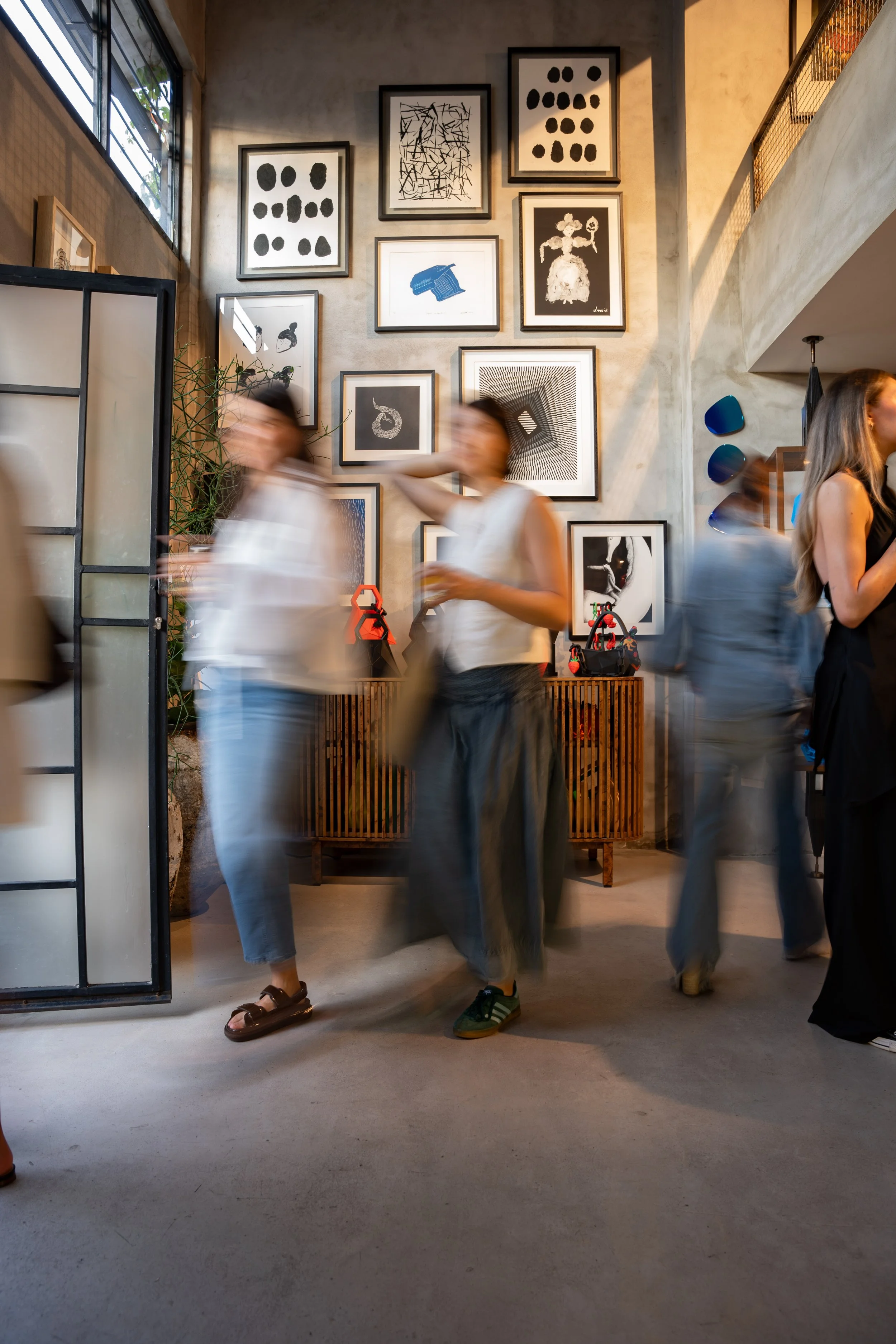
Opening at snob collector.
7. What has your aunt taught you that you have kept, and where have you deliberately gone the other way? Building something under an established name is a platform and a shadow at once - how do you handle both?
What I’ve learned most from my aunt is the importance of care and attention to detail. She has always approached the gallery with a very particular sense of taste, adding small, thoughtful touches to everything she does. That same care extends to people. Her relationships with artists and collectors have been built over many years through kindness, trust and genuine affection, and she has always made a point of welcoming anyone who takes the time to walk into the gallery.
I’ve also learned a lot from how much she trusts herself. She is very grounded in her vision and incredibly intuitive. If she believes in an artist, an idea or a direction, she trusts that instinct and takes a chance on it. There is a self-reliance in that which I really admire and try to carry into what I’m building.
At the same time, I don’t think carrying those values forward means doing things in the same way. Snob Collector has given me the space to interpret what I’ve learned from her through my own generation and perspective. I’ve never felt that I need to make something that looks or operates exactly like Pg Art Gallery. What feels more important is carrying forward the care, confidence, curiosity and strong relationships that define my aunt’s approach, while allowing myself the same freedom she gave herself to figure out what works for me.
8. Everything you make requires an artist to hand over their work and let it become something else - a print, an object, something worn. How does that trust get built? Tell me about one collaboration where the conversation changed what the piece ended up being.
Artists are naturally curious and often eager to explore different mediums. They have so many ideas, but even established artists can sometimes be hesitant to step outside the way they usually work. I think the trust comes from creating a space where they feel comfortable experimenting and allowing things to develop organically.
A collaboration very dear to me was one we did with Devran Mursaloğlu, who sadly passed away last year. We had been wanting to make something together for a while, but didn’t yet know what form it would take. One day, Devran came to the gallery with a bag full of paper strips, folded forms resembling rocks and other elements she used in her practice. She happened to have them with her, and by coincidence, there was also a photography team working at the gallery that day. We started experimenting with the materials, creating temporary compositions and photographing them.
Those ephemeral installations now exist only through the photographs, which eventually became three different editions of 25 prints. It was a new experience for Devran too, despite her long established practice, and she was genuinely happy with the result. I think that spontaneity and openness to seeing where an idea can go is one of my favourite parts of these collaborations.
9. I’d like to leave the last word about working with Turkish artistic talent: what do you want the world to know about Turkish artists and art scene in Turkey?
From my experience, the art scene here feels quite connected. Artists, galleries, collectors and people working across different fields of production cross paths often, so conversations and collaborations can develop quite organically. There is also an incredible amount of production knowledge in Turkey, from ceramics and glass to textiles, metalwork and printing, which gives artists a lot to work with when they want to experiment beyond their usual medium.
At the same time, I see a younger generation of collectors who are curious, informed and less attached to conventional ideas of what or how they should collect. I think bringing those two sides together creates a lot of potential for the art scene here.
Sevim Kaya
1. Your practice keeps returning to roots and seeds, to the idea that life grows through soft, steady becoming rather than violent effort. Where did that attention start? Was there a specific plant, garden, or moment?
I can’t say that there was a single moment when this began. It was an interest that developed gradually as I observed nature, especially the way plants grow. What affects me most is that growth in nature happens without any grand spectacle. A seed waits patiently beneath the soil, a root quietly makes its way forward, finding its way around whatever obstacle it encounters… None of it is in a hurry. I think my work gradually began to take shape around this idea. Realizing that growth doesn’t always have to be visible, fast, or powerful was an important starting point for me.
2. Clay and paper behave in opposite ways: one is fired and permanent, the other is fragile and light. What does each one let you say that the other can't?
Clay makes me feel its weight, durability, and our connection to the earth. While shaping it, I directly encounter the physical resistance of the material.Paper, on the other hand, stands at the opposite end of this spectrum. It is light, delicate, and fragile. It can be affected by even the slightest movement. It quietly records every intervention made upon it.
Each individual unit is simple enough to be considered independently from the whole, yet once it becomes part of the whole, it turns into an indispensable element of the structure. Both materials carry the strength that emerges from coming together.
3. Your surfaces are built from hundreds of small units, each shaped by hand. What happens to your mind during that repetition, and does the work change depending on the day you made those units?
Making each unit one by one has almost become a ritual for me. In the beginning, I would say it is a very conscious process; but as the repetition increases, my mind also begins to slow down.
After a while, I am no longer simply producing the units; I am also creating a space for thinking. Sometimes, I follow only the movement of my hands, without thinking about anything at all.
And yes, I believe that the mood of the day I make them becomes part of the work. Even when I use the same form and the same material, the units I make on different days are never exactly the same. In this way, the work becomes an accumulation of material and time.
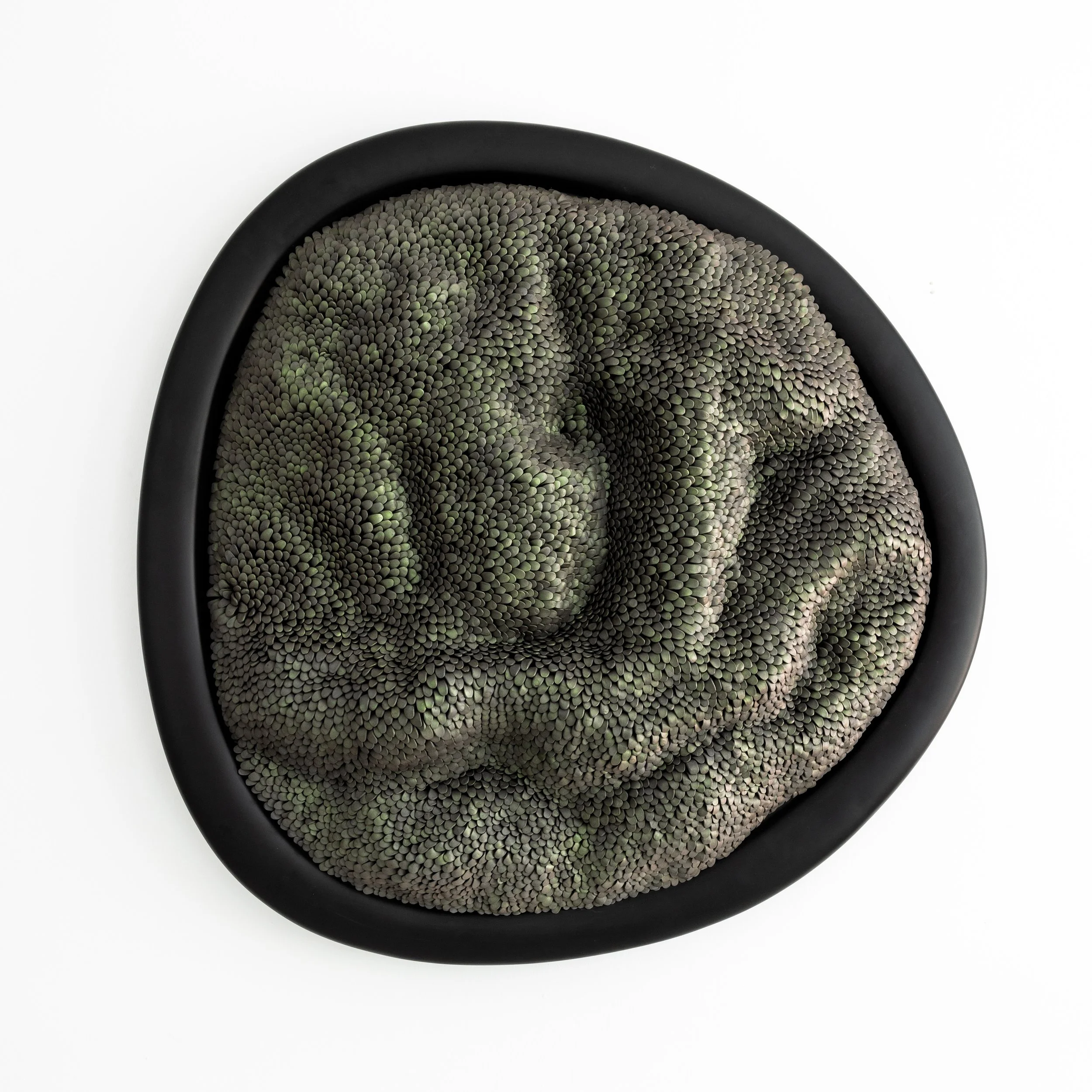
Sevim Kaya
The Grandeur of Small Things, 2023
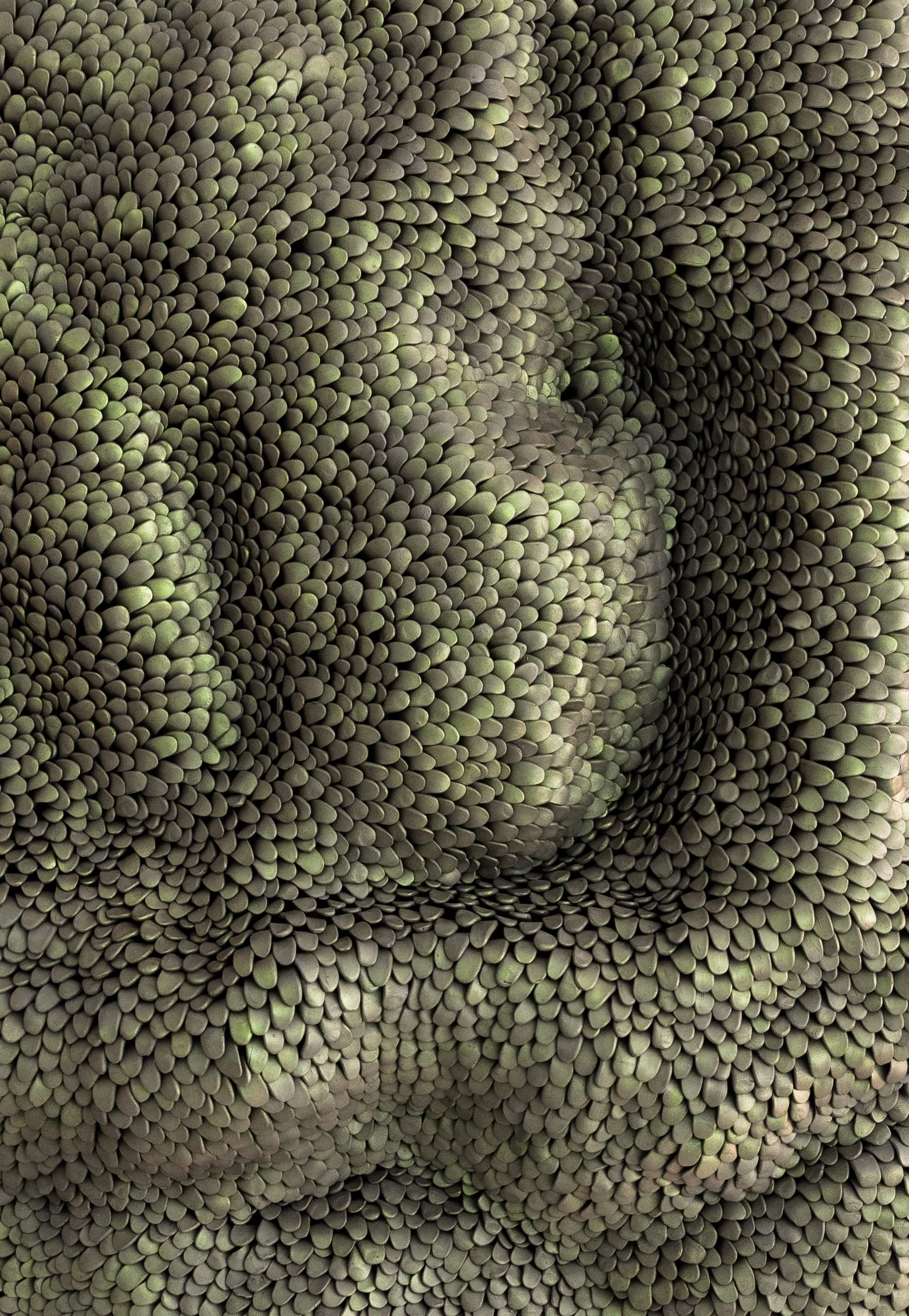
Sevim Kaya
Untitled, 2020
4. In Turkey, clay has long carried the weight of “craft” and sits in a lineage of women ceramicists like Füreya Koral. Do you feel part of that lineage, and has the way clay is read shifted for your generation?
Of course, ceramics has a very strong and deeply rooted history in Türkiye. I believe that women artists have also held a very important place within this history. The contribution of artists such as Füreya Koral to establishing ceramics as a powerful form of artistic expression is invaluable.
Rather than defining myself as someone who directly continues a particular tradition, I see myself as an artist searching for my own language within the space that this history has opened up. For me, clay is not simply a material I use to give form to something. Exploring the traces of the earth, nature, and growth through a material that comes from the earth itself creates a very important connection with my practice.
5. Your feed shows your hands constantly: pinching, pressing, sorting. Was that a deliberate decision to make the labour visible, and has it changed the way collectors relate to a finished piece?
Yes, I especially value making the labor visible. In my work, the process is just as important as the result. The fact that hundreds of small units are individually created by hand reveals how the work comes into being. I want the viewer to sense not only the completed surface, but also the time behind it. I think this changes the way we look at the work. It is no longer simply a finished object - it becomes an accumulation of time, repetition, and labor.
This is also partly why I share my process on social media. I want people to witness the making of the work, rather than only encountering the finished piece.
6. The title A Moment of Growth That No One Saw asks the viewer to slow down. How does that sit with an art world of openings, fairs and feeds, all of which move at the opposite speed?
The fact that this title asks the viewer to slow down is a conscious choice on my part. For me, A Moment of Growth That No One Saw is about growth that happens quietly, outside our immediate awareness.
In the art world, the result, visibility, and speed often take precedence over the act of making itself. Openings, art fairs, and social media feeds constantly expose us to something new and encourage us to move on to the next thing. My own process, however, is built on repetition and patience. I think this contrast is precisely why this title is important to me. A Moment of Growth That No One Saw draws attention to processes that take place quietly, unnoticed, in a world centered around visibility and speed.
The hundreds of small units being created slowly, one by one, point to a kind of time that is difficult to see. Growth is not always visible. Sometimes, for a long time, it may seem as though nothing is happening. And yet, something continues steadily beneath the surface.I think life often works in the same way. Change does not always happen through dramatic moments. Sometimes it happens quietly, through repetition, patience, and small shifts that only become visible much later.
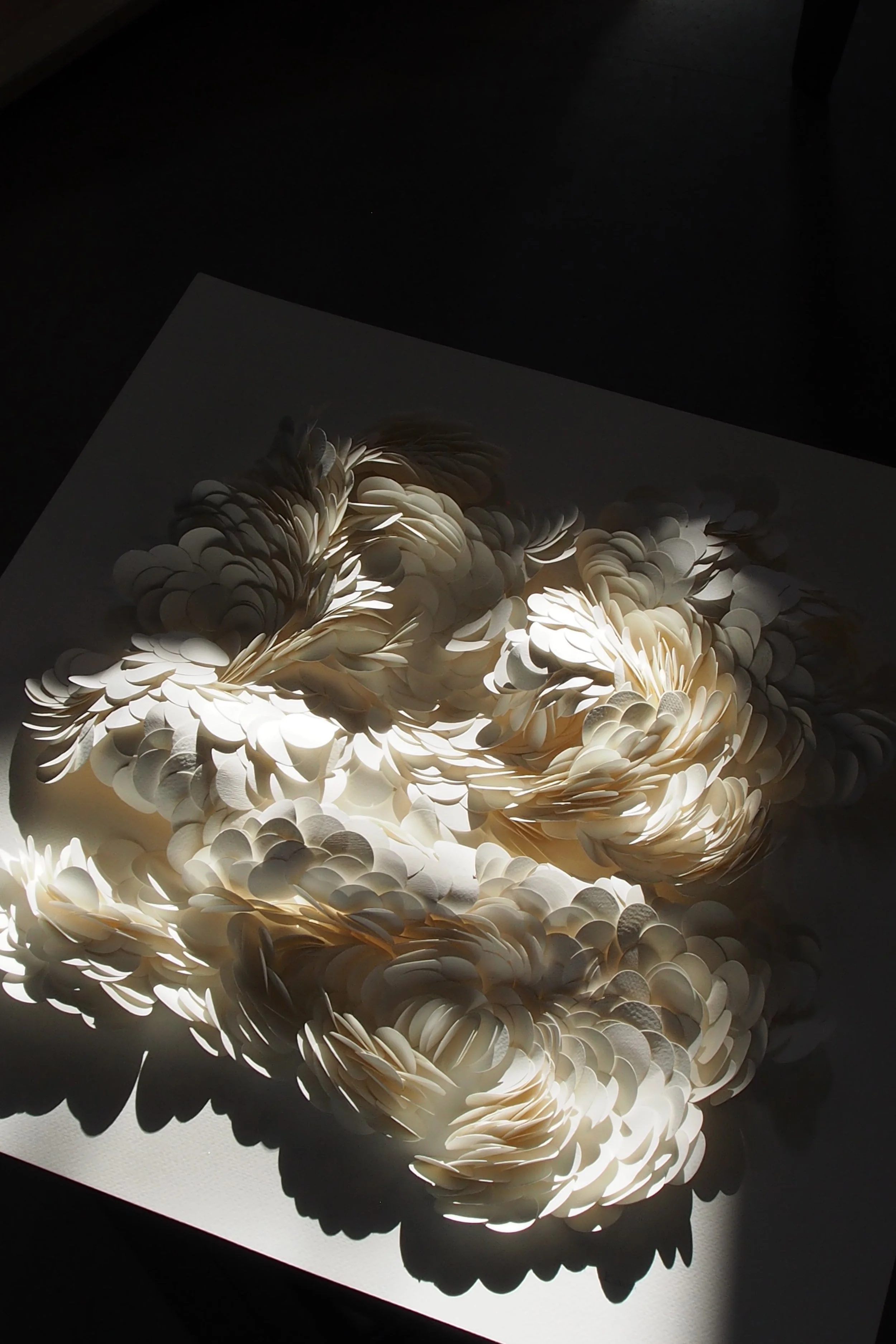
Sevim Kaya
A Moment of Growth that No One Saw Series, 2025
Ömer Faruk Yaman
1. You trained in aeronautics and astronautics at Istanbul Technical University before returning to drawing. When you sit down with a pen now, how much of that engineering eye is still working: the exploded view, the tolerance, the schematic?
Quite a lot. I no longer consciously think like an engineer, but the way something is constructed and how it might function still shapes the way I draw. My drawings may be imaginary, but I want them to possess an internal logic. Perhaps that is the strongest reflex engineering left me with: the urge to construct the impossible convincingly enough that, for a moment, it feels entirely possible.
2. Voyager watches contemporary technological systems from the outside, a traveller recording the porous zones between human and machine. Is Voyager a character you invented, or a way of describing your own position?
In fact, both. Voyager is a character I created to move through time and space, but he is also a way for me to think and imagine. He has access to possibilities that I could never have in the real world. He explores, invents, and follows paths that would otherwise remain inaccessible to me. At times, I think of him less as a separate character and more as an extension of myself, someone who can go where I cannot.
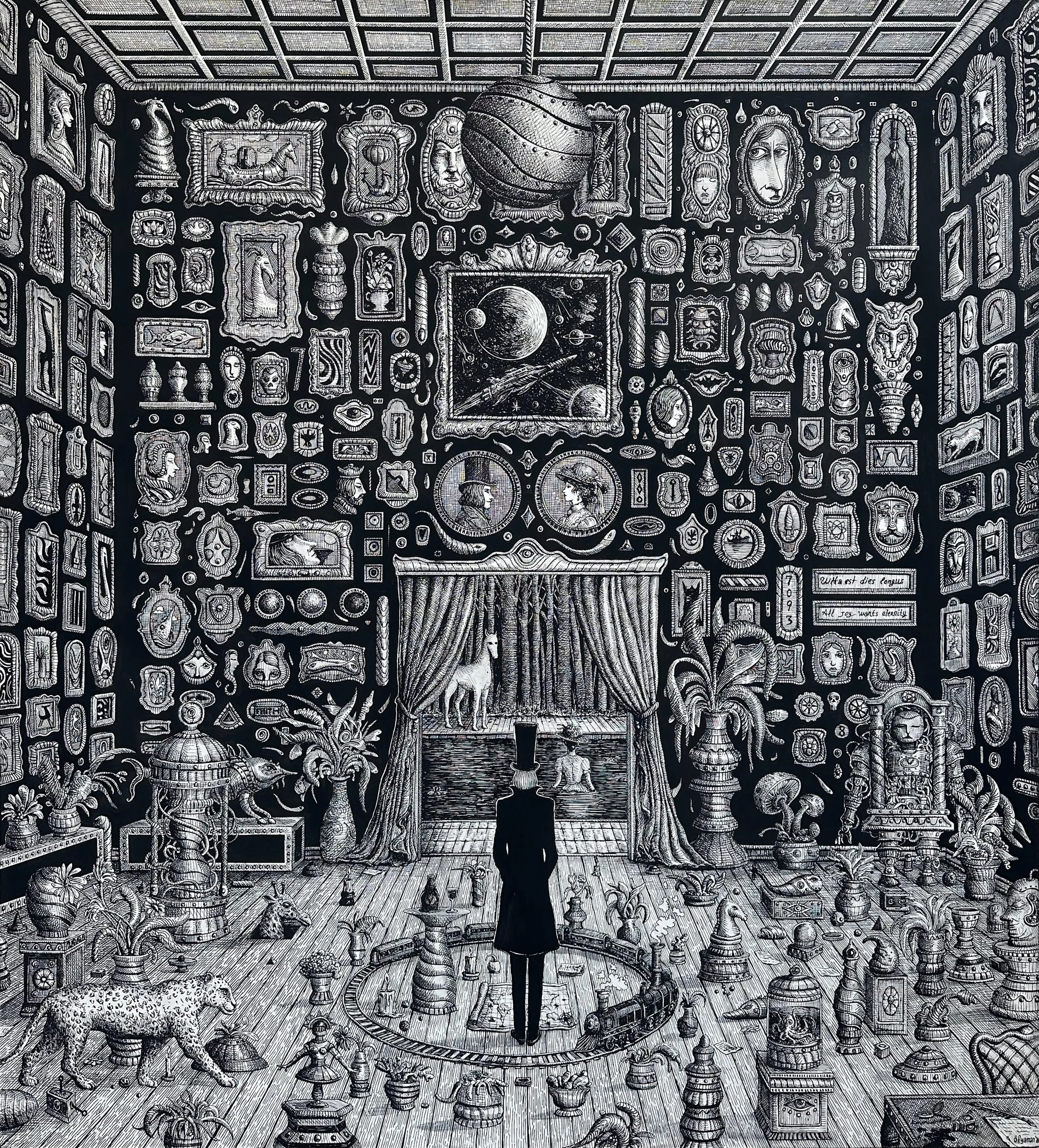
Ömer Faruk Yaman
Memory Series - All We Remember, 2026
3. Your creatures read as either an artificial intelligence product or a very old technology. You draw them entirely by hand, at a moment when machines generate images in seconds. Does that feel like resistance, irony, or something else entirely?
I see it less as an act of resistance than as an ongoing fascination with the ways people have made and understood things throughout history. Drawing by hand is not simply a technique for me; it is also a way of thinking. I believe the relationship between the hand and the brain continually reshapes thought itself. At a time when technology allows us to generate images almost without limit, it still matters to me that an idea first passes through my own hand. Sometimes a thought only fully takes shape through that physical act.
4. Several of your works show a small figure standing before a wall crammed with framed pictures. What are those drawings about: collecting, hoarding, the gallery itself?
When I draw, fragments of things I have lived through and made often begin to surface. I think of those walls filled with framed images as a kind of memory room. People place things on their walls because they matter to them, and in these works each frame functions in a similar way, as a small trace of the character’s history, memory, or inner world.
5. You work from a studio in İcadiye, Üsküdar. Istanbul is a city that repairs and salvages everything, from the oto sanayi workshops to the hardware streets. Does that material culture end up inside your machines?
I’m sure it does. I have always been affected by Istanbul’s layered, constantly shifting character. My studio is in a quieter part of the city, but I can still feel its vast, almost harmonious hum. Sometimes I think the city genuinely changes your frequency. Perhaps that is what enters the drawings: a state of mind that moves continuously between past and present, slightly noisy, restless, but intensely alive.
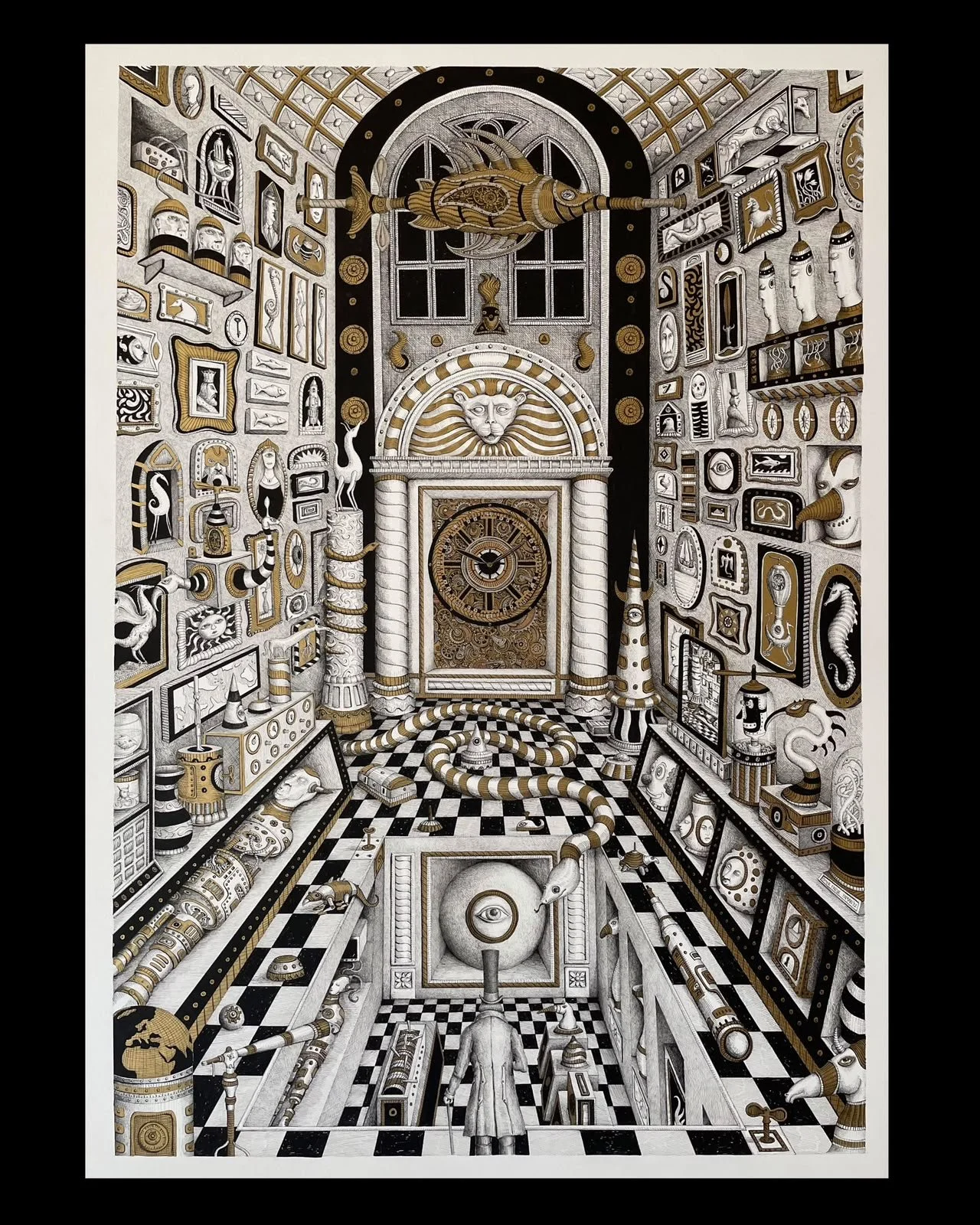
Ömer Faruk Yaman
House II, 2022
Images Courtesy of Snob Collector
Words Copyright of Naso Art Journal
