
Sudan: A Visual Art Narrative
by Shayhana Al Ghareeb
Almas Art Foundation presents a stunningly beautiful group exhibition as part of an ongoing series dedicated to Sudan and celebrating its artistic legacies. As the fourth exhibition, it displays the masterpieces of the second generation of Sudan’s modern art movement.
While influenced by the pioneers of the modern art movement, these artists took a distinctive path and explored new heights. Many adopted an autobiographical approach, exploring their identities and telling the hidden and untold stories of Sudan through their art.
At a time when their homeland is often presented through images of conflict and devastation, the artists offer a powerful and beautiful narrative of Sudan. Dr Fathi Osman and Yafil Mubarak’s curation intentionally presents a colorful and hopeful image amid a difficult reality.
The artworks also reflect the historical, political, and social contexts under which many of the artists practiced, whether shaped by instability or censorship, ultimately revealing their commitment to artistic, personal, and cultural expression. The exhibition becomes an act of preserving the arts, culture, and beauty of Sudan and its people.
Through calligraphic elements, human figures, abstract designs, mythological imagery, and natural symbols, second-generation artists present a diverse and rich visual narrative.
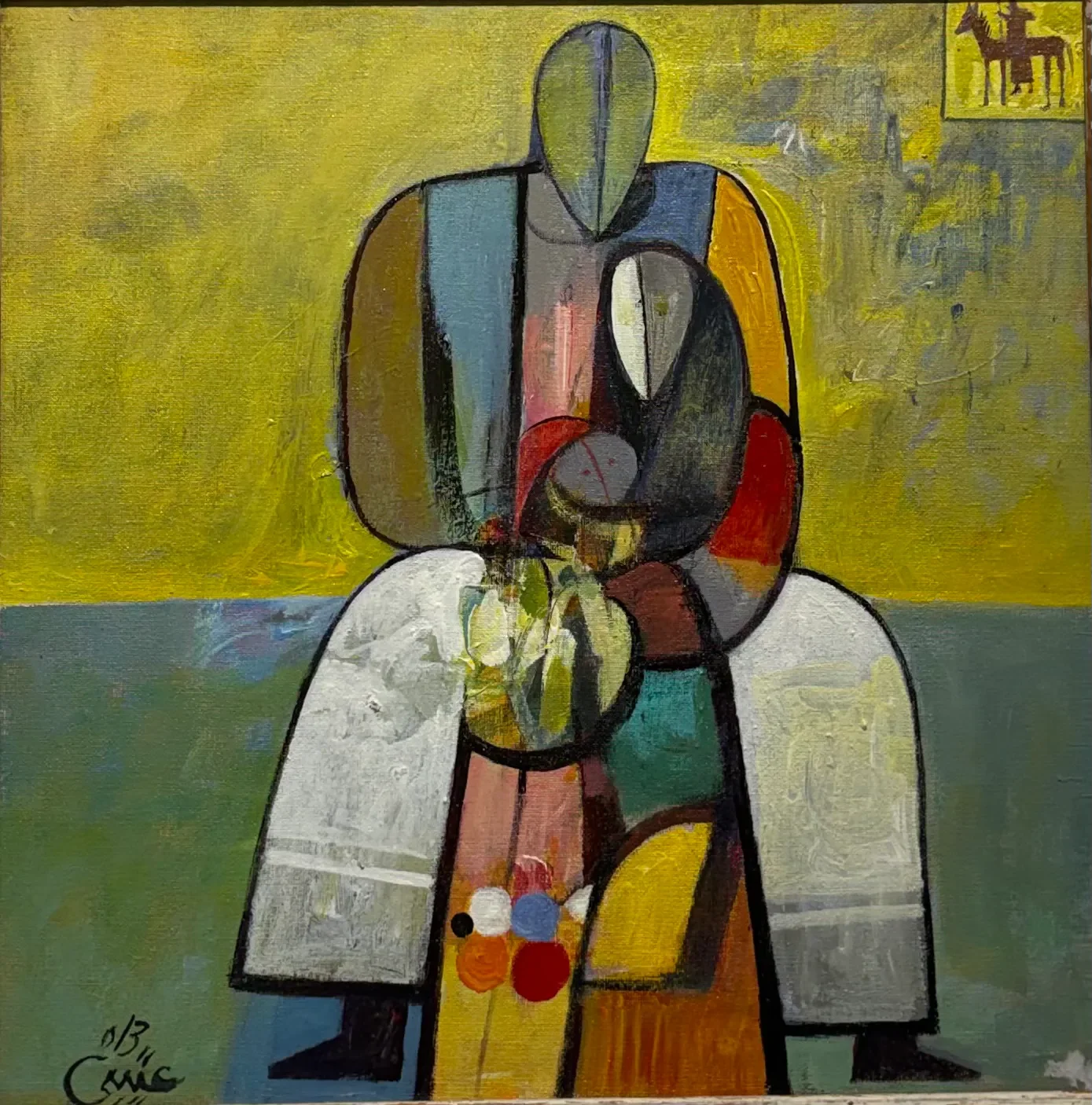
Expanding Artistic Practice
Distinctive about the second generation is the pursuit of other arts-related jobs such as graphic design or teaching due to the limited initiatives and infrastructure supporting independent artists.
But this has led to new and diverse artistic endeavors, from designing publications to illustrating cartoons, some of which were beautifully laid out in the exhibition.
Calligraphy & Poetic Expression
Upon entering the exhibition space, one’s eyes are immediately directed to the biggest piece of artwork in the room, a colorful canvas of Arabic calligraphy.
This piece is painted by the artist Tagalsir Hassan Sidahmed (b. 1954), a leading figure in modern Arabic calligraphy. The work clearly illustrates traditional elements of geometry and calligraphy alongside Sidahmed’s own contemporary innovations.
Written by Saudi poet and Prince Abdullah Alfaisal and sung by the iconic Umm Kulthoum, Sidahmed paints the verses of the poem Revolution of Doubt:
“I almost doubt myself because I almost doubt you and you are of me.”
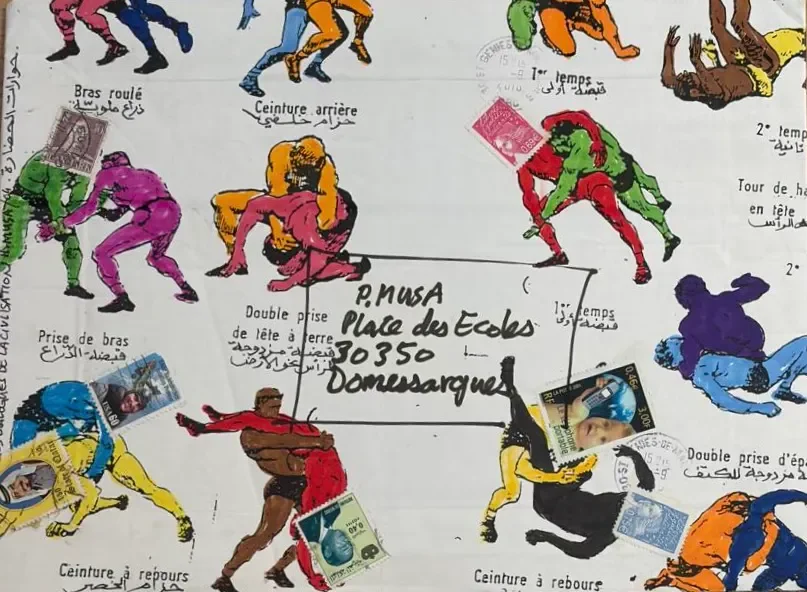
Hassan M Musa
In this exhibition, the creative excellence of contemporary Sudanese artist Hassan M Musa (1951) is beautifully displayed. The audience is invited to engage with many of his diverse works and interests.
In Le passeur tranquille (the quiet ferryman), Musa uses oil on textile printed wood to shed light on the journey of refugees in the Mediterranean Sea and the European authorities’ differentiation between political asylum seekers and economic refugees who are criminalised and pushed to return. He comments that soon Europe will have to deal with “climate refugees” who cannot be pushed back.
In this artwork, he sends a message that the world belongs to everyone. In contrast to this colorful work, Musa also presents a powerful piece of Arabic calligraphy. In We Drank (Sharibna), inspired by the Sufi poet Ibn al-Farid, the verses are masterfully integrated with the figure of a woman or beloved.
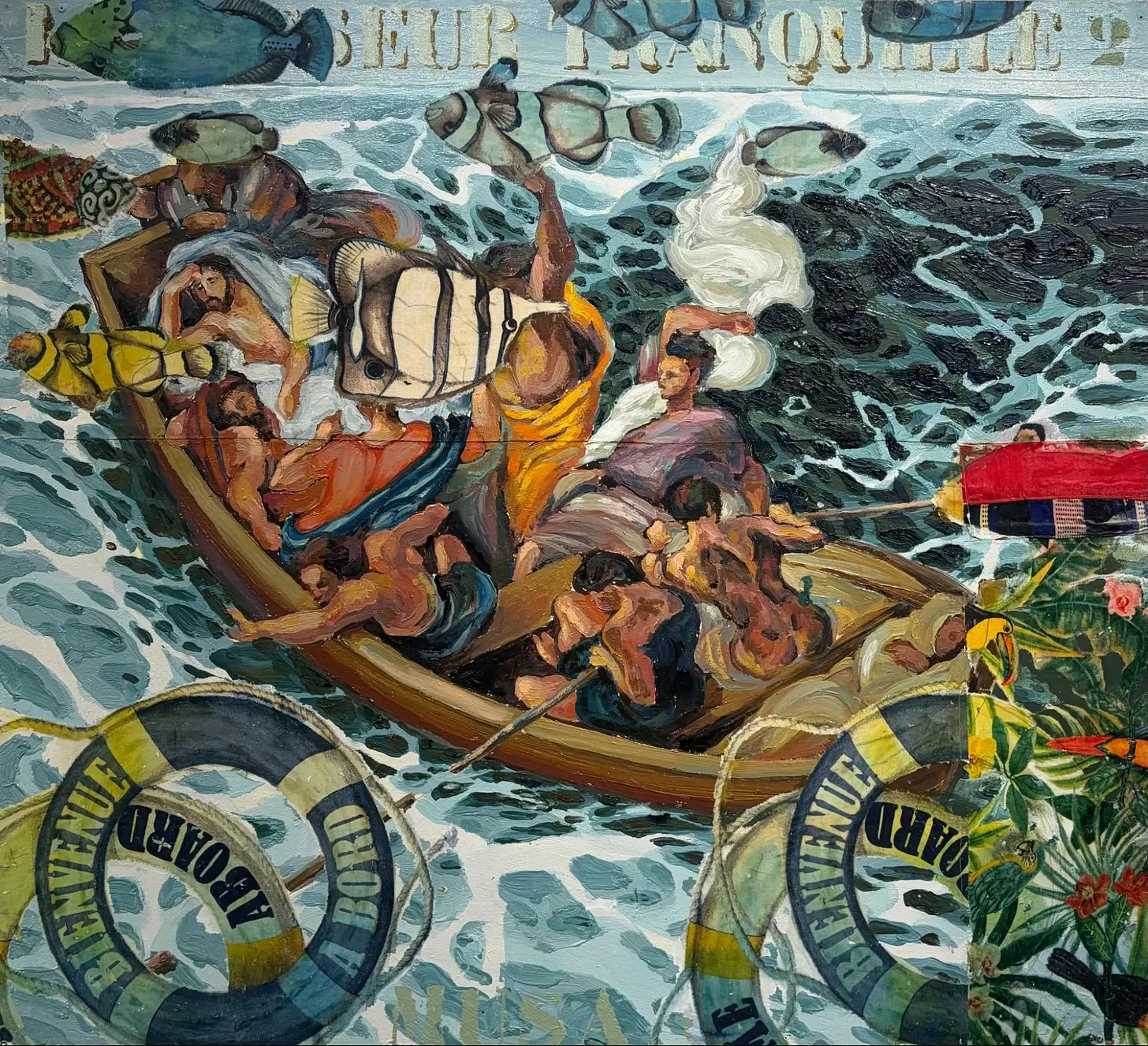
“Le Passeur tranquille (the quiet ferryman)” 2019. Oil and textile printed wood.
Rashid Diab
Fifty years after prominent Sudanese artist Rashid Diab’s (b. 1957) first exhibition at the Africa Center in London in 1976, his work is now featured at the Almas Art Foundation alongside other Sudanese artists of his generation.
Diab’s work is widely inspired by his hometown in Sudan and the landscapes and people of the country. Women are often the central subjects in his paintings, capturing their experiences of migration and the violence they endure during conflict.
What Diab presents is not merely imagery but emotional depth and human connection. Abstract scenes become full of life through gentle brushwork and silhouette figures. Forced to flee Khartoum in 2023, his work continues to give voice to his land and people through themes of exile, migration, resilience, and hope.
Mohamed Abdella Otaybi
Exploring the human condition, identity, and culture, Mohamed Abdella Otaybi (b. 1948) contributes to a dynamic Sudanese visual and artistic culture.
Although influenced by the Khartoum School, he has experimented with various artistic styles and developed a distinctive vision. His paintings often feature bold, abstract, and vibrant figures of both humans and non-humans.
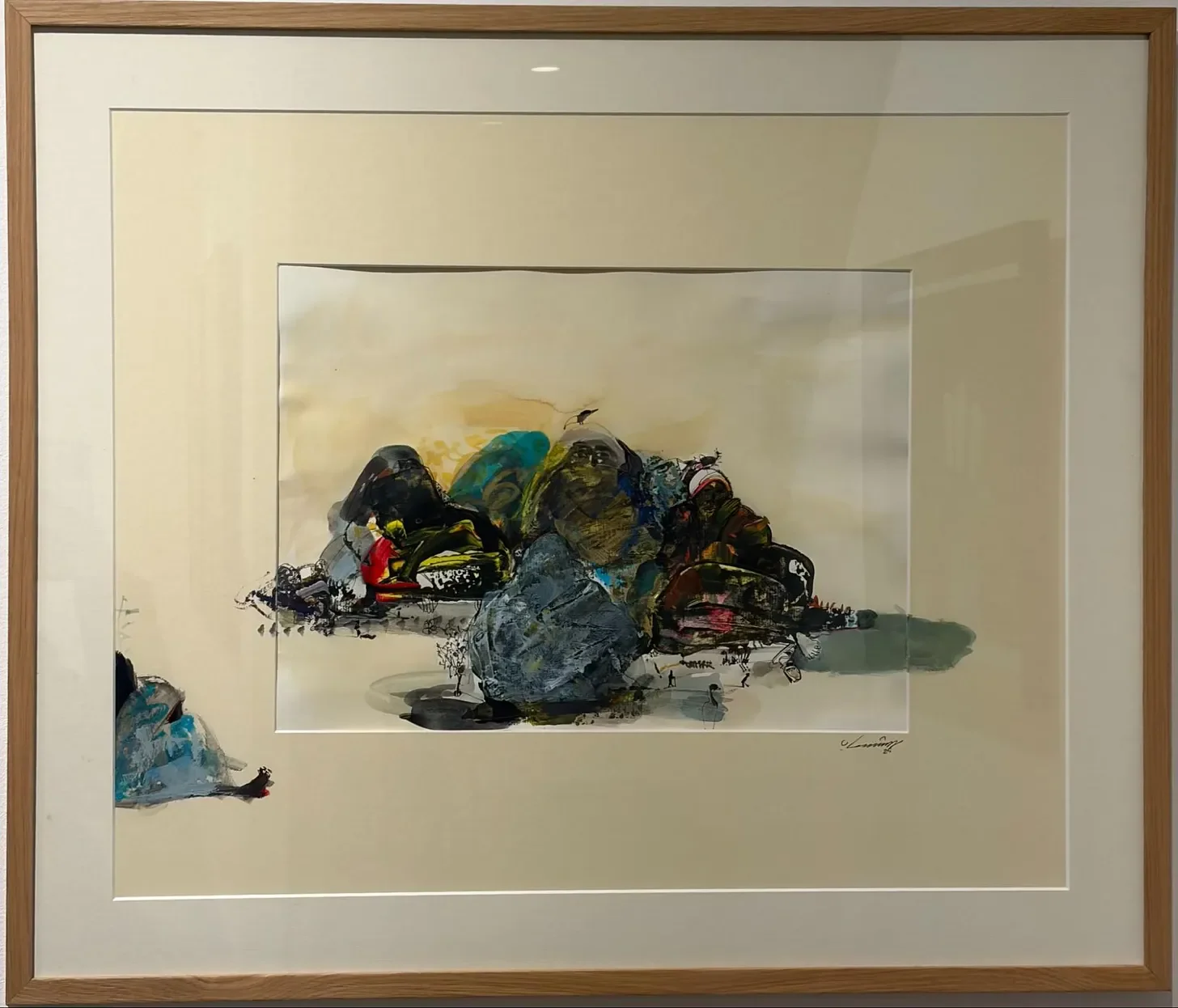
Warriors Rest V, 2025, Mixed Media
The fourth exhibition in Almas Art Foundation’s series dedicated to Sudan sheds light on the works of second-generation artists and their contributions to modern African, Arab, and global art.
The variety of materials and messages across the 33 artworks by 16 artists emphasizes the diversity and richness of Sudanese artistic practice. At a time when artworks in Sudan risk being lost due to conflict, this exhibition provides visibility to artists who have long expressed themselves amidst instability and destruction.
Together, these works reflect resilience, hope, and commitment. They invite audiences to engage with Sudan beyond narratives of conflict, presenting a complex reality shaped by Sudanese artists themselves.
In London, the exhibition also resists erasure and colonial representations by centring Sudanese voices and stories. It acknowledges both the artists featured and those whose works are missing, affirming the importance of carrying these artistic legacies forward.
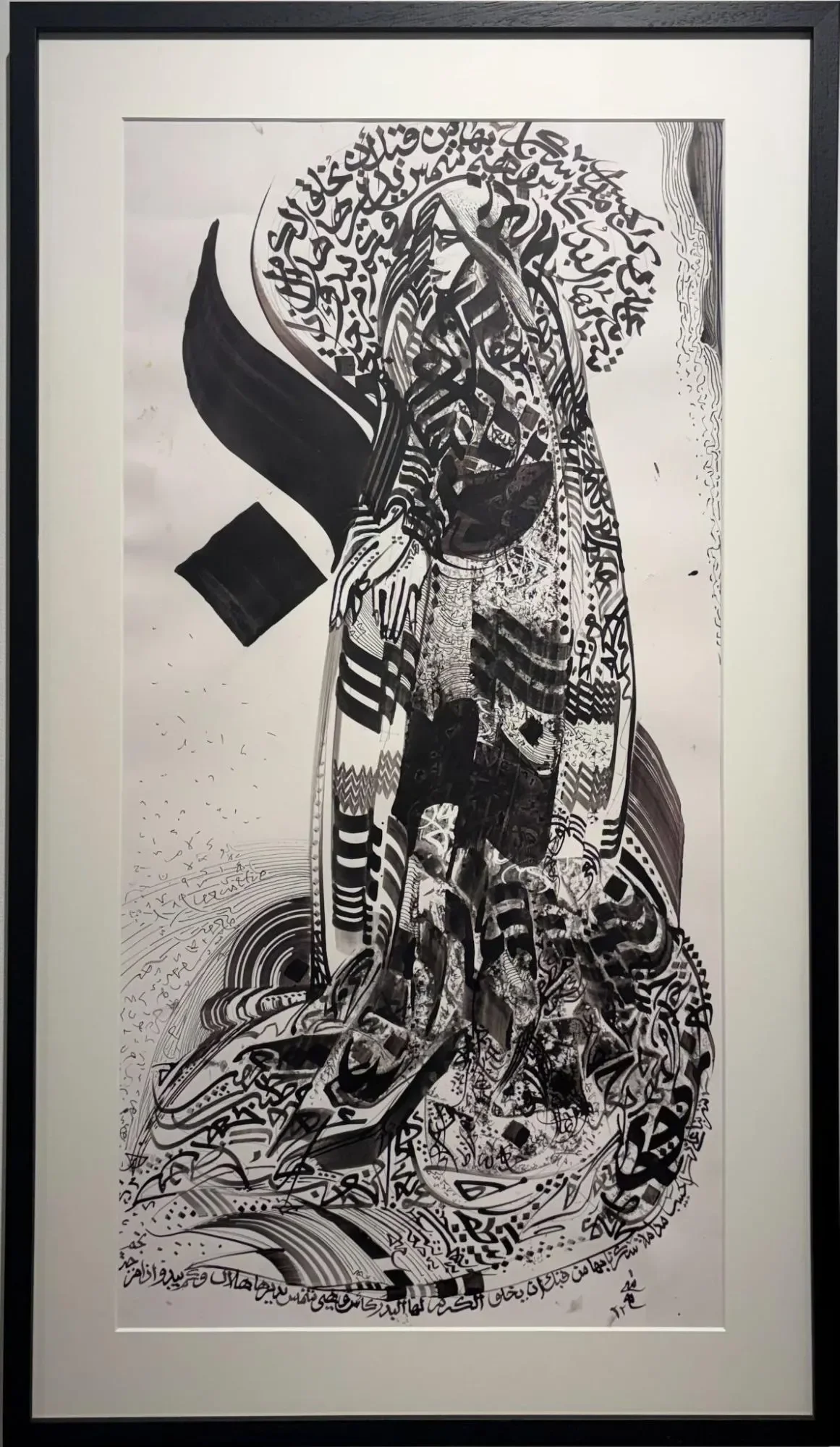
We Drank (Sharibna), from the verse by the Sufi Arab poet Ibn al-Farid. 2022. Black ink on paper.
