
Q&A with Ieva Douaihi about STILL LIFE
by Kalina
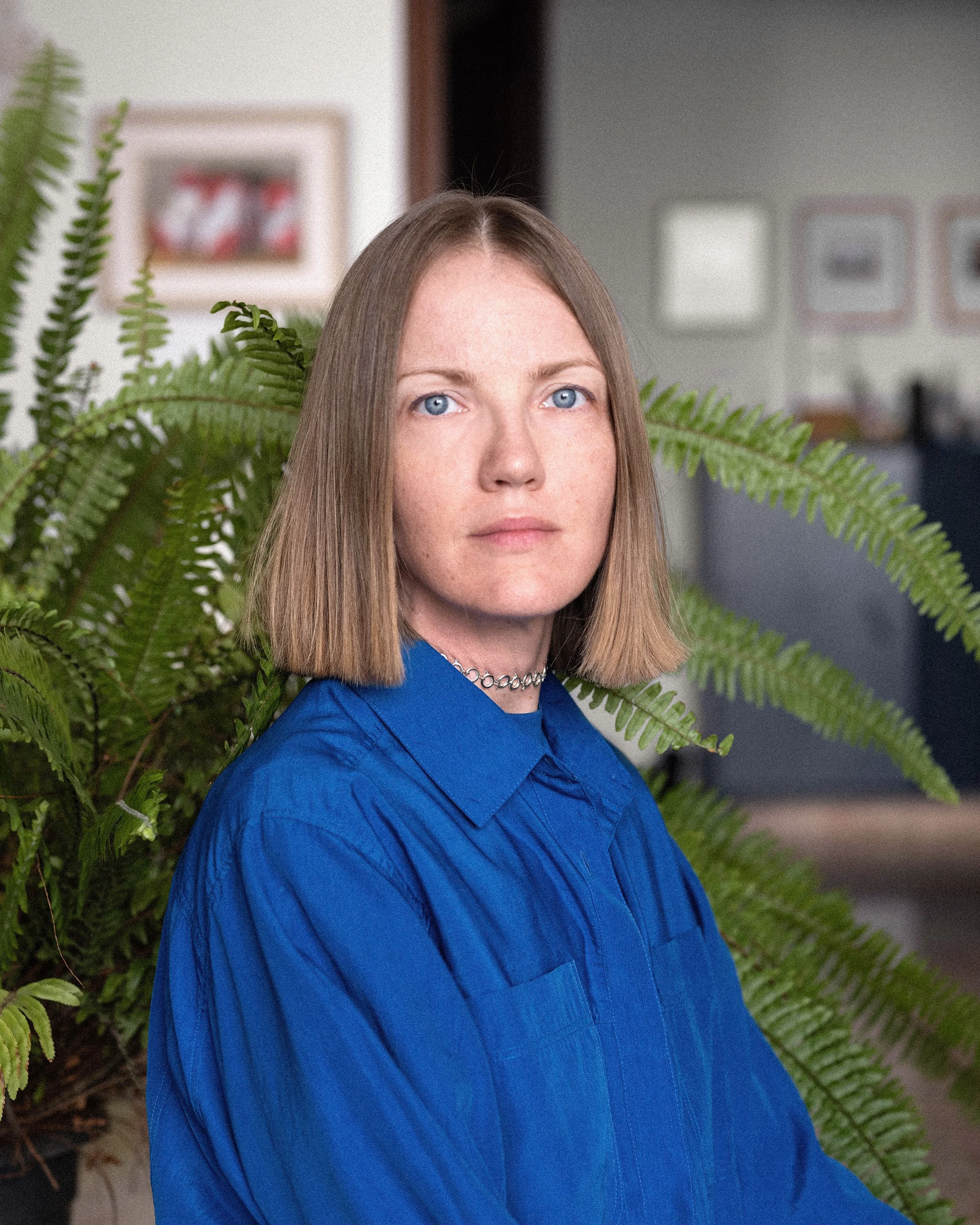
Still Life opens on 24 November at ISD Studio in Nasra, Beirut, the studio of artist Ieva Saudargaitė Douaihi, and runs until 9 January 2027. Douaihi says that, in a way, the exhibition began in the first week of the October 2019 uprising, when she entered an abandoned heritage building, and found something that would stay with her.
In our conversation, Douaihi talks about why she chose the title, how her studio became part of the show, and what it means to work on objects in a city where life is rarely still. She also tells us about Palm Readings, and about making an exhibition at a time when she questions the act itself.
Kalina: The exhibition is titled STILL LIFE. What does it mean to you, and how does it reflect the ideas explored throughout the exhibition?
Ieva: I was looking for a title that could carry multiple notions at once. I'm interested in the tension between the apparent stillness of things and everything that is happening around them, before them and after them. I've always been drawn to objects and spaces, particularly to the histories and meanings they carry; so much can be implied and imagined from a particular object in a particular place. Though seemingly still, they remain entangled in the theatre of human lives, carrying traces of preceding scenes and playing a part in what comes next.
Life here, in Lebanon, has never been still. It is always interrupted by something, and yet, at times, it can feel motionless, stuck, or stuck in motion. At other times, life can feel impossible. And yet. And yet. We continue to live, finding respite in the intimate moments of everyday life, in the small details we take pleasure in, and in the shared experience of carrying on as friends, family members, lovers, and part of a community.
I wanted the title to hold this coexistence of seemingly opposing conditions.
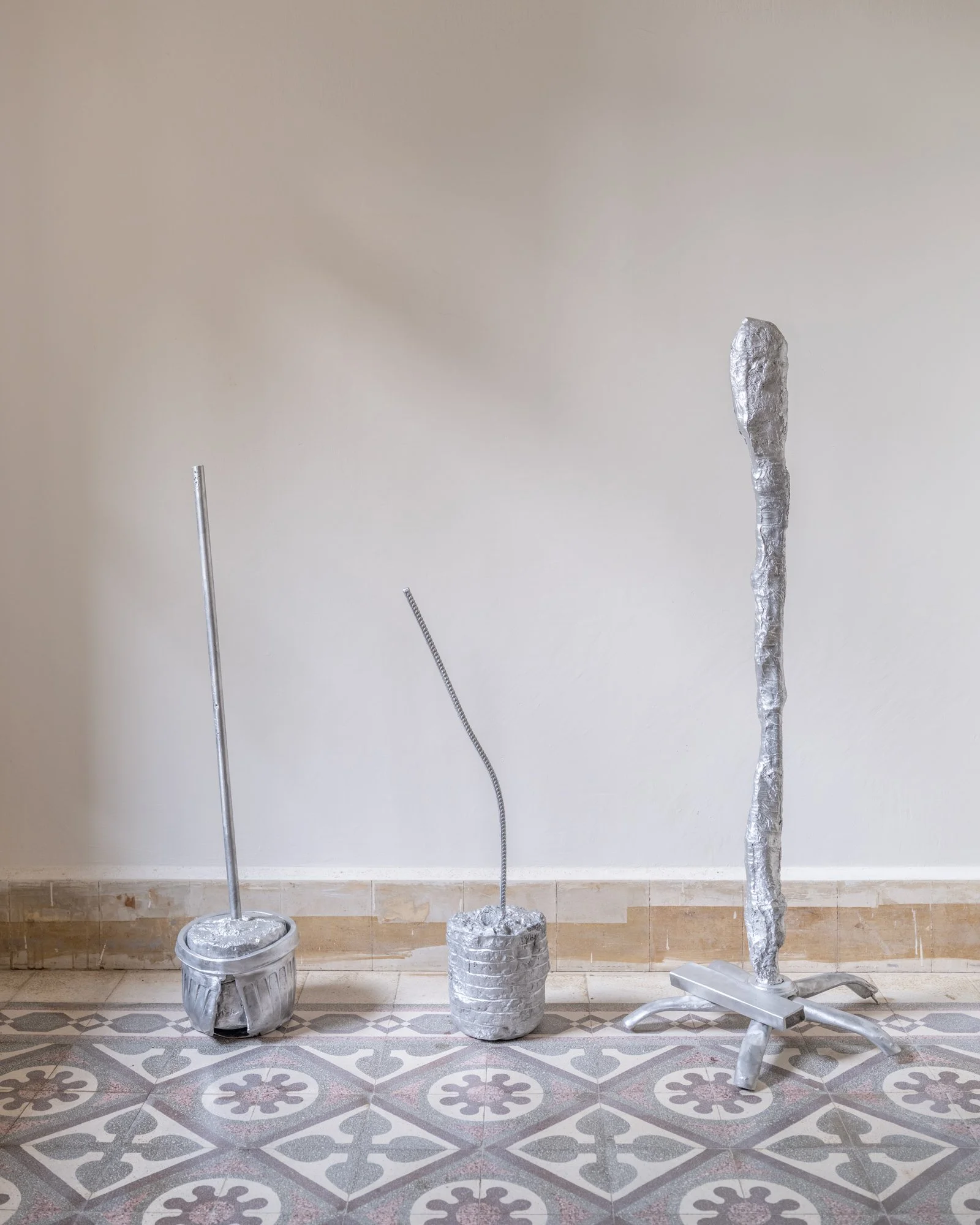
Ieva Saudargaitė Douaihi, Street Occupants, aluminium, 2026, various dimensions © Ieva Saudargaitė Douaihi
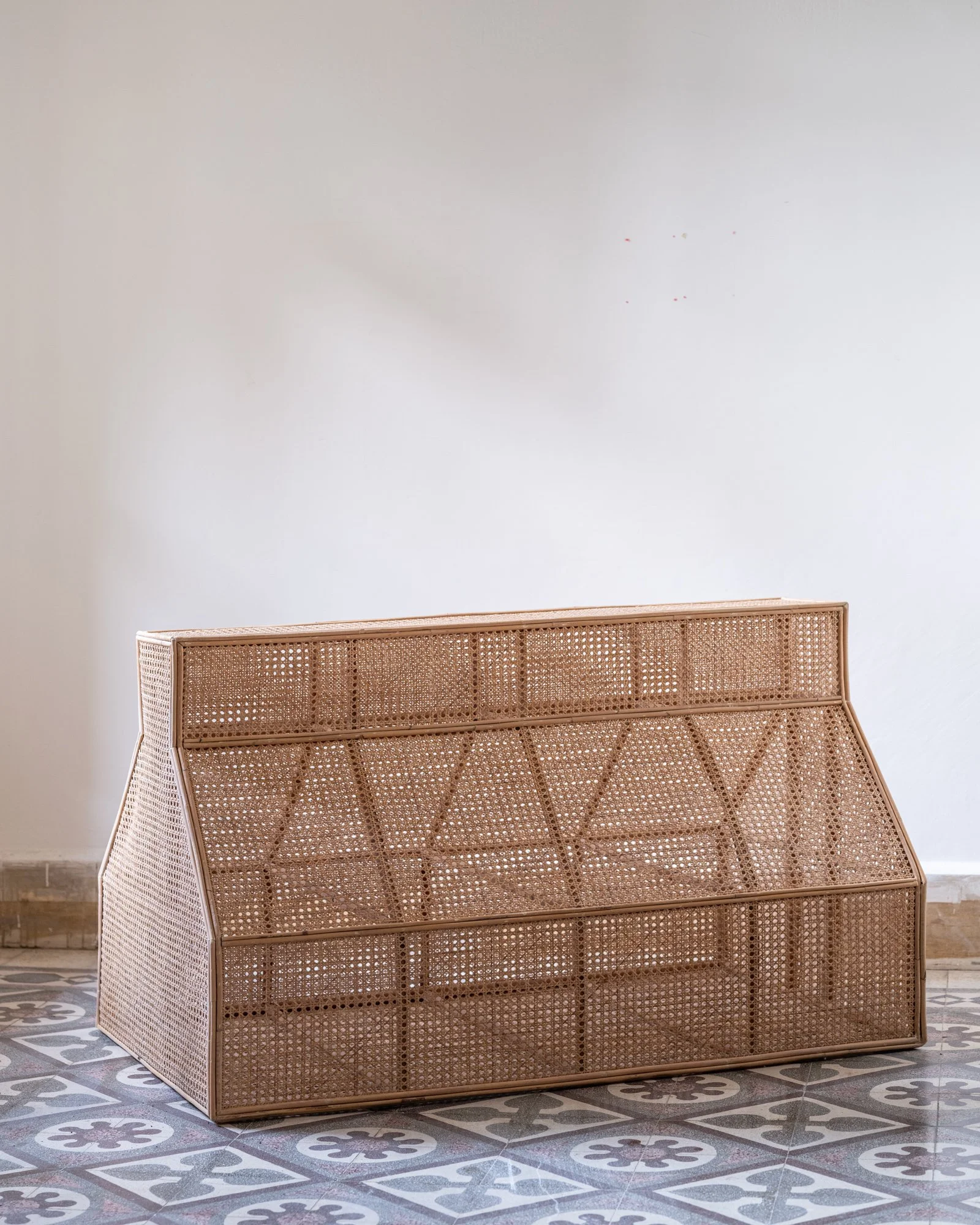
Ieva Saudargaitė Douaihi, Barrier, 2024, rattan, 120x80x73 cm © Ieva Saudargaitė Douaihi
Kalina: What was the starting point for this exhibition? Was there a particular experience, observation, memory, or question that led you to develop it?
Ieva: It was during the first week of the October 17 uprising in 2019. I was walking back from Sahat el Shouhada when I came across a beautiful abandoned building surrounded by an opaque fence. There was a narrow opening, and I slipped inside. What I encountered was a horrific scene: nothing but red sand where tiled floors had once been, and above me, several stories of floor slabs with large holes at their centers, the steel rebar holding them together like exposed sinews. It was clear to me that someone was deliberately compromising this listed heritage building to the point where it would be unsalvageable, leading to an inevitable demolition. I noticed some tools lying in the sand - a shovel, a pickaxe, and a sledgehammer - and took them with me, hoping to disrupt the illegal operation, even if only briefly. These objects stayed with me, as did their capacity to carry history and evidence. Those three implements were the seeds of this body of work.
Kalina: STILL LIFE has a long history within art, yet its meaning continues to evolve. How do you approach this in your own practice, and what does still life allow you to express that other forms might not?
Ieva: A still life is an invitation to look closely at a deliberate arrangement of objects, to consider the associations that emerge between them, and to think about their individual roles within a bigger picture. I approached this body of work as a constellation of objects and interventions that can be considered on their own, in relation to one another, and as a whole.
For me, still life is not necessarily about isolating objects or fixing them in a particular arrangement. I'm interested in the relationships they establish and the histories they bring into that arrangement. In this exhibition, the still life doesn't lie flat on a surface; it unfolds in space, where objects occupy physical space, and our bodies experience them in relation to one another.
Perhaps what this form allows me to do is hold different things, histories and associations together without having to resolve them into a single narrative.
Kalina: Could you tell us about your creative process? How do you move from an initial idea or image to the finished artwork, and how much room do you leave for experimentation?
Ieva: It begins with observation. Whether I'm moving through the spaces of my daily life or through the city, I find myself looking for repetition, variation, accumulation, and transformation. I'm interested in how instability manifests itself across different scales, whether it's a crack in my nightguard or fighter jet contrails drifting across the sky.
These observations lead me to think about how a particular condition or experience might be translated into a different material or form. I'm interested in finding a relationship between the material and the idea, where each informs the other, rather than performing a simple illustration.
Often, I set specific parameters without knowing exactly what the outcome will be. I like leaving room for experimentation and for things to take an unexpected direction. There is usually some element of serendipity, which I find important to preserve.
Kalina: How do you think about the relationship between time and memory in your work? Are you interested in capturing a specific moment?
Ieva: The present moment is haunted by both the past and the future. We tend to experience time as a chronological sequence of events, but I'm curious about how different temporalities overlap, how the past remains active in the present, and how our anticipation of what’s to come shapes the way we experience it.
I'm perhaps less interested in capturing a specific moment than in looking at what surrounds it: what preceded it, what followed it, and what remains. Materials and objects accumulate traces of time, sometimes visibly, sometimes in less apparent ways.
This body of work is informed by a particular period, but it isn't an attempt to document it chronologically. The Reznema calendar, for example, brings personal events into the same timeline as the political and social events unfolding in Lebanon across the past seven years. Other works approach time through accumulation, repetition, or transformation. I am intrigued by the way memory evolves, turning things into bridges between our past and present selves.
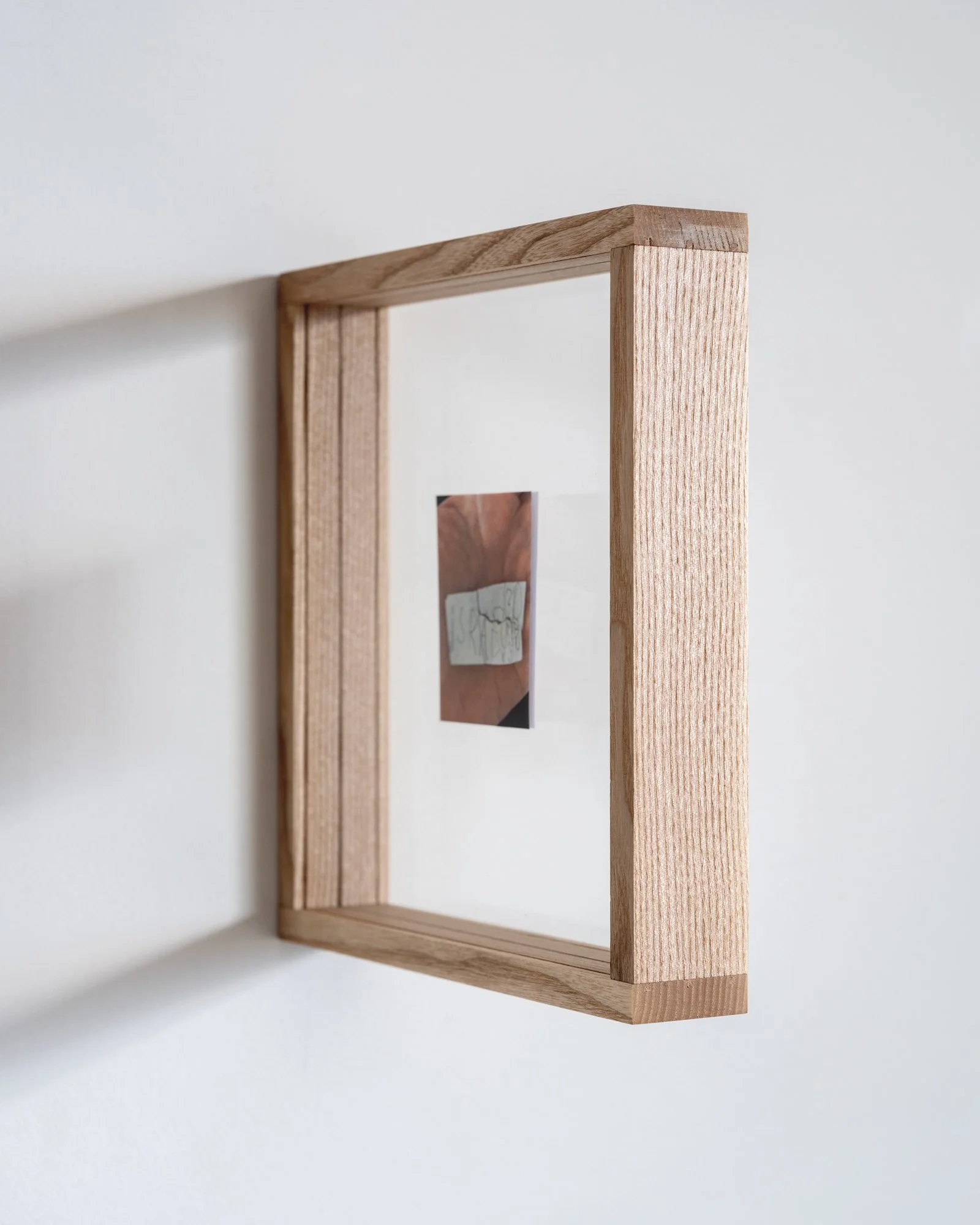
Ieva Saudargaitė Douaihi, Theo’s Note, inkjet on paper, 2026, 24x26 cm © Ieva Saudargaitė Douaihi
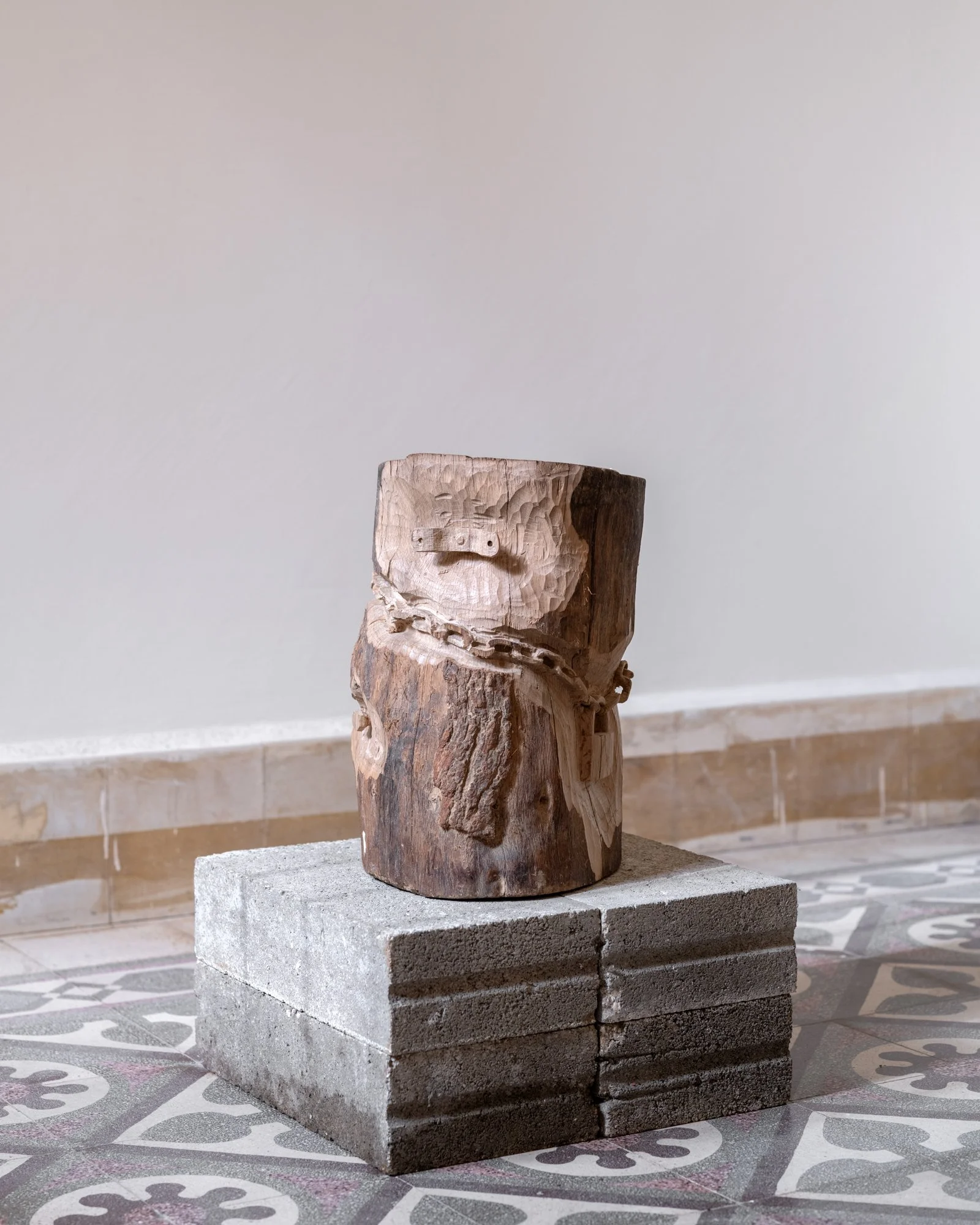
Ieva Saudargaitė Douaihi, Trunk, oak, 2026, 38x28x26 cm © Ieva Saudargaitė Douaihi
Kalina: Does the relationship between the artworks and their surroundings play an important role in the exhibition?
Ieva: Very much so. Back in June, when I decided to go ahead with producing this body of work, I started making a list of potential spaces where I could present it. It didn't take long before it became clear that my studio would be the ideal accomplice in this undertaking. I borrow this particular word from Shalmali Shetty's exhibition text.
The space is haunted by the stories of previous inhabitants. It is located in Nasra, a neighbourhood that developed around different religious communities and institutions, whose histories have unfolded alongside one another for more than 150 years. Today, the surrounding buildings are either falling apart, being emptied of their “old rent” tenants, awaiting renovation permits, or under construction. To the west, the 195-metre Sama Beirut tower occupies the site of demolished heritage houses, replacing a finer-grained residential neighbourhood that once spread across ten lots with an entirely different urban scale.
In this sense, the surroundings are not merely a backdrop to the exhibition but an extension of it. The building, the neighbourhood and the city beyond its walls are all part of the same shifting landscape that the works inhabit. I wanted the exhibition to remain porous to its surroundings, allowing the histories, tensions and transformations taking place outside to enter into conversation with the objects and situations inside.
The works do not attempt to represent their environment, but exist within it, carrying some of its conditions and contradictions.
Kalina: Is there a particular work in STILL LIFE that holds a special significance for you, or that you feel particularly connected to? Could you take us through the story behind it, from its initial conception to its final form?
Ieva: One work I'm particularly connected to is a series of clay tablets, or Palm Readings, carrying physical impressions of screenshots taken on my phone between September and November 2024.
The smartphone is an object that has recurred throughout my practice. I first explored my relationship to it during an artist residency almost a decade ago, and later made works that existed entirely on Instagram. It has become an extension of ourselves: something we rely on to connect with others and the world, and to navigate and orient ourselves within it. It gives us a certain agency, but it also quietly observes us and feeds information into larger systems that are not necessarily in our best interest. It's both an intimate and useful object, but also a potentially dangerous one.
During this period, I became interested in how the experience of war was being mediated through this device. Alongside the inaccurate locations my phone was recording – Queen Alia International Airport, "undetermined", or Null Island, a fictional location approximately 600 kilometres south of Ghana – were images and information documenting violence as it unfolded around us. The phone brought together very different registers of experience: direct witnessing, distant observation, humour, commercial messaging and the everyday operations of digital platforms. At times, these appeared side by side in ways that were deeply unsettling.
I began translating these screenshots into physical impressions on small, phone-sized clay tablets. For me, this gesture is also a way of thinking about the future: taking something fleeting, something that might otherwise disappear with the next scroll, and giving it a form that could be preserved and exist in a time to come. The work moves between the digital and the physical, the ephemeral and the enduring, while asking what it means to preserve these fragments of a moment that was itself so difficult to comprehend.
Kalina: What was the most challenging or unexpected aspect of creating STILL LIFE?
Ieva: It is always a challenge to work towards something knowing that circumstances can change at any moment, and that your plans can be interrupted, suspended, or rendered trivial. I feel a constant inner conflict about focusing on my practice at a time of genocide and ultraviolence.
On a practical level, there was an endless to-do list: coordinating with fabricators and craftspeople on some of the works while producing others myself, clearing out and preparing the studio, while writing and designing the accompanying fold-out for the exhibition. Although I often wear multiple professional hats, I had never worked on a project of this scale before.
And in the midst of it all, I kept having new ideas, scrapping old ones and transforming things until the very last minute. That being said, having the freedom to remain in constant dialogue with the works and the space is precious. I don't think of the exhibition as something that ever becomes entirely fixed or final. Everything remains in flux, and I'm glad to have been able to embrace that.
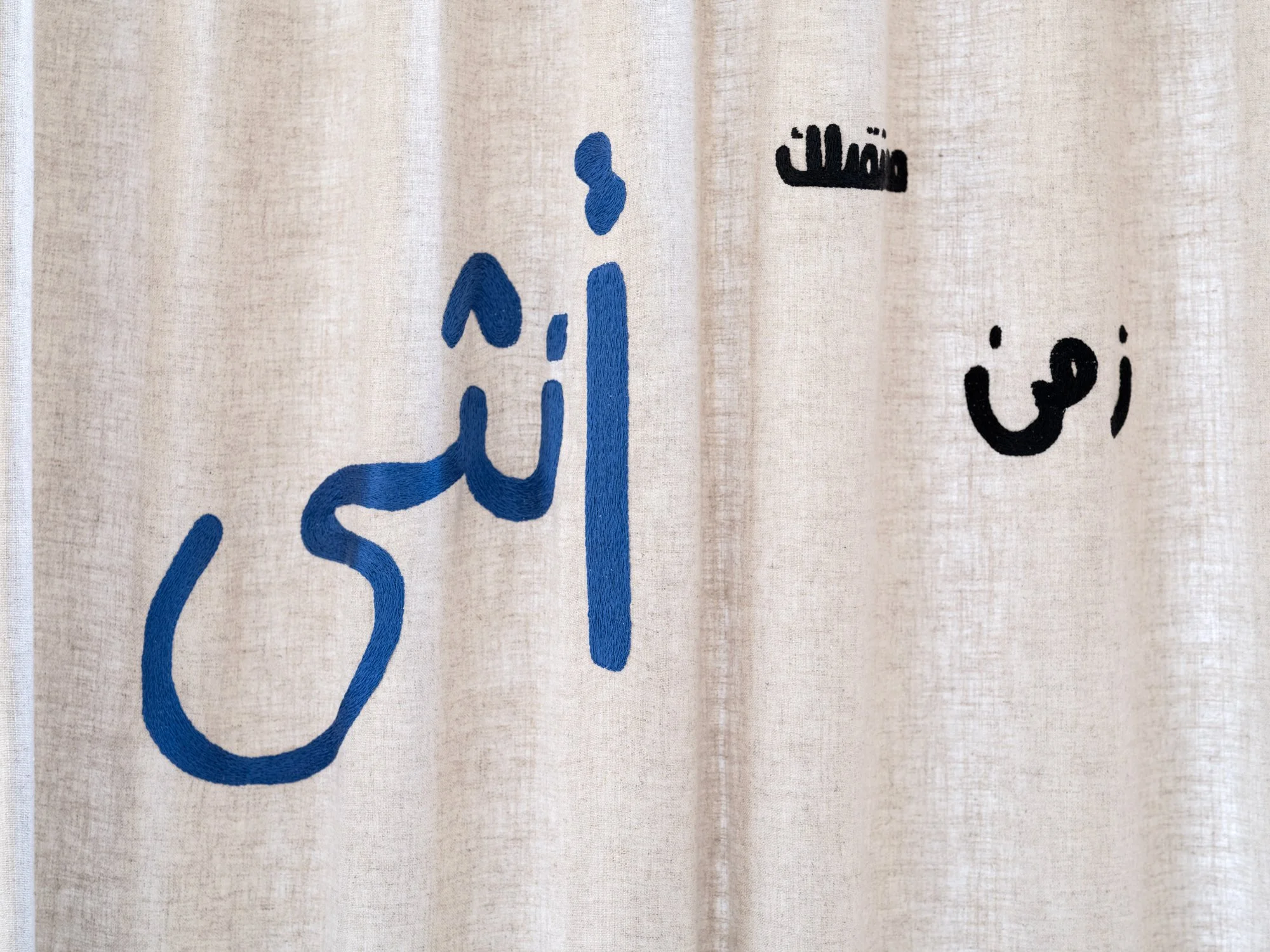
Ieva Saudargaitė Douaihi, Curtain Wall, embroidery on fabric, 2026, 290x265 cm © Ieva Saudargaitė Douaihi
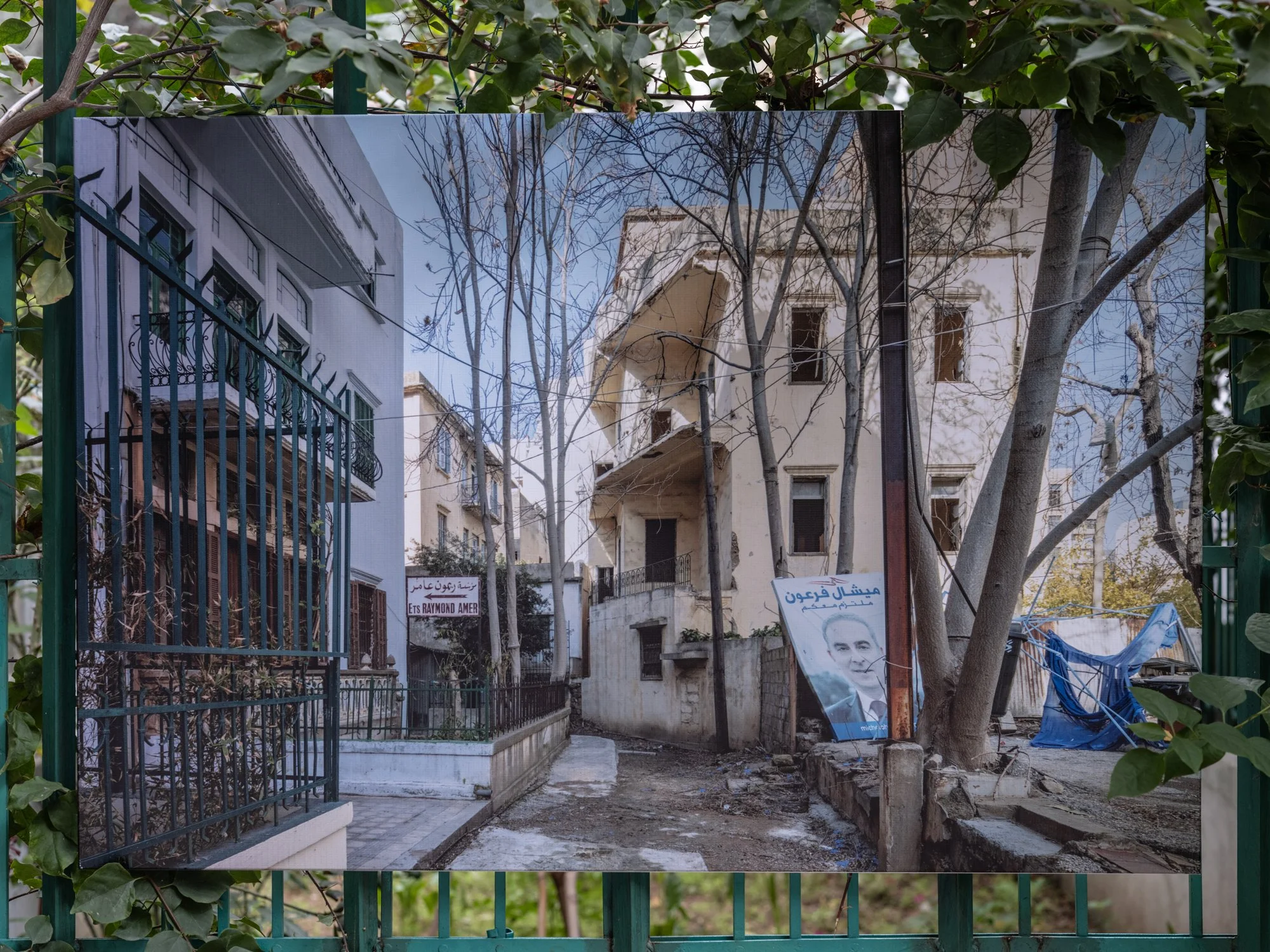
Ieva Saudargaitė Douaihi, Building Entrance 2019, 2026, digital photography on flex, 135x90 cm © Ieva Saudargaitė Douaihi
Words Copyright of Kalina and Naso Art Journal
Images Courtesy of the Artist & Mirros ME
