
Interviewed by Kalina
Frieze Abu Dhabi has opened its first edition this week at Manarat Al Saadiyat. Mandy El-Sayegh is one of three artists on the stand of the Dubai gallery Lawrie Shabibi, alongside Shaikha Al Mazrou and Hamra Abbas. At the fair she is showing Net-Grid (missing eye) (2023). Each painting layers printed and collaged material from her own archive under a hand-painted grid, so what’s underneath stays in the work but is harder to read.
We decided to ask her what the “missing eye” means to her, and how her source materials come together from a personal archive. We also discuss what it means for an artist to be from a place of “in-between”. She also tells us what’s next for her.
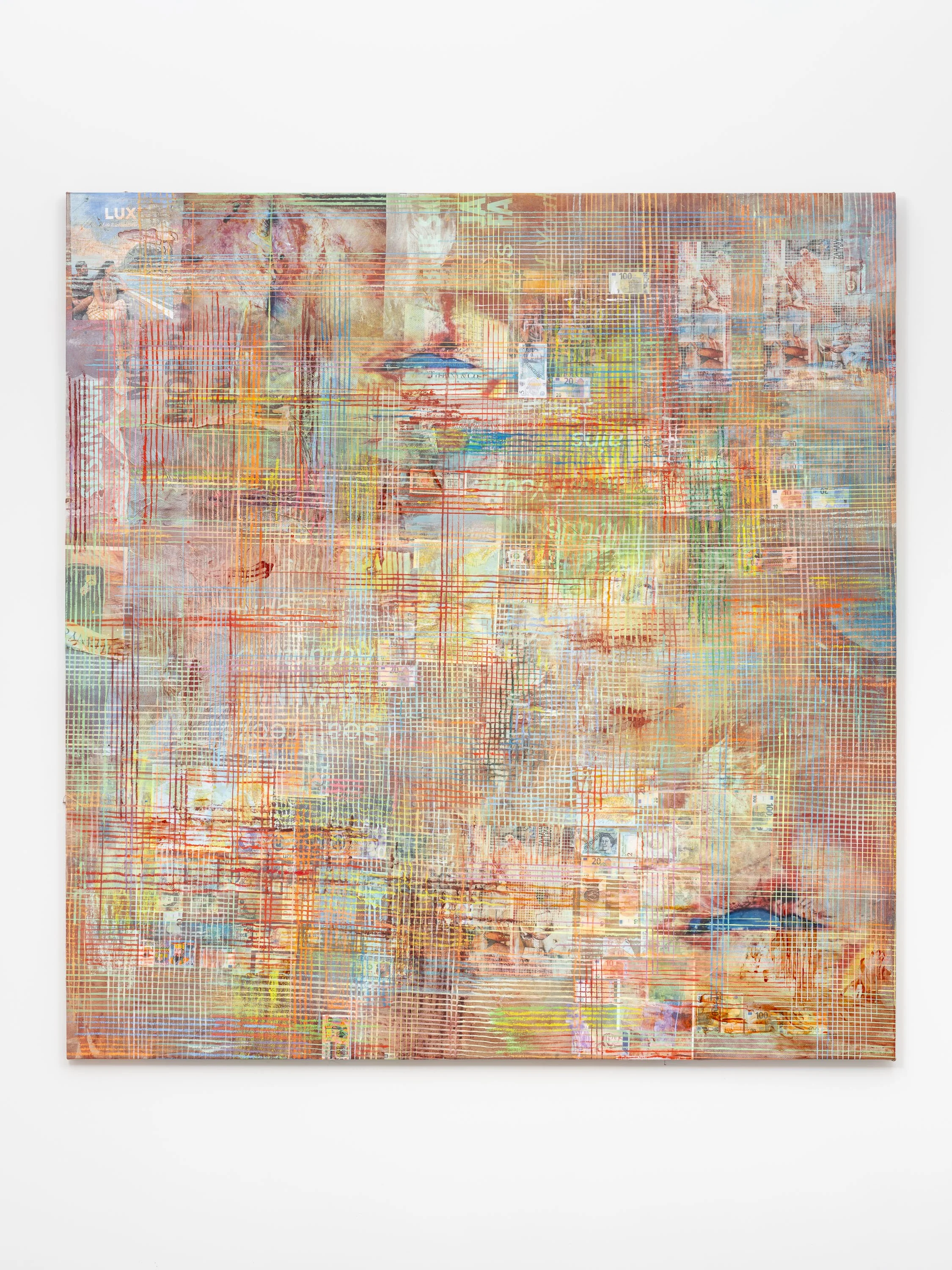
Net-Grid (missing eye), 2023
Kalina: We understood that the “missing eye” is a metaphor for incomplete perception. What does it mean to you personally?
Mandy: Missing eye has multiple meanings. In the painting’s composition, there is literally a painted fragment taken from forensic imagery, of a skin graft around an eye. The shape of the image also reminded me of a horizontal map of Palestine. That is quite an obscure reference that doesn’t need to be caught by the viewer. It is just a kernel from which to start the grid formation.
There are also multiple connections to the eye as a symbol in my practice. The nazar reappears in my work in various guises. Eyes can symbolise protection, and link to how I see paintings functioning as amulets. I also think of wanting to return the gaze, hiding fragments, and of protection and perspective.
Kalina: Your paintings layer grids, fragments of imagery and information. How do you decide what stays visible and what doesn’t?
Mandy: I would say that I don’t consciously decide what gets obscured and what remains visible. It is a tussle between distinct fragments, the paint, and the canvas. These interacting surfaces are working with each other and often, because I work on the floor, it takes away a level of conscious decision-making. It is more a case of the conscious having to submit to the alchemy of matter.
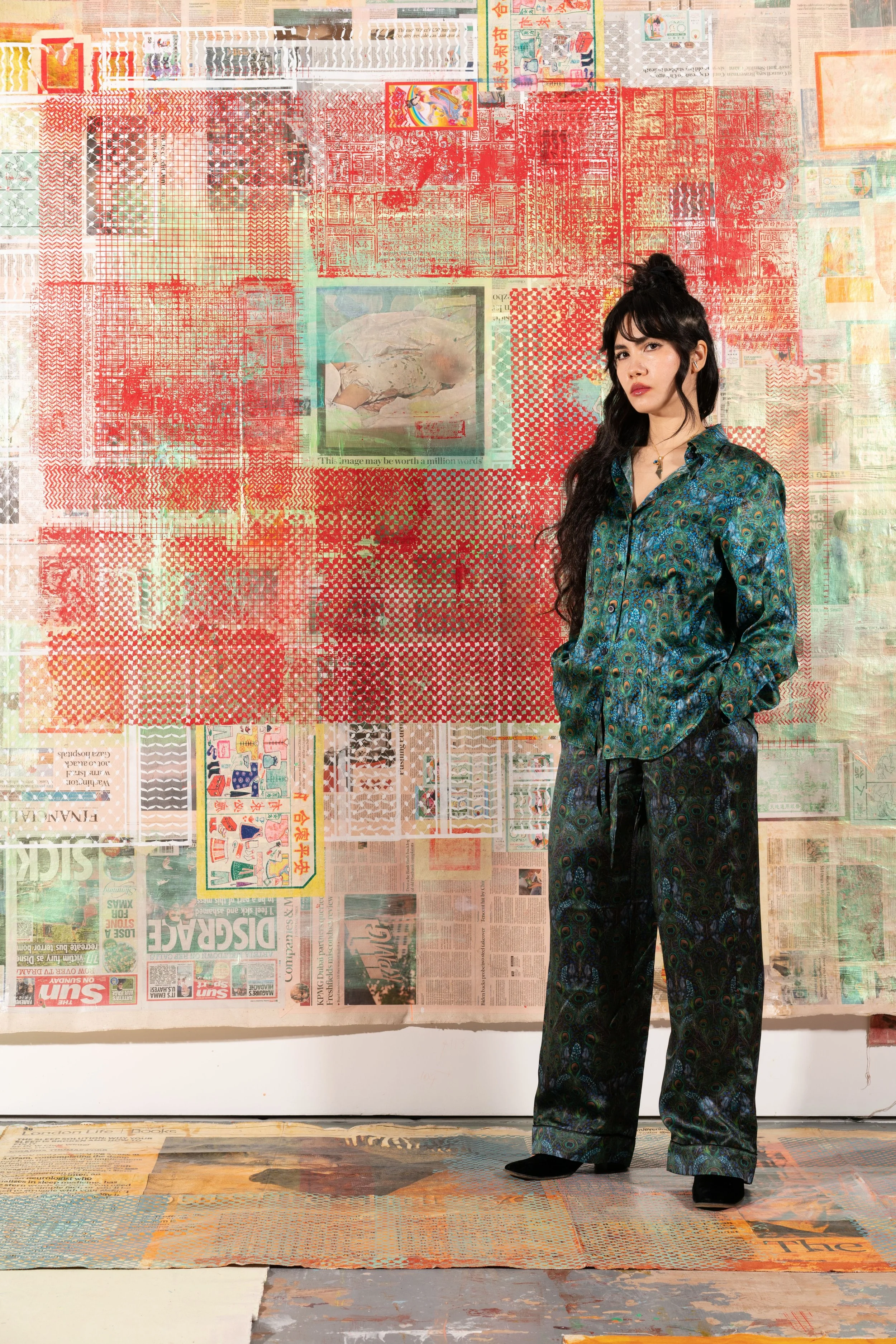
Portrait of Mandy El-Sayegh
Photo by Abtin Eshraghi
Image Courtesy the artist
Kalina: You put together very different source materials. Where do they come from, and is there anything you won’t use?
Mandy: Source materials come from my own personal archive, that I always return to, so materials come together that were collected during many different periods in time. These range from very personal items to things that are throwaway— there isn’t really a hierarchy. There is nothing I won’t use. They just all have to resonate with the unconscious in some way, and with memory—I don’t necessarily need to understand how they connect narratively. In terms of items not being used, it is more the case that the censorship of each place would decide that, not me.
Kalina: You were born in Malaysia, studied in London and still work there. Does that sense of being between places show up in how you work with images and information?
Mandy: I think every artist works from this place of ‘in-between’. There is a lack of a sense of seamless identification with a place—be that a physical location, or a place in the world, a place within the family…It is this idea of working from a border—by which I mean a border in many different senses. This is what allows for a novel aesthetic language, one that isn’t colonised or even formed yet. So yes, I think that movement, migration, and dislocation of identity formation has definitely affected the way that I produce work, as well as the way I think and speak. There is a kind of stutter, or brokenness, that is always under the surface of the smooth coherence of a composition.
Kalina: You’ve shown in Dubai, Abu Dhabi, Basel and Seoul. Do you notice people reading your work differently in the Gulf than in London or Europe in general?
Mandy: My work has so many different layers and references and elements which are not even consciously included by me, so I think there are always multiple ways into reading them. What someone will draw from the work will be very specific to them—there are lots of factors that will play a part in this and the location, and geopolitics, will definitely play a part in that, but it’s always something of an unknown to me.
I have a personal connection to this region in my family history, and I grew up partly in Sharjah, so it is always very important to me to show in this part of the world, and I am always grateful that my work seems to be warmly received.
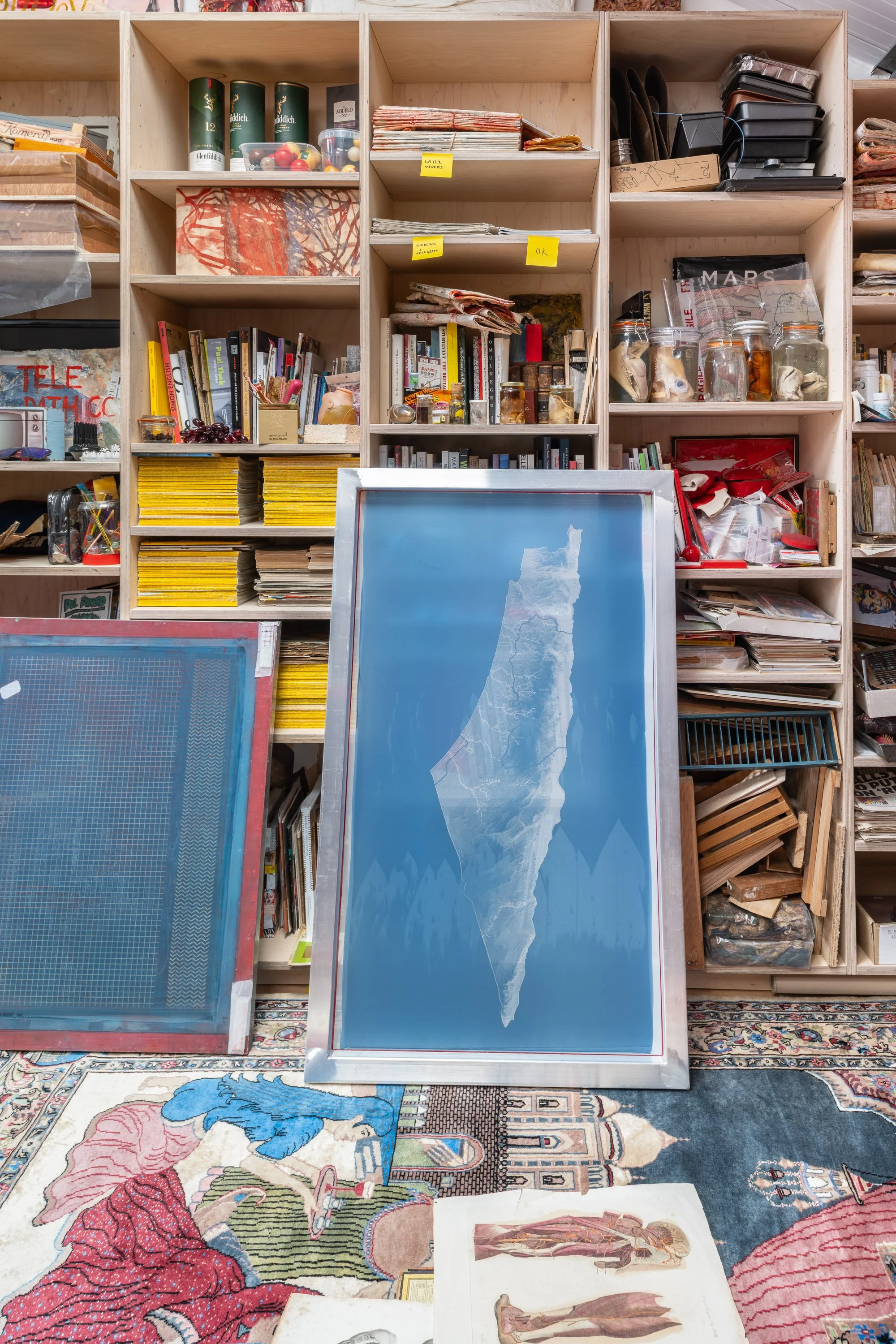
Library at Mandy El-Sayegh’s studio
Photo by Damian Griffiths
Image Courtesy the artist
Kalina: This is the first Frieze Abu Dhabi, and you’re on an all-female booth with Hamra Abbas and Shaikha Al Mazrou. What does it mean to you to be part of this edition, and how do you see your work next to theirs?
Mandy: I am honoured to be in great company, and to be part of important shifts.
Kalina: What are you working on at the moment, and what are you most curious about trying next?
Mandy: I am part of the New Museum Triennale in New York, which is on view from 5 February–16 May 2027. The title of the Biennale is The Outside Expands, and as a whole it considers the idea of moving beyond preexisting structures in a number of different ways. What is currently engaging my thinking is the idea of working in more expanded forms of painting, and painting’s relationship to dislocated states of subjectivity and language. I am interested in exploring the intersection where painting and language meet, and trying to find a lingua franca between both mediums.
Words copyright of Naso Art Journal & the Writer
