
Buildings That Breathe: Ala Younis on Abu Dhabi’s Modernist Façades
Interviewed by Soraya
Ahead of the first edition of Frieze Abu Dhabi, which opens at Manarat Al Saadiyat on 19 November, Taymour Grahne Projects presents a solo booth by the Jordanian artist Ala Younis in Global Futures, the fair’s curated section. The works on view belong to Climate Conditions, a series of hand-cut stone mosaics that isolate the façades of Abu Dhabi’s older Modernist apartment and office blocks, pair them with oversized trees and set them against pale, mostly empty grounds.
Younis trained as an architect and lived in Abu Dhabi for about three years before returning to Amman, where she is based. She first showed the series in 2025 at The Art Gallery at NYU Abu Dhabi, while she was preparing to leave the city. The buildings she depicts rarely make it onto postcards. They are the deep-set windows, shaded balconies and tiled fronts that line the downtown grid, some of them already fenced off and waiting to come down. In her mosaics, they are given the kind of attention usually kept for icons.
A few days before the opening, I spoke with Younis about a construction manual she found in Beirut, the sound of materials shrinking as the temperature drops, and what a tree can say that a building can’t.
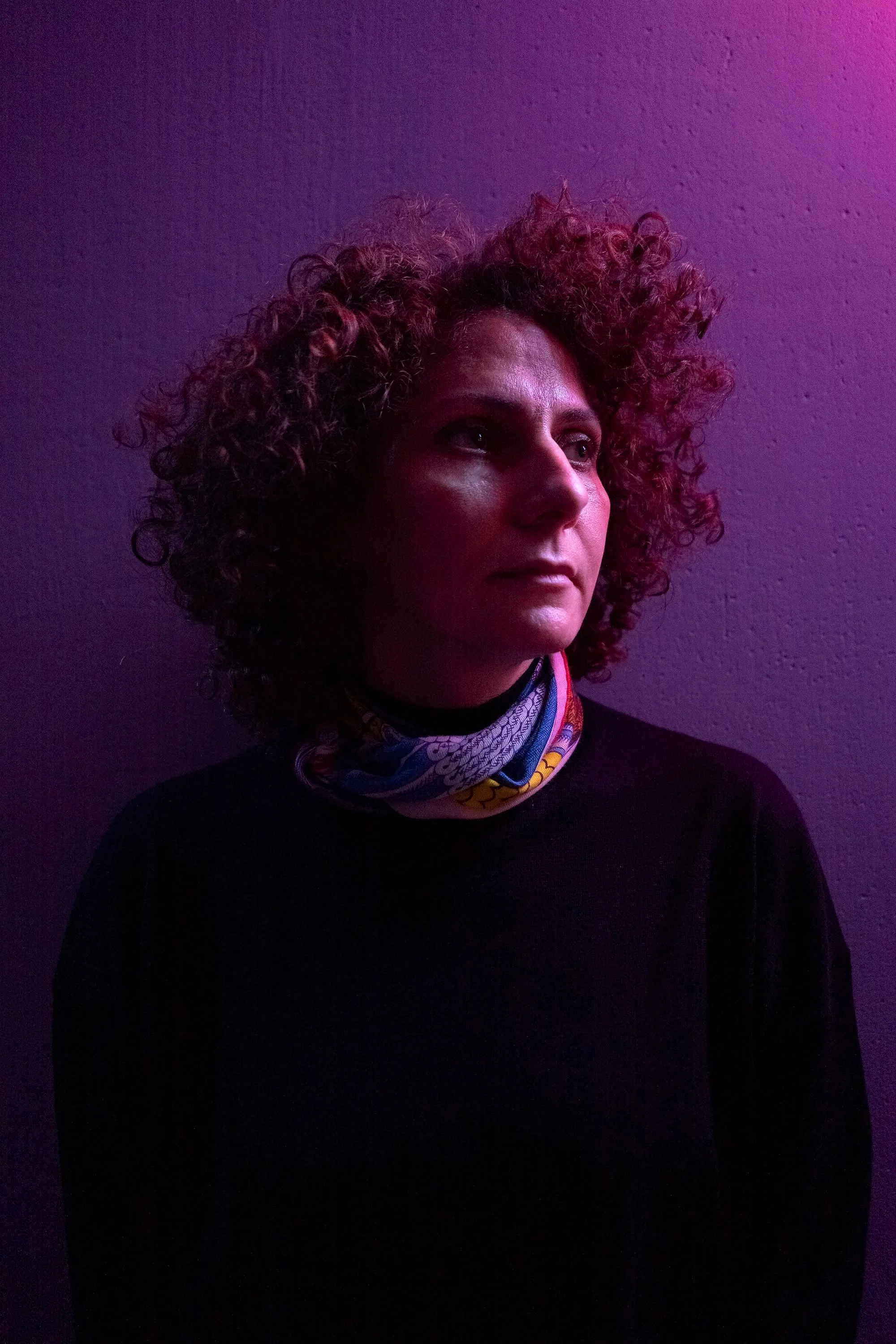
Photo Credit: Leonie Hugendubel
The series goes back to a visit you made to Abu Dhabi in the 2000s, before you lived there. What did you see in those older Modernist blocks then that you only understood after living there for three years?
When I first visited Abu Dhabi around 2001, a colleague showed me around. I was amazed by the city’s vertical dimension and by how uniformly the buildings lined up along the grid of roads that maps the city. My hotel room overlooked one of these boulevard-like roads, and at night I loved watching it glisten with the white and red lights of traffic. I was told that buildings here don’t stand for long before they are demolished and rebuilt. It was a striking fact, and I think I assumed it was a business model.
When I moved to Abu Dhabi in 2022, I brought with me a book I had found in Beirut about construction works in the Gulf. It was a fascinating technical read, and many of its examples were from Abu Dhabi, so I found myself looking for them whenever I was out on the street. The book explains how the extreme climate affects construction, both at the moment the concrete is poured and later, once the building is up and in use. It read like a race against time, with chemical formulas and machines deployed to slow the rusting of the steel rods that reinforce the buildings. My understanding of the fenced-off sites I saw around downtown began to change. It is a business decision afterall, but also a long negotiation between the buildings and the climate: heat, humidity and salt working on materials that, like us, breathe and drink water.
The panels in Climate Conditions are built from hundreds of small stones, a technique more often associated with the floors of Roman villas than with a downtown office block.
Why mosaic. Mosaic usually signals permanence: churches, palaces, public murals. Why use it for apartment and office buildings that the city may well tear down?
As I roam downtown running errands, I take pictures and watch with great interest the architectural motifs of these buildings, their shade and reflections. I notice how some stand out among neighbours of similar height while others sink between towers. Their openings vary in rhythm from one building to the next, like a gathering of people, each with their own character. I think of each owner working with an architect to make their building distinct, while still keeping it coherent with those around it. I find that fascinating. I knew I wanted to make a work about these charming and genuine features of Abu Dhabi and its sister cities in the Gulf. After all, I lived the first decade of my life in a similar environment in Kuwait. In a souvenir shop in Amman, I saw a panel with a Byzantine icon in the centre, surrounded by a minimal monochrome field of mosaic. I immediately imagined these façades rendered the same way, singled out and cherished. The mosaic treats these buildings as monuments and gives them a durable mention.
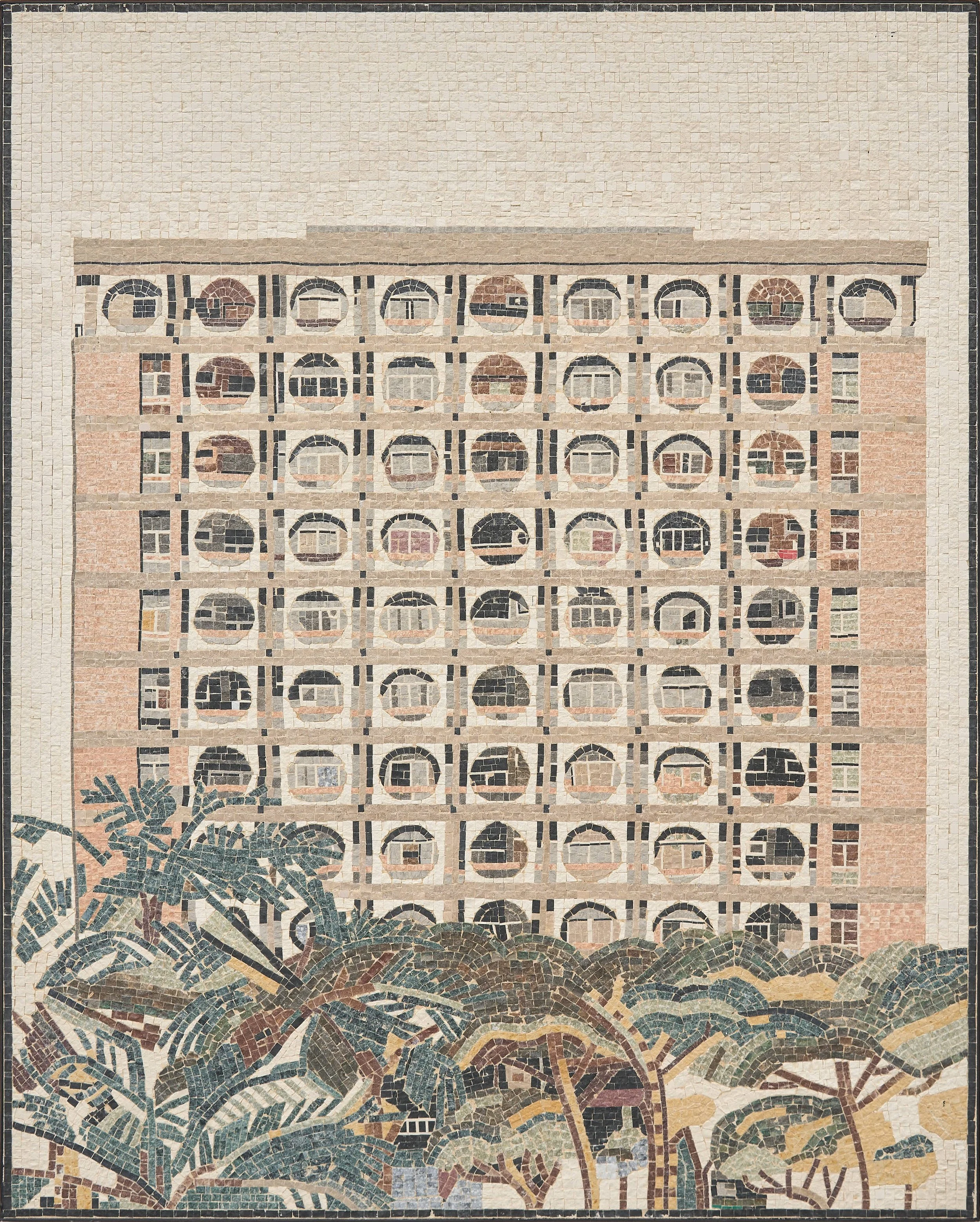
Climate Conditions 2, 2026
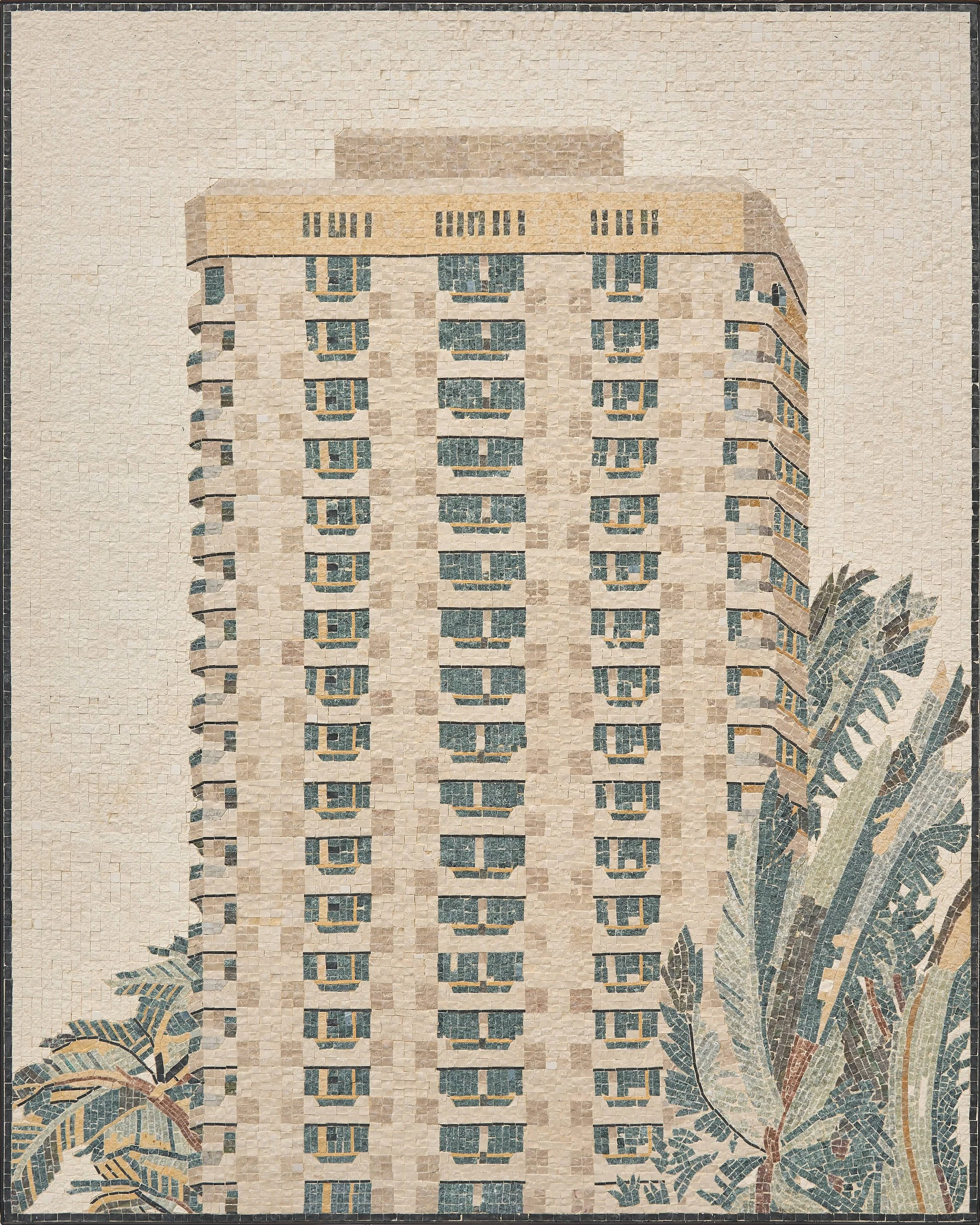
Climate Conditions 2, 2026
The cracks. The cracks and variations in the stone are presented as traces of the forces the buildings have absorbed over time. Did any of those flaws happen by accident while the panels were being made, and did you decide to keep them?
The cracks are not flaws. Some might read the lines between the stones as cracks, but the panels did not begin as a single slab that was shattered. They were assembled from small pieces to create the impression of a monument, with the lines twisting direction to draw an arch or a shadow. They are like pixels, placed together to make an image. Many of Abu Dhabi’s buildings are tiled themselves, and the construction book describes how heat and humidity complicate the tiling process, from matching seams under the sun to working on humid scaffolding. If anything, the lines give a voice to the sounds you hear inside these buildings, of materials shrinking and expanding as the temperature shifts between inside and outside. While they piece together the image of each building, they also make those sounds visible.
Younis does not cut the stones herself. Each panel starts as one of her drawings and is built by hand by artisans, piece by piece.
Working with artisans. Artisans hand-built each panel from your sketches, using hundreds of small stone pieces. What happens to your drawing once it’s in someone else’s hands? Is there a panel that surprised you?
I observe the façades and choose the ones whose openings make each building instantly recognisable. Then I make drawings that reduce each façade to its grid, its depth and its shadow, and decide where colour will enter the windows. In the workshop in Jordan, there is a lot of back and forth with the artisans about colour, scale and how openings and reflections should read. The circular openings were the most demanding, especially on the Connect Four building, because a circle has to be built from fragments while keeping the uniformity of the grid. I am always surprised by how beautiful the buildings turn out once they are interwoven with the trees, and grateful for the sensitivity of the artisans who brought them together with such finesse.
Throughout our conversation, Younis talks about buildings the way one might talk about bodies. They drink, they breathe, they wear out.
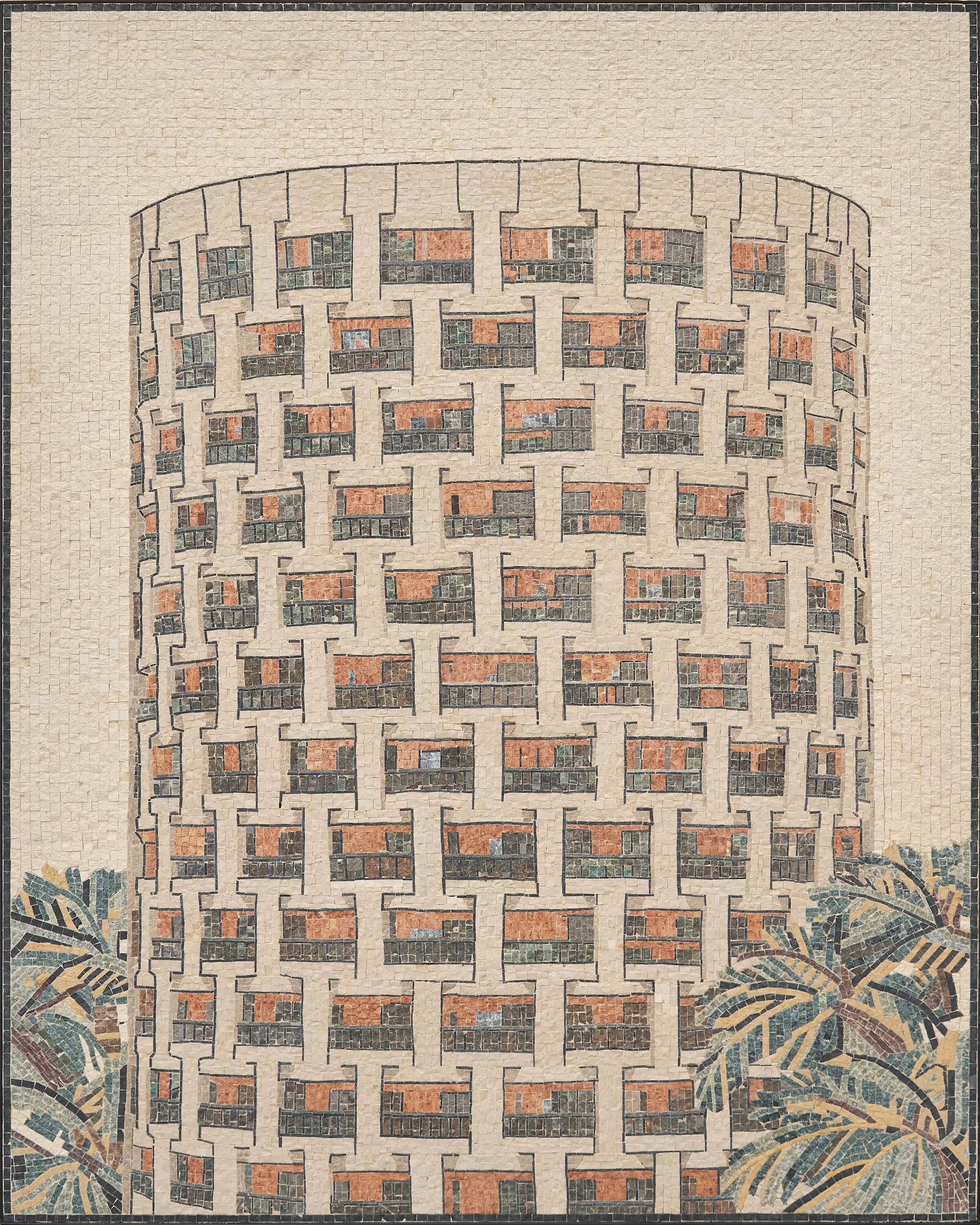
Climate Conditions 10, 2026
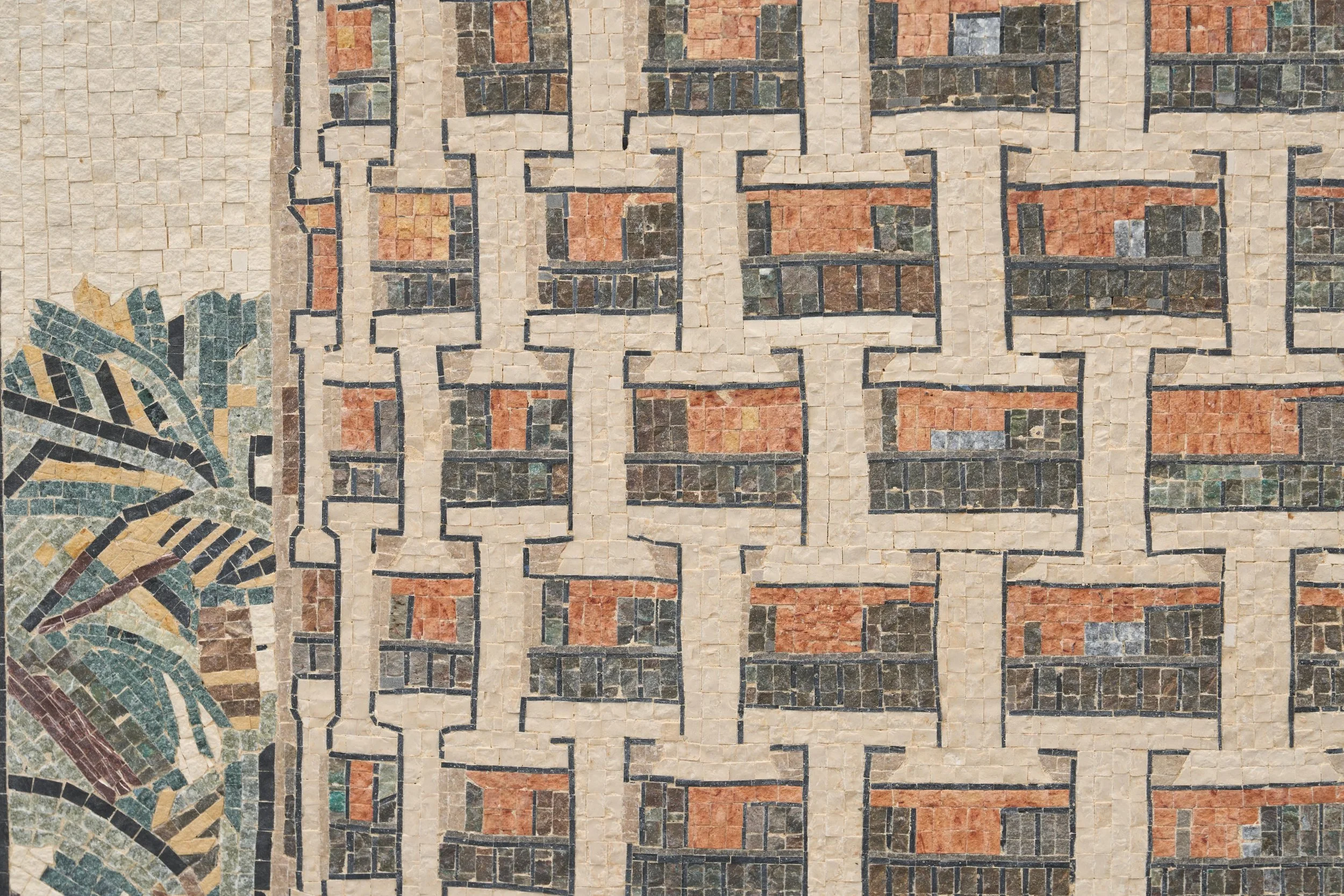
Climate Conditions 10, 2026. (detail)
Living materials. You've called these materials "still living forms." Coming from an architecture background, when do you think a building starts to age? Is it when it's finished, or before?
I would say before it's finished. Odeh Mohammad al-Agha's 1996 book on executing construction works in the Gulf explains how heat and humidity act on concrete and steel from the very first day. Decisions about speed, materials and protective treatments are made knowing the building is already starting to age. After that, it never stops responding. It drinks water, breathes air, rusts and ages. Ageing isn't something that happens to a building at the end. It's a condition it lives with from the start.
The architect in her is never far away. Younis studied architecture at the University of Jordan, and much of her work has looked at how buildings and public spaces carry political and social history.
Adapted, not imported. The works argue that Gulf Modernism was adapted by local architects and engineers rather than simply imported. Who were those people, and why do you think their story is still so rarely told?
You can read it in the façades themselves. These buildings were designed with great intelligence about the sun. Deep, recessed openings and projecting elements let in light but not so much heat. At 925 Zayed the First, the arches are slightly faceted, a quiet reference to traditional form that stays firmly geometric. Next door at 929, smoother semicircular arches sit above a bold geometric motif. Modernism arrived here and was adapted by regional architects and engineers to the climate and the needs of residents. One of my pieces is based on an unbuilt design by Rifat Chadirji for the National Bank of Abu Dhabi, which extends the style he developed for buildings in Baghdad and have built some across the region. It is the only piece I made from archival material.
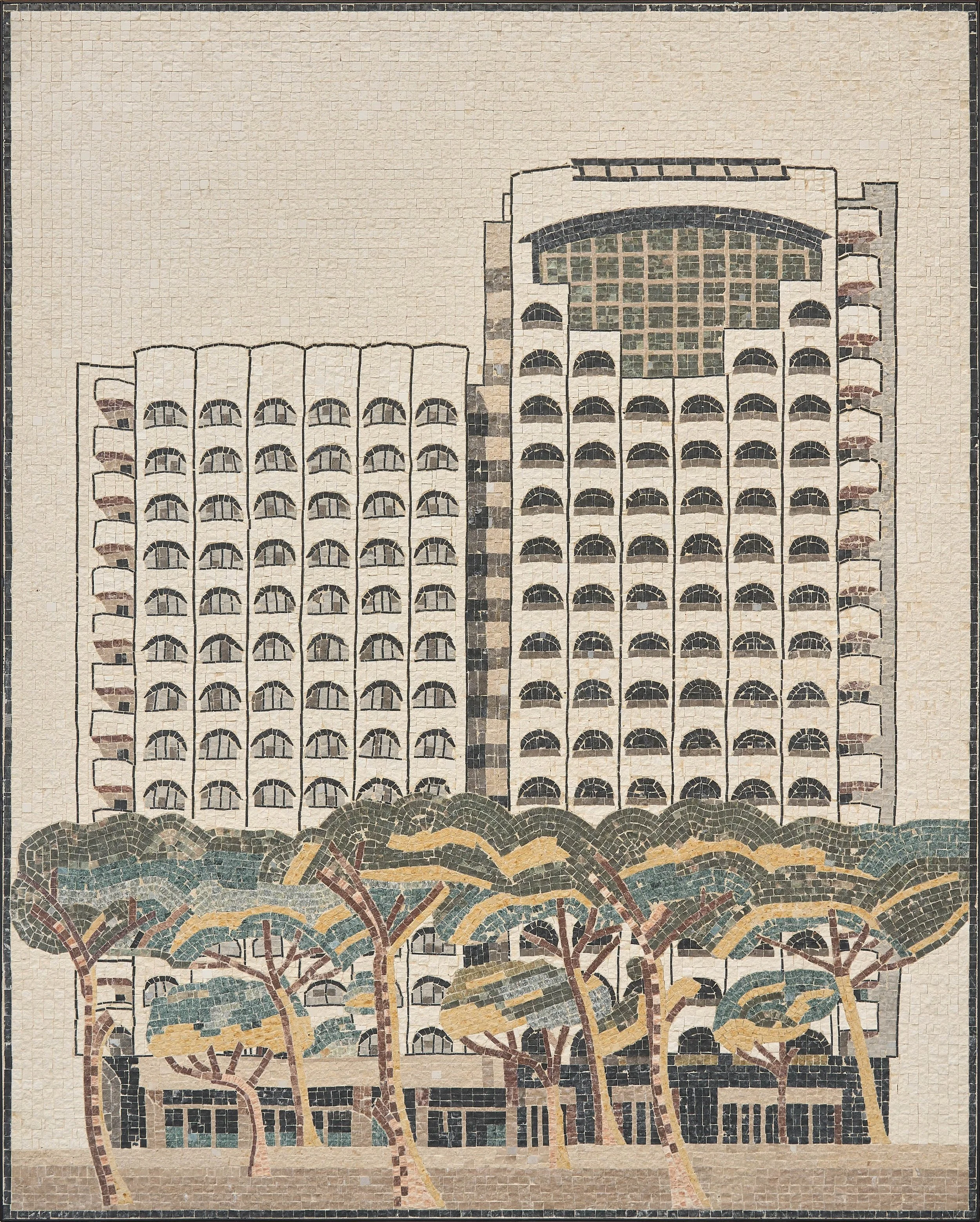
Climate Conditions 11, 2026
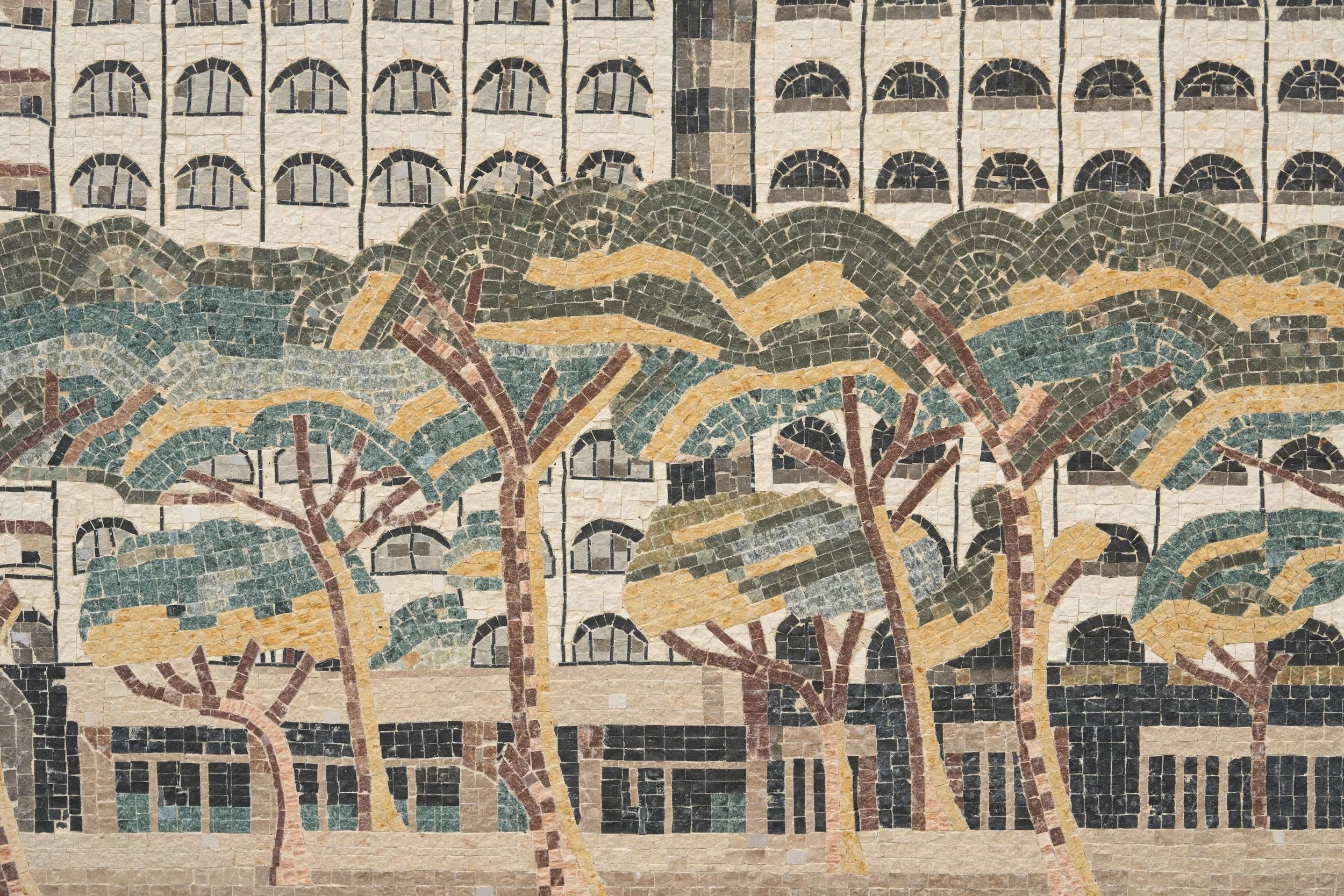
Climate Conditions 11, 2026 (detail)
The trees. Some of the trees are native and some imported. Did you choose each species on purpose? What does a tree say that a building can't?
In architecture school we were taught to plant deciduous trees that shade in summer and let light through in winter. In a city shaped by heat, you become very aware of where the shade is. I was already looking at trees as part of a building’s response to the sun, and I saw how Abu Dhabi’s greenery softens the heat and breaks up the concrete. Colleagues spoke about how palm trees travelled between Gulf cities, which fascinated me too. Buildings and trees go through the same cycles of growth, migration and ageing.
In the mosaics, the trees are exaggerated in size. From the street, we see them up close and large, while the buildings stand further back and we look up at them from below. From a pedestrian’s point of view, the trees look as if they are guarding the buildings. When the trees are leafy and spread horizontally, they dither the building’s motifs, which adds another fascinating layer.
Manarat Al Saadiyat sits in the cultural district of Saadiyat Island, a short drive from the downtown streets where Younis took her photographs.
Showing them here. These buildings are now on show a few kilometres away, in the first Frieze Abu Dhabi, surrounded by brand-new architecture on Saadiyat. How does that change how people see them?
When someone tells us a story about a building, it starts to mean more to us. I don’t see the works as resisting the city’s evolution, which is necessary and often about safety. But they keep a record of a moment we have witnessed.
Ala Younis, Climate Conditions, is presented by Taymour Grahne Projects at Booth G1, Global Futures, Frieze Abu Dhabi, Manarat Al Saadiyat, 19–22 November 2026. VIP preview by invitation on Thursday 19 November; public days Friday 20 to Sunday 22 November, 2–9pm.
Images Courtesy of Taylor Grahne Projects
Words copyright of Naso Art Journal
