
at Green Art Gallery Dubai: What a City Holds
Written by Soraya
As the inaugural Frieze Abu Dhabi opens, Green Art Gallery in Dubai presents Rossella Biscotti’s first solo exhibition in the Gulf. Centrifugal Time is built in part from garments entrusted by people across the UAE.
This week, the inaugural Frieze Abu Dhabi opens at Manarat Al Saadiyat, running from 19 to 22 November. It is the first Frieze fair in the region and takes over from Abu Dhabi Art, which ran for seventeen editions. In Dubai, Green Art Gallery is presenting Centrifugal Time, the first solo exhibition in the Gulf by the Italian artist Rossella Biscotti. At its centre is a new site-specific work made with garments that people living across the UAE chose to give to the project, shown alongside works in brass, neon and video that deal with labour, migration and the materials that build a place.
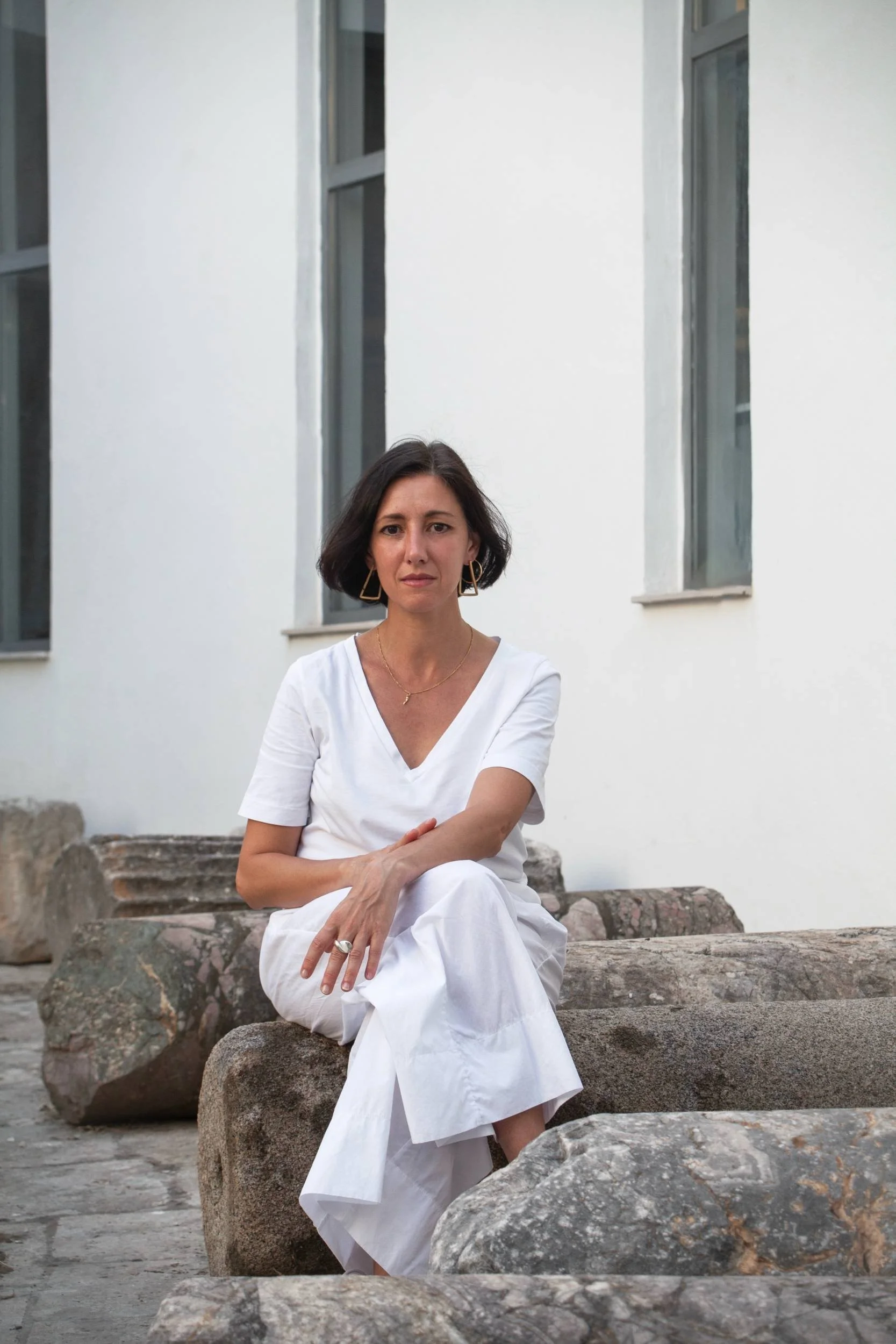
Photo by Raffaella Quaranta
On Working in the Gulf
The artist is not from the region, but she is hardly new to it. “I have visited the region every year since 2022,” she says, “and I came to know the context I would be working in.” She showed at the Diriyah Contemporary Art Biennale in 2024, and in 2025 brought Saturated Salty Mud Stories to the Sharjah Biennial, an installation that read the Emirates through their own materials: pipelines and the energy economy, glass vessels, and ceramics made partly with matter she foraged in Sharjah. For the gallery, that history matters. “She arrives at her first Gulf solo as someone who has already done fieldwork here.”
Green Art Gallery first showed her work in 2021, in the group exhibition Map ≠ Territory, with The Journey, a work for which she sank a 20-ton block of Carrara marble into the sea between Italy, Malta, Libya and Tunisia, then used it as a fixed point to map the military remains, trade routes and migrant routes along those waters. “It was already a work about bodies, migration and how a territory is made,” the gallery says, “so in a way Centrifugal Time picks up a thread we started five years ago.” Representation followed in November 2024. The show also lands at a full moment in her career: the Gwangju and Lyon biennales this autumn, and the BelgianArtPrize, which takes her to Bozar in 2027.
On Gathering the Garments
She first cast garments into concrete spheres in 2018, for a commission at Kunst-Station Sankt Peter in Cologne that was closely tied to the history of that space and its community. She thought the form could travel to Dubai. The city changed it. “Dubai is a fast-paced city made of so many different people, communities and subjectivities,” she says, “and the spheres became a way of compressing those presences and desires into single pieces that hold them together.” The result, Centrifugal Gravity, sits at the centre of the show, developed as a site-specific work and produced directly in the gallery space.
From February 2026, the garments were gathered through conversations across the UAE. The artist did not lead them herself. “The gallery was the mediator,” she explains. People were asked to think of a piece of clothing that held part of their life: the trousers worn to work every day, a father’s kandura, a sari a grandmother brought with her, a daughter’s football shirt. “From the start, I wanted it to be clear that this was not a donation of things people no longer needed,” she says. “It could be something given with a wish.” When she came to Dubai for production, she added another layer, visiting tailors and collecting the leftover pieces of fabric that customers had brought in because those fabrics represented them.
The gallery is careful about what this exchange means. “Nothing was taken from the city,” it says. “People across the UAE chose to entrust these things to the work, and the gallery became part of the social fabric the work is made from, not just the place where it is shown.”
On What the Concrete Holds
Some of the garments carry stories the artist still finds moving. There is a piece of clothing a woman wore after giving birth, which “made her feel comfortable and sexy”; a fragment of handwoven textile from an indigenous community in the Philippines, collected during the pandemic; a pair of socks printed with Bashar al-Assad’s face, part of a wave of satirical garments that circulated after the revolution; artists’ work clothes still marked with paint. And there is a keffiyeh, “which feels especially meaningful to have at this moment.” It became the centre of one sphere. Casting it meant folding and shifting the cloth while pouring concrete in between, so that it would wind through the whole form. “It turned out beautifully. The sphere holds that movement.”
Partly hidden in concrete, the fabric withholds the people who wore it, yet she resists the word absence. “I’d say there is more presence than absence, and that’s true across my work,” she says. Choosing, interpreting and casting are themselves a performative act, one that creates “a new presence within what we might call an absence, or only a trace, of the body.” The gallery puts it plainly: “No single story is put on display. The artist does not claim to explain the UAE; she gives form to what people chose to share.”
That also shapes who the show is for. The invitation went to anyone living in the country, so the people who gave garments and the people walking through the gallery overlap. “Some are collectors, some are workers, some are Emiratis, some arrived last year, and many are several of these at once.” In the spheres, their clothes are bound in the same concrete, with no hierarchy between them. “The audience for this show is, quite literally, inside it.”
On the Man Who Walks Backwards
The figure of the worker in the exhibition begins in Biscotti’s own family. She comes from Molfetta, a port town on the Mediterranean, and her great-grandfather, and later other relatives, made rope for the maritime industry. “In our dialect, a rope maker is called ‘the man who walks backwards’, because to twist the rope they have to walk backwards.” Looking into that history last year, she found that the fibres had come from Asia: coconut and Manila. “Once again, something personal connects to a broader level and can speak about labour, global trade and the circulation of resources.”
The Man Who Walks Backwards is a brass text that unfolds in a reverse spiral, held together by rope and set in Arial, “one of the typefaces that shaped our digital world.” The artist does not illustrate working conditions; the piece is about progress, and who it reaches. “I wanted to bring together the idea that we keep progressing and developing technology, while working conditions, for many people, are not getting better.” Progress, in her reading, stays within “the economy, certain states or a few individuals, rather than reaching the general population.”
On Lucy, and a Heritage Held in Common
The question of who benefits returns in Lucy, a neon portrait of the early ancestor whose remains are kept at the National Museum of Ethiopia in Addis Ababa. “She is usually seen as a specimen, a set of bones, rather than as a woman,” Biscotti says. Drawn in a 9 mm tube, the red neon gas keeps moving inside it, “never quite stable.” While she was developing the piece, Lucy was on loan to the Natural History Museum Abu Dhabi, and nobody knew how long that loan would last. The work became a reflection on how fragile heritage is, who gets access to it, and how it travels. “For me, her power lies in that quiet persistence, in a glow that is also an alert, carrying our common origin.”
Nearby is Cesar, the artist’s first video, from 2001: a single-take portrait of a friend, a young Argentinian electrician who had emigrated to Valencia after one of his country’s worst economic crises. He stands still and silent for a long time, then begins to sing Inconsciente colectivo, a song that took on political meaning after the end of Argentina’s dictatorship. In the gallery’s words, it “speaks of the vulnerability carried by those forced to leave everything behind, like many in the UAE.”
On a Region That Keeps Widening
For Green Art Gallery, which opened in 1995 to promote Arab art, first through the modernists and later through a contemporary programme, an Italian artist’s solo show is a continuation rather than a detour. “What has changed most is how we understand ‘the region,’” the gallery says. The UAE has long been a crossroads, linked by trade, migration and history to South Asia, Iran, Turkey, Africa and the Mediterranean, and the programme reflects it, from Emirati artists such as Afra Al Dhaheri to research-led practices like those of Nazgol Ansarinia, Hera Büyüktaşçıyan and Alessandro Balteo-Yazbeck. “Showing her work does not move us away from our commitment to the region; it shows how wide that commitment has become.”
Asked what working in the Gulf has taught her, Biscotti speaks of “a beautiful openness and interest in art, along with gentleness and a real sense of welcome.” Her hope for Centrifugal Time is simple: “I hope people in Dubai will find a piece of themselves in the work.” And beyond that, as with everything she makes: “My wish is always that anyone who sees it is left with questions, and with the wish to return to it, also in their thoughts, with curiosity.”
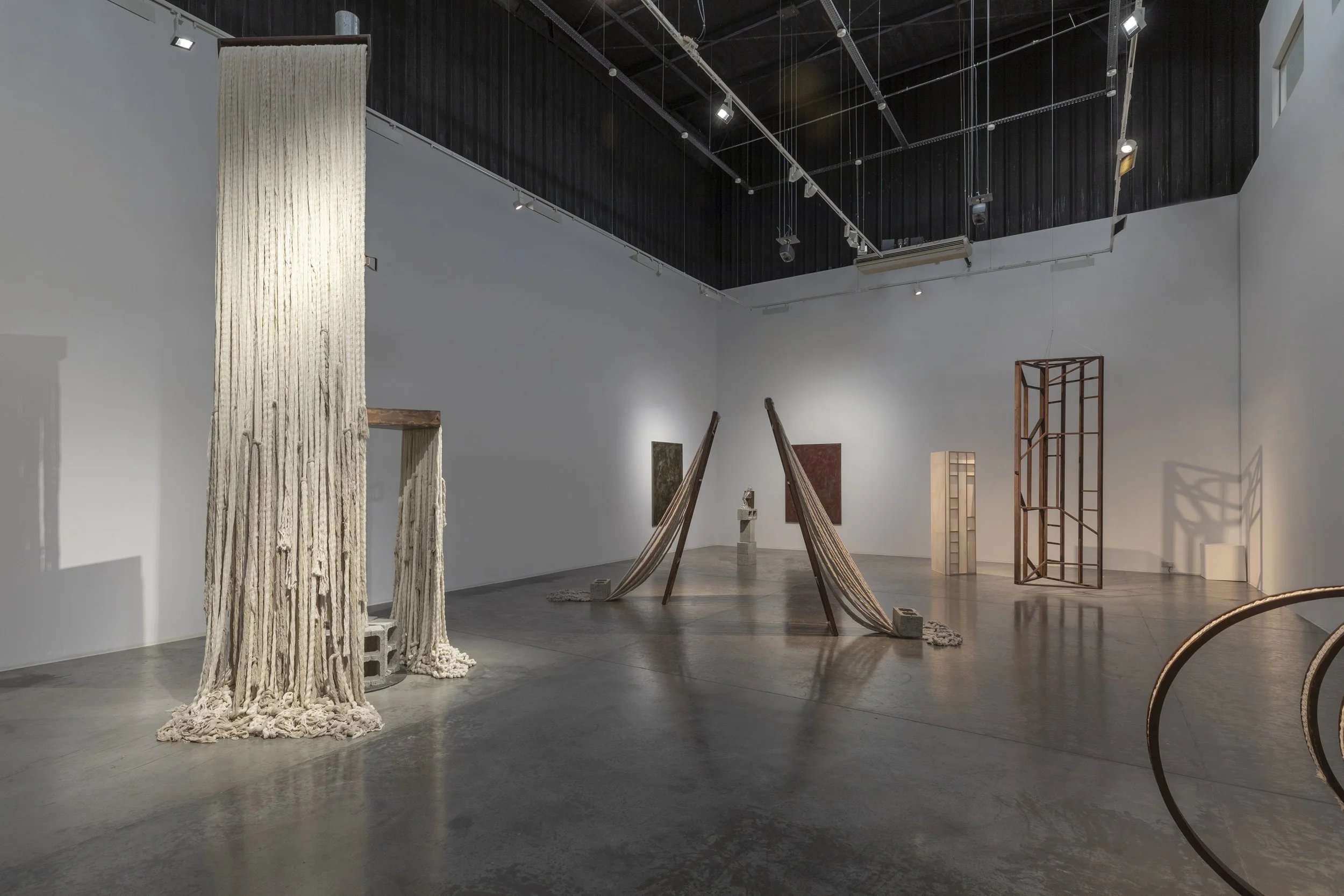
Afra Al Dhaheri, Give Your Weight To The Ground. Installation view at Green Art Gallery, Dubai, 2023. Photo by SeeingThings - Ismail Noor

Chaouki Choukini, Citadelles of Today. Installation view at Green Art Gallery, Dubai, 2024. Photo by Anna Shtraus
