
The Dangers of Nostalgia.
By Nayla
1. To begin, could you introduce yourself and tell us a little about your artistic practice andthe ideas that currently interest you?
I am Muna Al Fadl, a Syrian American-painter based in New York City, investigating cautious nostalgia, inherited culture, technological intervention in perception of ancestry, and a general criticality towards the diasporic perspective. In a pursuit of an unbiased image, understanding architectural destruction, and reconstructing the memory of place, the work builds from appropriated and abstracted images from Damascus’ Google Earth Street Views. However, there is no unbiased image; and this pursuit has led beyond reconstructing memory, and towards being critical of my own Syrian identity. The work is not an attempt to feel more connected to Damascus, but an attempt to investigate the nuances of biased image and perception.
Which takes me to the physical manifestation of the work. I spend a lot of time on Google Earth; I like to call them my “walks through Damascus." I began image sourcing from there.
After choosing street view panoramas, I abstracted them, considering patterns development found in marquetry, composition, and moments of curiosity. Through this abstraction I am adding my own lens as the diaspora, beyond the lens of technological intervention. A moment of distortion skewing reality and perception. Then I paint them onto wood panels with inks and stains. As an ode and bite towards nostalgics, my choice of wood is meant to reference woodworking and marquetry. This creates a distorted scene stagnating a moment in time, filled with my own inherent perceptions of culture.
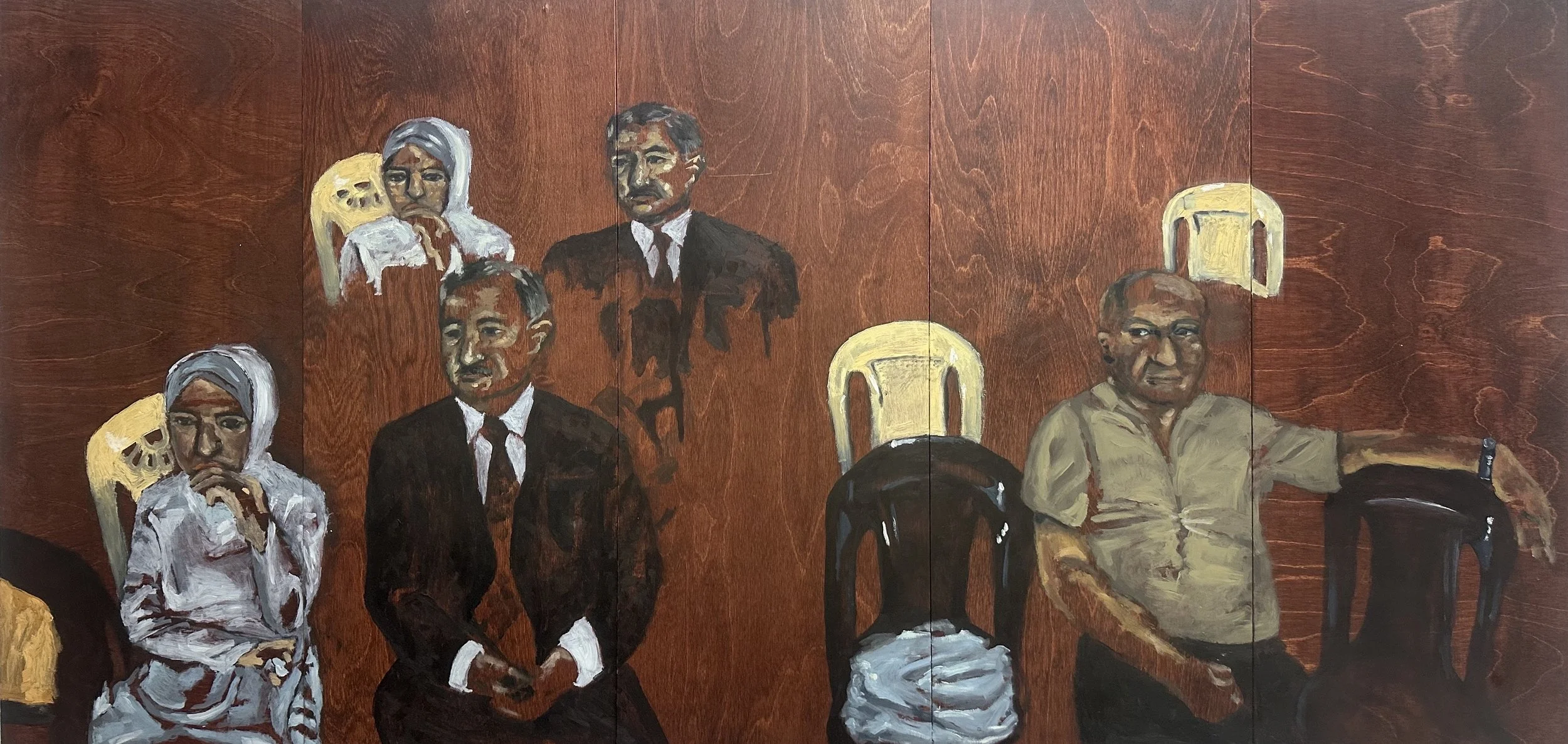
Google Earth, 33°30'47N 36°18'20E
2. How has growing up with an inherited understanding of Damascus shaped your sense of cultural identity and belonging?
Growing up understanding my own culture through the histories and memories of others, I became fascinated with history. With an inherited understanding of culture, you're living in the past in most ways, and in someone else’s. But for me, this has caused a much deeper feeling of being part of something grand. When you place yourself into the history of a 10,000 year old city, it is easy to feel small, but I have always viewed this as an undertaking. When disconnected and miniscule in the face of culture, history, and diaspora, how can I carve myself in? In a sense of belonging, I always struggled to feel secure culturally in my childhood. I didn’t know many Syrians, except for my own family, and those I did know had a different understanding of inherited culture. I felt culturally homeless; unable to find those who understand my culture at home, unable to return to where my blood is from, and ostracized from the larger culture surrounding me.
Now in life, coming from a Damascene background has given me nothing but strength and security. As a child, I was always reminded of the resilience of a city that can stand for thousands of years; as I inherent this, I cannot feel anything but determination.
3. What first interested you in exploring architecture as a way of understanding a city's history and cultural identity?
Destruction of intangible culture has always struck a cord with me. Architecture is tangible history, but there is an immense amount of intangible history held within the stone walls of Damascus. The memories, conversations, and trauma that fill courtyards that have stood for thousands of years, build a broader cultural history and personal histories.
My great-grandfather hid from French bombs in the Al Azim Palace during the Great Syrian Revolt, and when I paint the courtyard that he hid within, with a man I’ve never met, I'm finding a connection between the two of us as strangers. I wonder if he sat in the same place my great-grandfather sat. By painting these spaces, places that have been damaged, destroyed, or have remained untouched, it gives a moment to these intangible histories that can be lost to the test of time.
On another hand, Damascus, and the broader region, hold the beginnings of human history and civilization. A history that I believe every human being has an inherent connection and attachment towards. Which of our ancestors walk the same streets that we do today? How many oral histories going back centuries exist within the courtyards of Damascus? Or the villages in Raqqa? Can we all connect and overcome through shared history? Architecture and space can stand as that connecting branch.
Architecture does not only share a people's lifestyle, structure, and artistic culture, but the walls hold thousands of stories, millions of family histories. When I paint a space it's not only taking a walk through a city I yearn for, but finding a way to connect with each person who walks along those streets. You understand a city and a culture through the people.
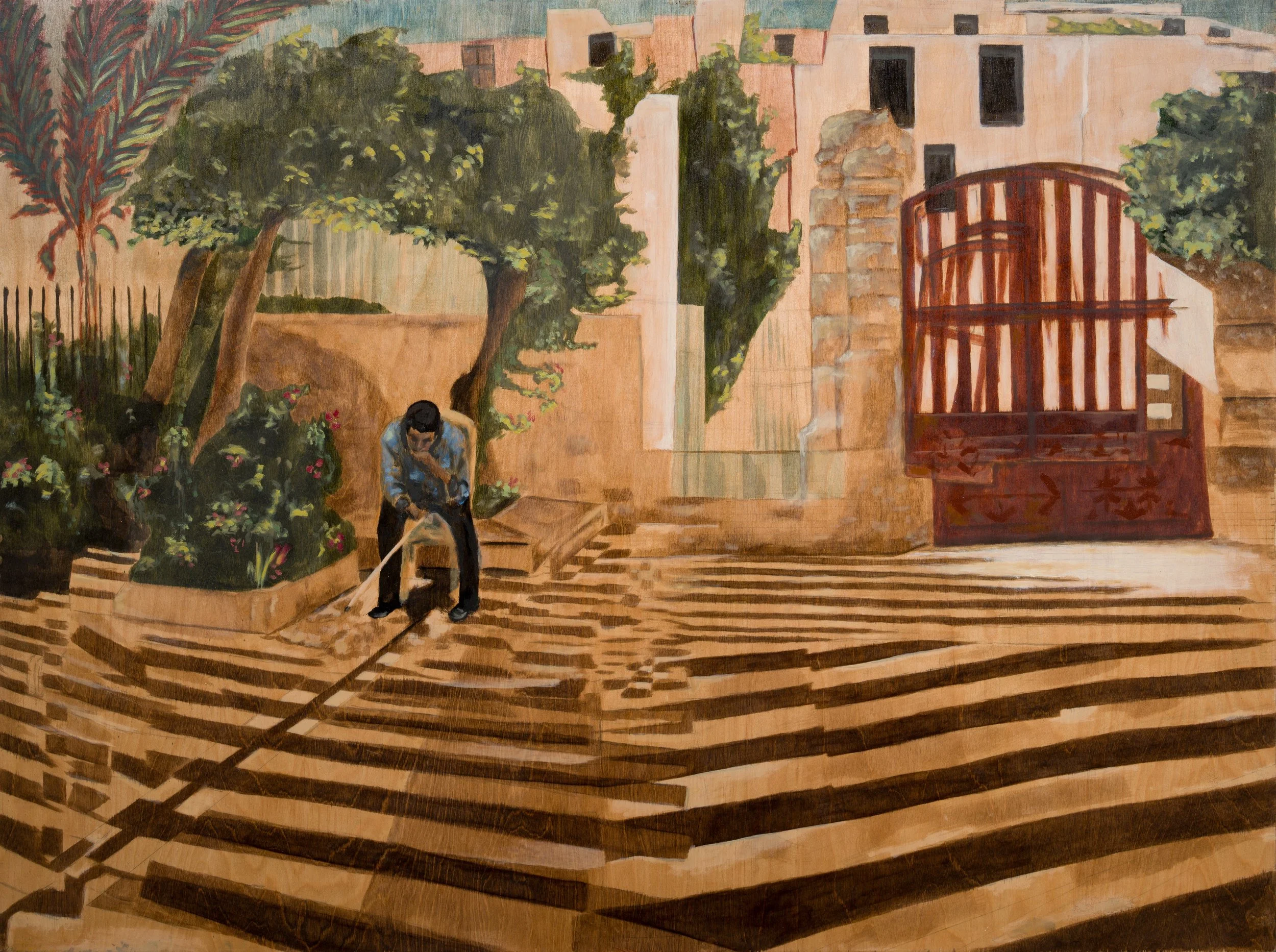
Google Earth, 33°30'44.21N 36°18'22.54E
4. How has living and working in New York influenced your practice and your relationship with Syria?
I’d have to give everything to New York when it comes to my practice; I went to college here, established lifelong friendships, and have deeply grown as a person. In regards to my practice and relationship with Syria, there is a real Arab and Syrian community in New York. I grew up in California during a time when Arabs felt the need to hide our identities in the US. I didn’t know many Syrians outside of my own family and my cultural experience was one that existed within the walls of my home. Once moving to New York, there was both a huge cultural shock that came from moving East, but also a cathartic experience seeing people embrace themselves.
As an artist and a person, that is life changing. I found myself exploring parts of my culture I never knew, and meeting so many artists who can address and criticize my work from a similar cultural perspective.
New York City’s multiculturalism is organic, constantly in flux, and expansive. When I first moved to NYC, I met El Ateeq Abba, and he would take me to different Arabic music performances across Brooklyn. He introduced me to other artists and creatives from Syria and the broader region. When he first opened BarZakh Cafe, he commissioned a few paintings from me and they still hang on the cafe walls. Places that grow out of something uniquely New York, give space for the diaspora, artists, journalists, and culturally homeless. There is nothing like it. The influence New York City has had on my relationship with Syria bottles down to connection with people. That cafe has always been home to conversation, connection, and culture. New York City has this amazing way of allowing everyone to create a home. And when you get to be part of building that home it is the most fulfilling part of being an artist.
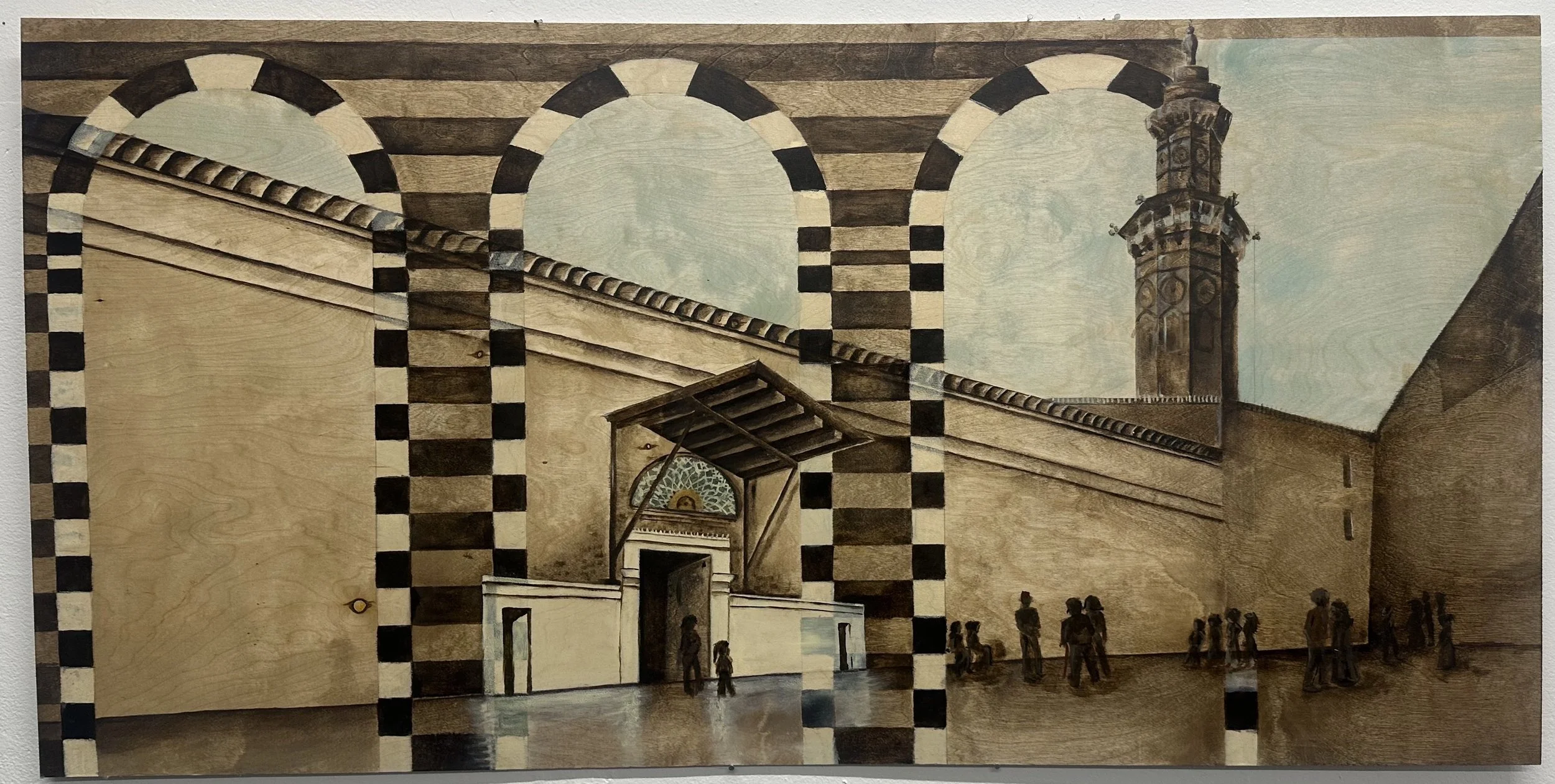
Umayyad Mosque, Google Earth
5. What initially drew you to using Google Earth as a source of imagery, and how do younavigate the limitations of representing the place through the platform?
Honestly it was a recommendation from a friend. I had just started painting on wood, and Assad had been ousted; I felt a deep need to create work that was confronting, but can I really do that in the diaspora.
I started exploring architectural loss and grief towards history I had never seen, but felt had been taken from me. During a public critique at uni, I was speaking about how images can construct fantasy and complaining about not having reference images that I truly felt connected to. Then a friend in the audience simply recommended Google Earth. And from there my work has become fully engulfed in Street View.
Limitation of representation is part of the reason I am interested in using Google Street View as a means of image sourcing, but navigating this also highlights the economic limitation that Syria faces due to sanctions. All of the Street View imagery for Syria, are self-uploaded 360 panoramic images, many of which are uploaded by photographers, tour guides, archivists, journalists, and business advertising services. People upload all of the material rather than cars due to sanctions. I am being hit with an initiation emotional lens and an economic lens; a moment worth capturing. I believe that many of these images are captured randomly and with emotional disconnect, but many of them are living documents, preserving memory to place for the entire world to see.
Much of the limitations comes from a lack of documentation of place. There have been many places, specific streets, and buildings I deeply wish to paint, but they aren't on the platform. For me this honestly fuels the practice and is a reminder that technology and globalization will never be a true cultural bridge and faces their own limitations. However, I think that as sanctions are lifted and Google could place cars, or pay people to upload specific areas to the platform, my
perspective on limitation and bias within this area of the work will change. This means of navigating images also points to my own political implications being brought up in the West.
Until walking through the streets of Damascus, my current view is determined by an interventionist, politically aggressive country and through an American technology that dominates the world. Our interaction with technology and place is a reflection of deeper political hypocrisies that are inherent by the chance of birth.
6. What interests you about incorporating traditional Damascene woodwork and marquetryinto your paintings, particularly in relation to cultural memory and heritage?
As a child, my Jiddo would bring jewelry boxes from Damascus when he would visit the United States. There is not a period in my life where I do not remember Damascene woodworking. For much of childhood, the mosaic patterns were the closest connection to Damascus I could hold between my own hands. As artists it's very easy to become fascinated with construction and craft, and I always was enamored with woodworking and precision. So when exploring nostalgia, I wanted to pay homage to the nostalgic artwork I grew up with, but also a craft we all inherit. As a painter, I can find connection to family, ancestry and culture, but finding connection to another artist is euphoric.
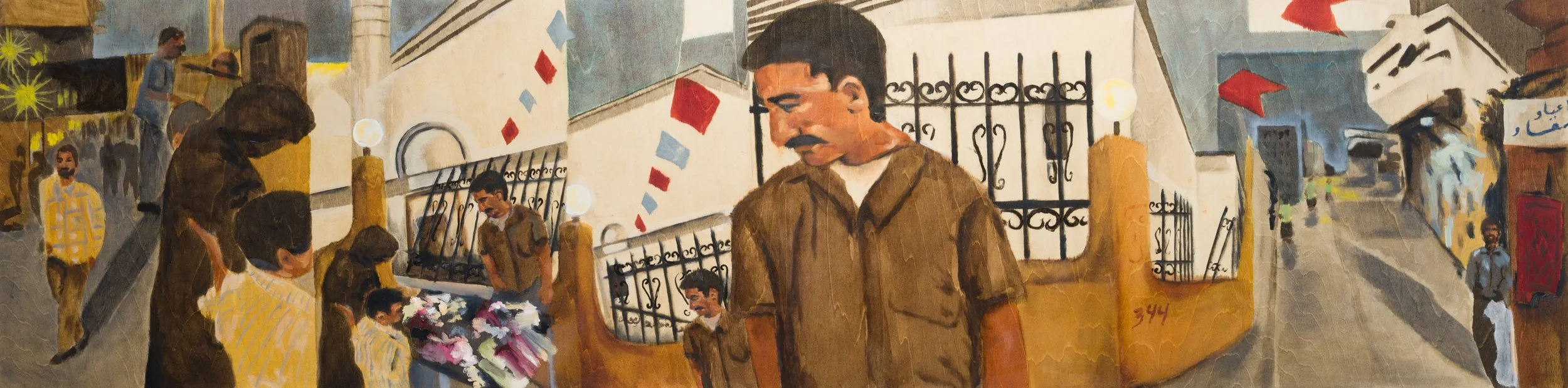
Google Earth, 33°30'47N 36°18'20E
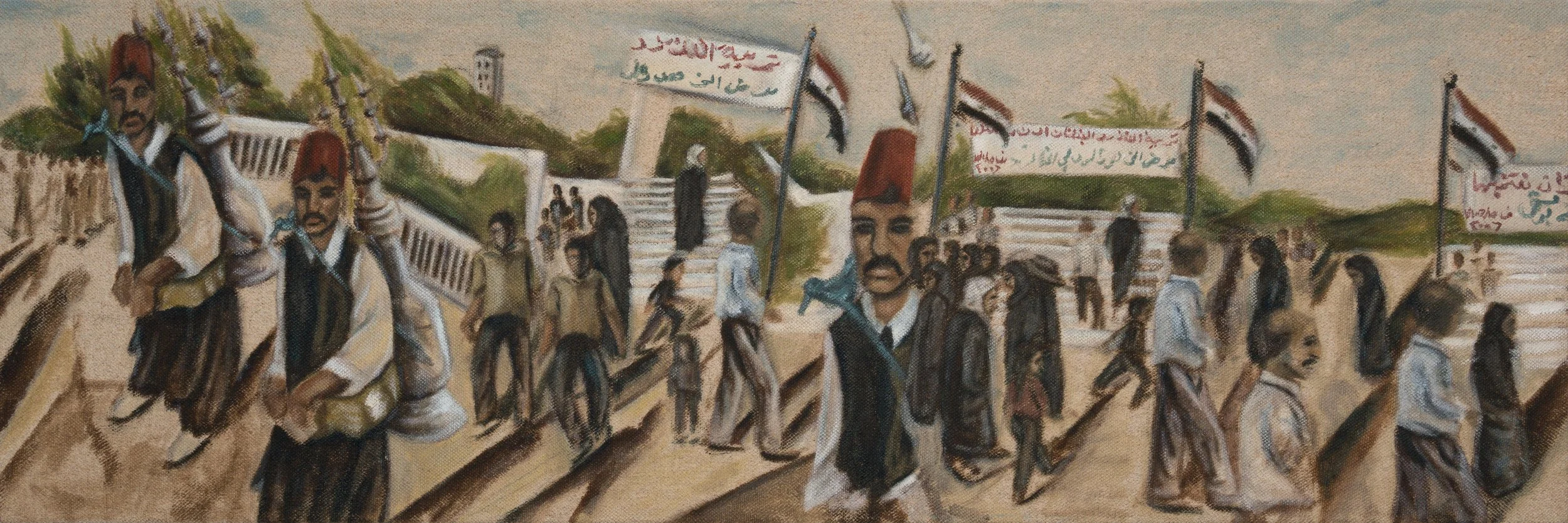
Google Earth, 33°31’02”N 36°16’09”E
7. How did your approach to fragmenting and reconstructing architectural spaces develop, and what does this allow you to explore?
Fragmentation grew from an attempt to reconstruct memory, to be cautious and indulgent within my own nostalgia. When I first started this project, I was deeply interested in bias and reconstructing memory. As I would place my own familial history into the panoramas, and find myself engulfed within nostalgia, I knew it needed to be broken.
Acting as my own internal confrontation with the dangers of nostalgia and cultural distortion, the fragmentation originally came from a place of being critical of myself as I was attempting to search for an unbiased perception of Damascus. Unbiased image does not exist, which has led me farther into the fragmentation as an attempt to avoid and critique glamorization and disrupting a plausibly romantic lens within my viewer and not only myself. When you are looking at a city through the lens of someone else's camera, a mapping platform, and then through your own biases, a memory and reality will never be clear. By fragmenting the architecture, people, and moments a confrontation occurs within the reconstruction of space. This confrontation leads towards my physical approach. If I am curious about the perspective a viewer might uphold on a specific person in the image, I will fragment them more than the others as a means of a call to attention. In my piece google earth, 33°30'42"N 36°18'26"E, exploring the interior women’s section of the Umayyad Mosque, all the women are distorted, one as a means to consider their privacy in an act of worship, but also to draw attention to the viewer’s perception of religiosity and privacy within faith.
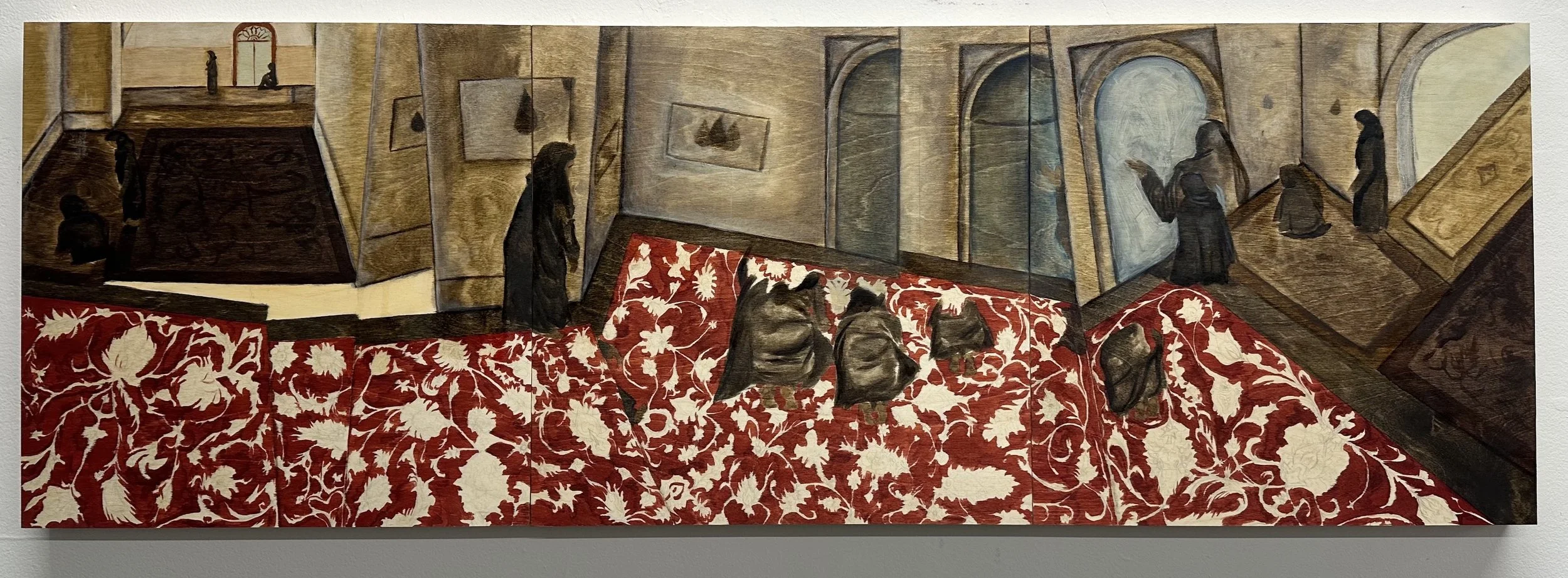
Google Earth, 33°30’42”N 36°18’26”E
8. You've written about the complexities of nostalgia. How do you navigate the tensionbetween your personal attachment to Damascus and the risk of romanticising a place from afar?
That’s my question, honestly. I struggle with this as an artist. My initial reference, Google Earth Street View, is a moment of reality, which is obstructed by the lens of technology and my own perspective. But does one moment of reality reflect stagnation, thus creating a reductive fantasy? I am not sure.
As an artist I think it is really important to be honest with yourself and your viewer. I don’t think there is a way to avoid romanization and glamor, but I can engage in confrontation. Criticizing the diaspora’s romanization is at the crux of this work, making indulgence necessary to become cautious of nostalgia. I cannot critique something I avoid. The activity of choosing certain images, or certain people, or images from neighborhoods my family lived in, creates a divisive tension between me and Damascus. There are parts of the city I am unable to view, or might find myself avoiding, creating a specific Damascus.
The viewer will always be subjected to my personal attachments, but abstraction and fragmentation break this lens. By abstracting my initial references from Street View, I’m almost catching myself (and the diaspora) in the act, pausing, and considering the consequences of nostalgia. Because I have not yet walked down this street… I look at Google Earth panoramas
that are dated 20 years ago. Reconstructing a memory that is not mine cannot avoid glamor and romance.
Oftentimes I find the Arab diaspora taking the role of a Neo-orientalist, glamorizing ancestry, while ignoring the deeper political implications of said glamorization. I don’t believe I fit into this title, but this perspective is one I hope to confront.
The viewer can visually understand some aspects of the work, but many become lost and distorted. This is the relationship and tension I hold with Damascus. I understand some, but much has been lost, destroyed, and distorted by my own diaspora.
Nostalgia is dangerous. It creates fantasy, inaccuracy, and ignorant romance. To reflect on the relationship, to question why an intervention has been made within the image, why wood as the material of choice; I hope the viewer will reconsider their own perspective and not just my cautious nostalgia. As our own memories and technology fragment reality, to what extent are we complacent in our own skewed perspectives?
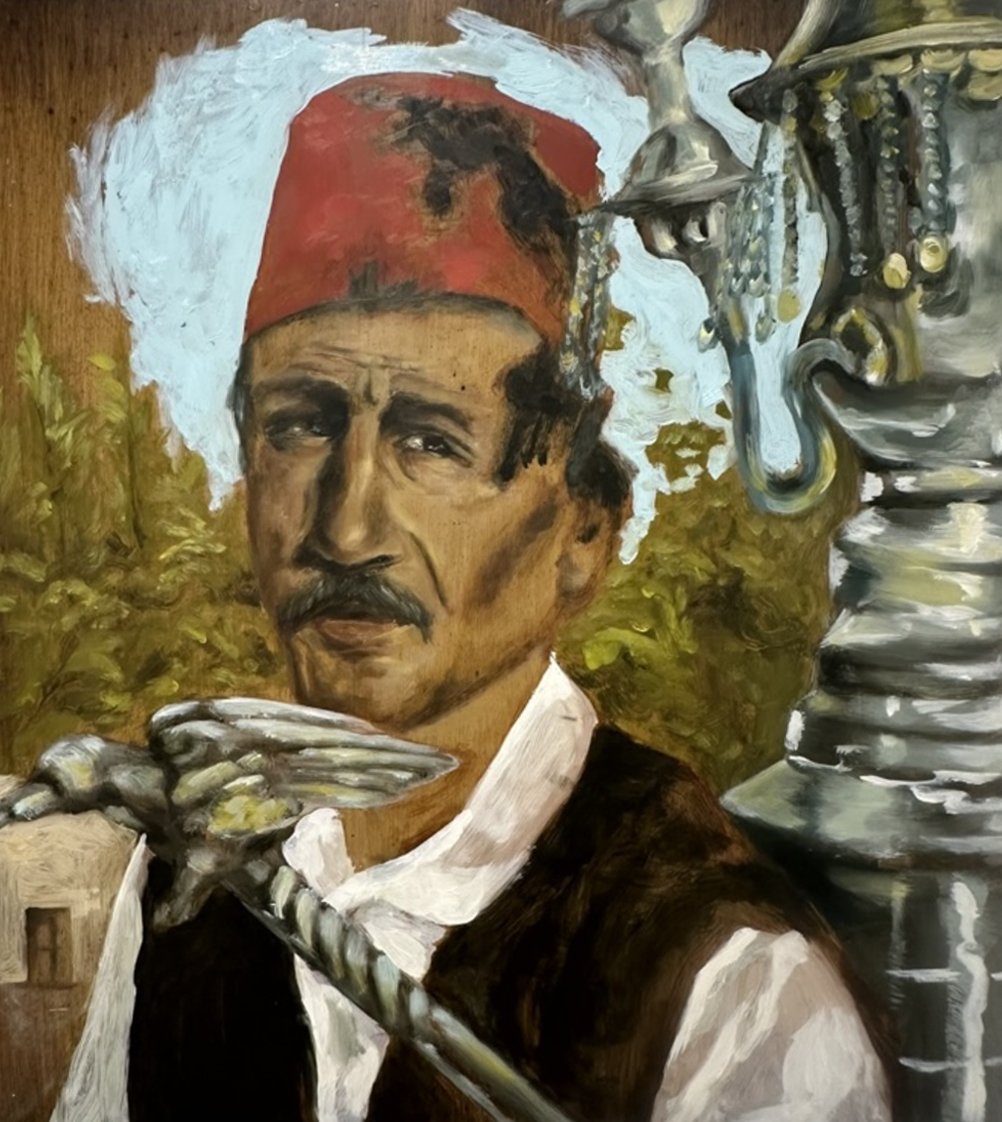
Google Earth, 33°31'02N 36°16'09E
9. Has your experience as a curator influenced the way you approach your own artisticpractice?
The way an artist understands storytelling and a collection of work completely shifts with the experience of curating. You are no longer looking at one piece or body of work, rather you’re pulling strings between them, finding links and building connections that are meaningful for the public. As you put so much thought into the viewer's position, your own work begins to shift with it. Now when I am painting a larger body of work, storytelling between pieces and building a larger narrative seems crucial. Something emerging within my work is the repetition of specific people, moments, and buildings. There is the initial level of artistic pursuit; how can I paint the same moment and invoke multiple responses and feelings? But on another level, what narratives and stories emerge out of repeating person or motif?
10. Looking ahead, are there any new ideas, subjects or directions you're particularly excitedto explore?
There are a few directions I am considering taking this work. I want to explore other countries and political implications through Google Earth and technological intervention as a lens. I want to work with other artists, maybe journalists, lawyers, anyone in those realms. Often when I show the work I get hit with these questions about why I don’t focus on other countries or if I have interest in doing so, which I do. I’ve explored other cities through the maps and there is so much to examine beyond my own personal lens.
Grief is attached to this work, and handling it seems inevitable. I’m not yet sure how this will manifest. In a visual sense, I have been thinking a lot about isolation of people, objects, and space. I know that these thoughts are connected.
Images Courtesy of the Artist
Words Copyright of Naso Art Journal
