
Kaïs Dhifi
On Forging Myths in Metal
Written by Nayla
“This dynamic tension between precision and imperfection defines his practice. Each piece becomes an odyssey in metal, both mechanical and poetic.”
On Kaïs
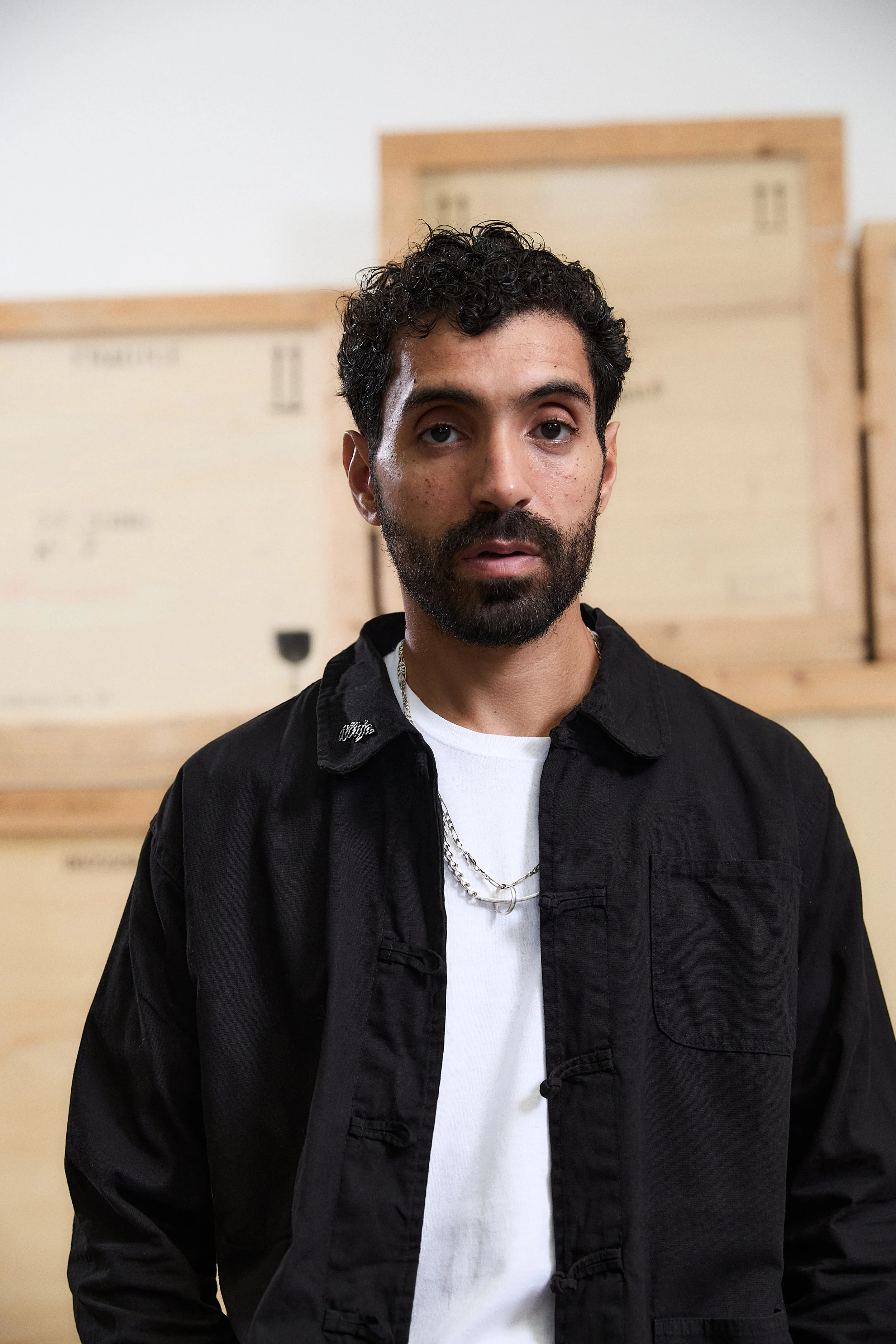
Born and based in the realm of Metalia, Kaïs describes himself as both wanderer and forger, an artisan of myth who divides his time between crafting artifacts and exploring the rocky desert that composes his world. His practice, deeply rooted in self-taught curiosity, is less a career than a fateful path.
“If full-time means dedicating one’s entire energy to expressing existence through art,” he once said, “then I have walked that path since 2020, without overthinking it.”
It is this sense of unpremeditated devotion that defines Kaïs’s approach, a journey guided not by ambition but by providence.
“Seeing my father draw was what first made me want to draw too”
Before talking about your work, could you tell us a little about yourself and what first drew you towards becoming an artist? Where are you from, and how does home inspire you day to day?
I’m Natalie Ayoub, I’m Jordanian, and I’m currently pursuing a Master’s in Visual Arts and Curatorial Studies at NABA in Rome. I did my undergraduate studies at the American University of Beirut, where I studied Environmental Health and later decided to pursue a second degree in Studio Arts. Alongside my own practice, I’ve also been working as a Senior Editor at Kaph Books for the past several years, where I work primarily on art and cultural publications. That experience has become integral to rethinking artistic practices and production through researching, editing, contextualising, and working closely with other artists and writers.
My relationship with art really began in childhood, but I think the biggest inspiration for me was my father. He’s an architect, and he was always drawing. He would leave his sketches around the house, so I grew up seeing drawing as something that was simply part of everyday life. Although most of his drawings were architectural sketches, he would sometimes draw portraits as well, and that really encouraged me to start sketching myself. I became particularly interested in drawing the body, anatomy, and portraits — especially eyes, for some reason. So in many ways, seeing my father draw was what first made me want to draw too.
I’ve also lived between several places — Jordan, Lebanon, and now Rome — so the idea of home has always been somewhat mobile for me. It has moved through different cities and countries rather than being tied to one place. At the same time, I continue to find inspiration in my surroundings and in what I’ve learned along the way.
My studies in Environmental Health, for example, made me increasingly attentive to the environment as something that has its own agency, processes, complexities. I think this way of observing the world around me has become an important part of how I approach my practice. In that sense, home for me is less about a fixed location and more about observing and engaging with my surroundings.
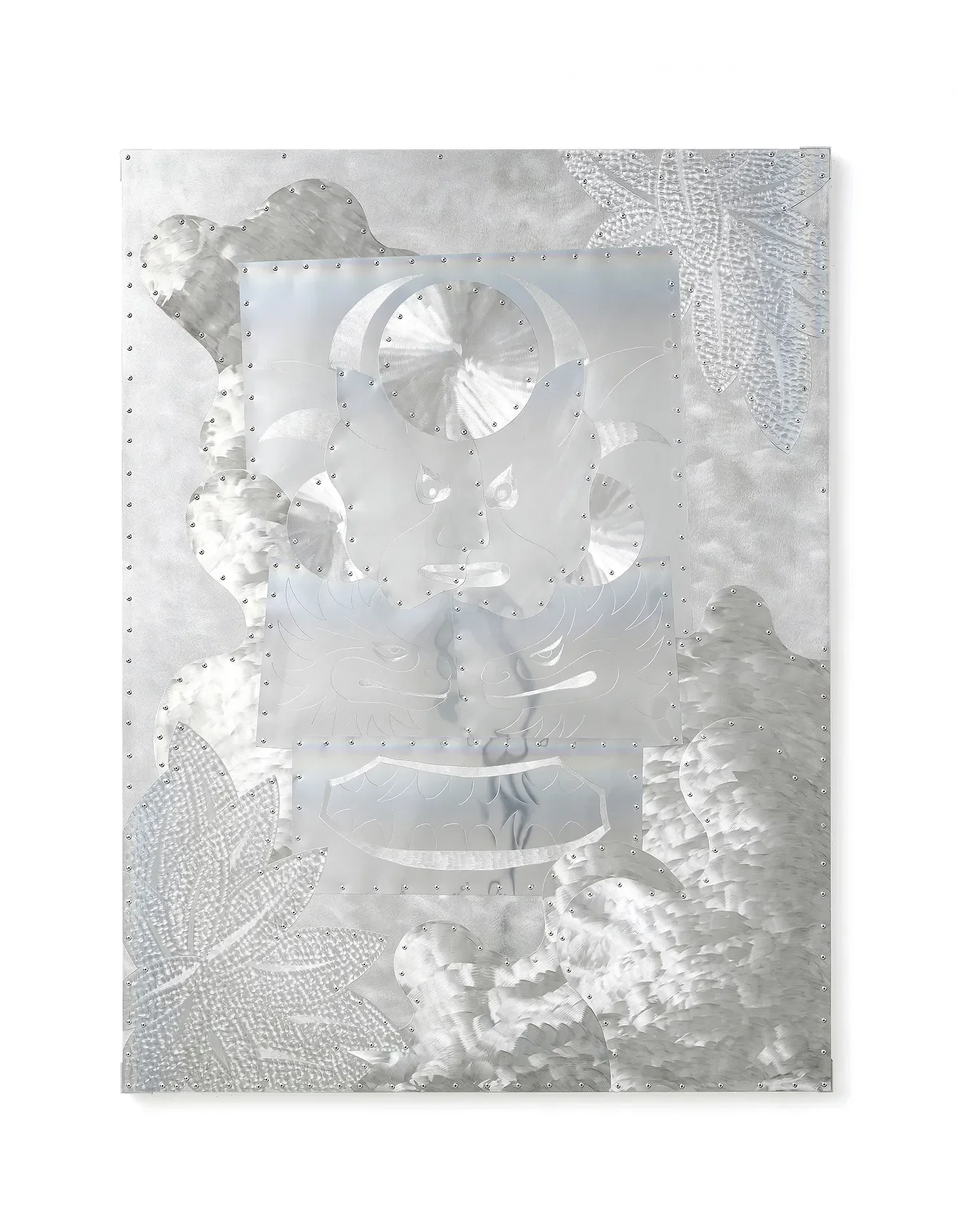
Silver Spirit, 2023, Engraved and riveted aluminum
On Mediterranean Identity
Though he speaks of Metalia, Kaïs’s universe is grounded in the typology of his territory. Yet, for him, the Mediterranean is not a natural border but a single, continuous island of cultures. “Tunis lies on the southern shore, Marseille on the northern,” he reflects, “moving between them is simply crossing the island.”
This fluid sense of belonging shapes his visual language: fragments of myth stripped of context and function, recomposed into new narratives. “Where the journey ends, myth begins,” he explains. The rupture between lived experience and symbolic transposition gives rise to what he calls Metalia, a poetic counter-mythology, a “shared neo-folklore” built from both memory and vision.
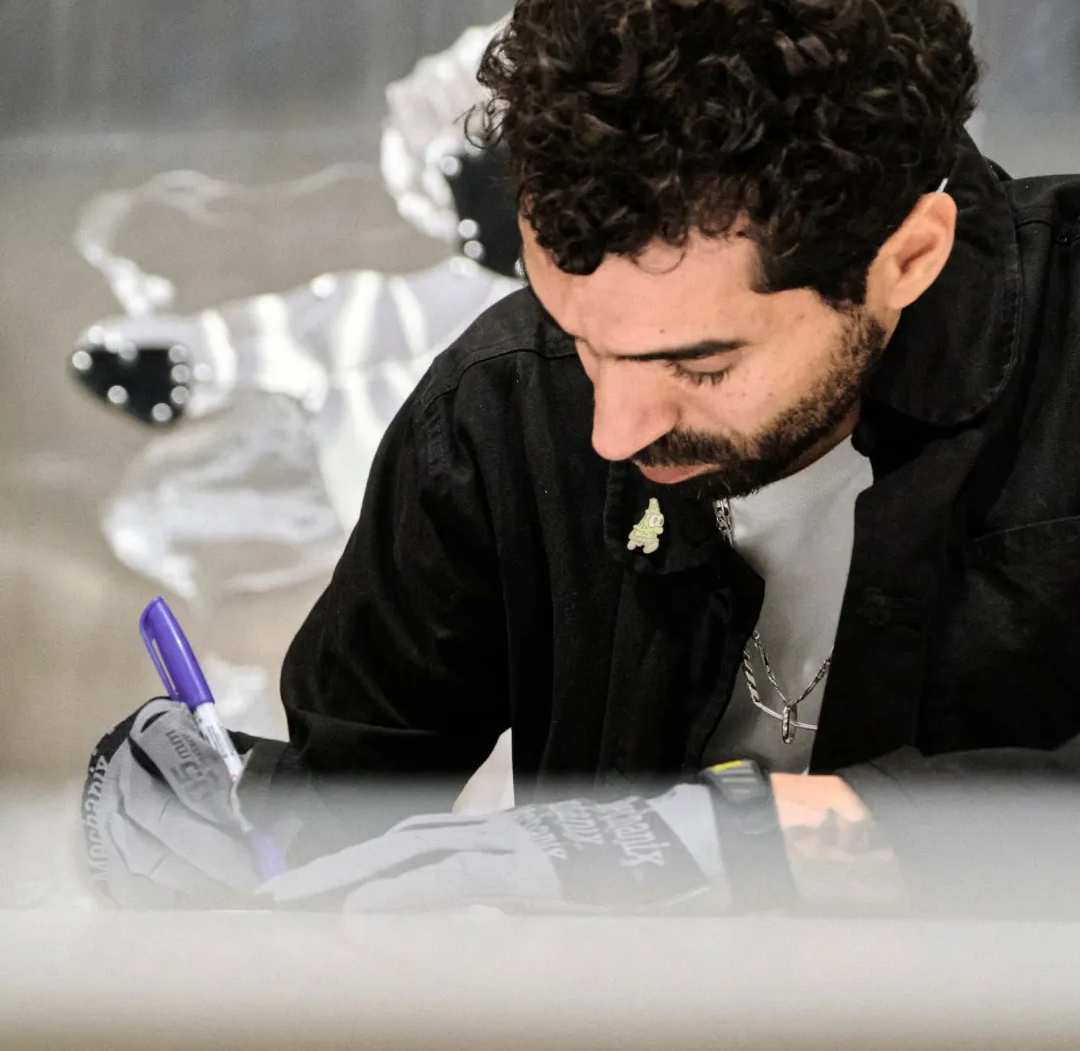
Image by Renaud Morin
On The Alchemy of Time
Kaïs’s work sits at the intersection of archaeology and fiction. For him, the dialogue between ancient gesture and speculative technology is not an aesthetic exercise but a secular pursuit. “What the eye sees, the hand remembers,” he notes. “The vernacular is charged with human experience, while technology allows us to transcend limitation.”
Citing Arthur C. Clarke’s dictum that “any sufficiently advanced technology is indistinguishable from magic,” Kaïs locates art precisely in that liminal space between wonder and knowledge. His creations appear as artifacts from a past, lost, or yet-to-come civilization, objects that invite viewers to question their own sense of time and memory.
His atelier motto captures the essence of this vision: Rien n’est vrai, tout est permis — “Nothing is real, everything is permitted.” It is both an invitation and a declaration, suggesting that perception itself is the most reliable form of truth.
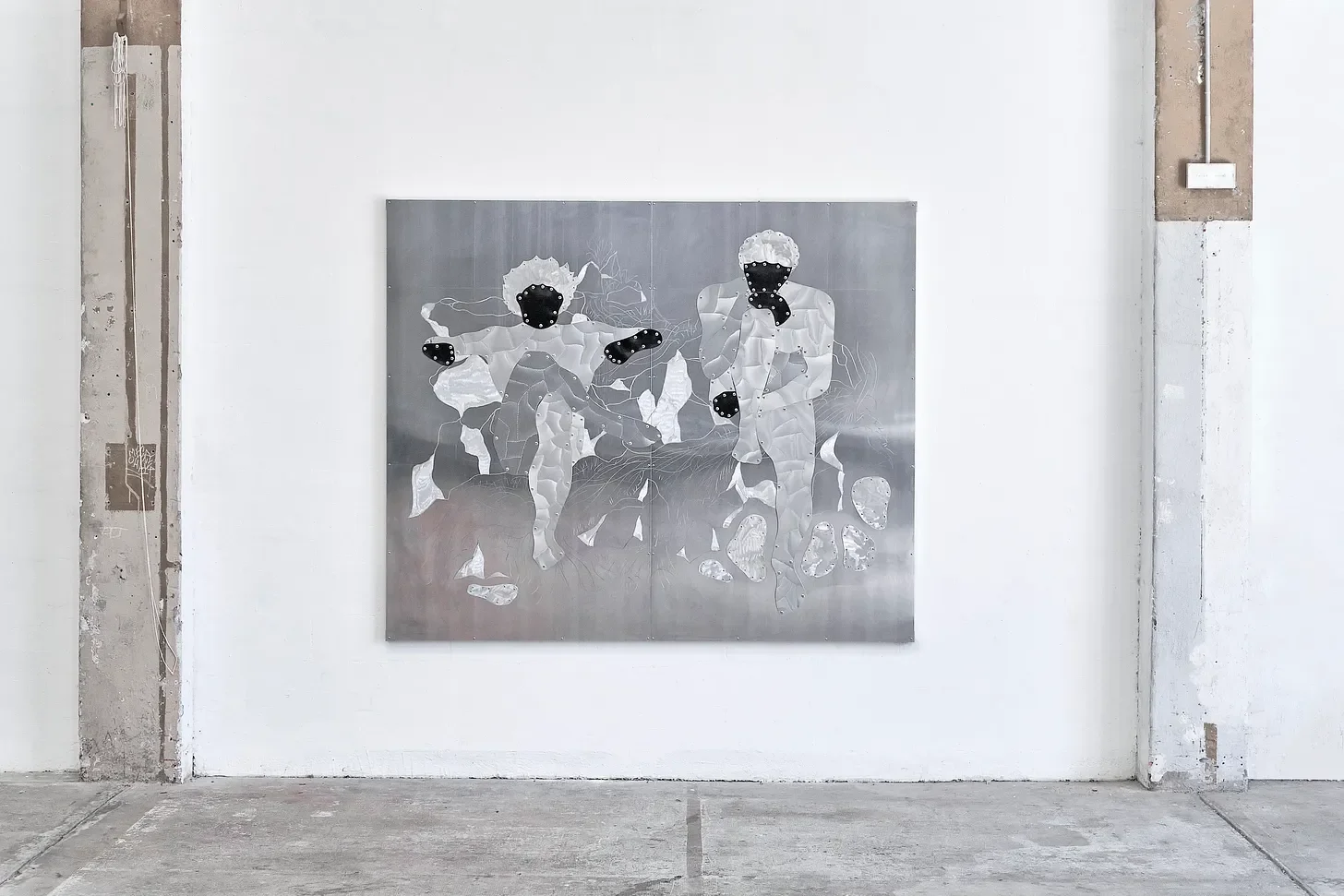
The Giants, 2024, Engraved and riveted aluminum, Caoutchouc, Photo courtesy of Renaud Morin
On The Metal That Remembers
Among the many materials he has explored, aluminum occupies a central role in Kaïs’s visual and symbolic lexicon. “Aluminum presented itself to me,” he says, “and in a way, it was also awaited.” As a child fascinated by engineering and space exploration, he now fulfills that dream metaphorically, building his own vessels inspired of aerospace techniques.
Lightweight yet unforgiving, aluminum records every touch and every error. “It is a living material,” he explains. “By understanding and accepting it, the relationship began to soften.” This dynamic tension between precision and imperfection defines his practice. Each piece becomes an odyssey in metal, both mechanical and poetic.
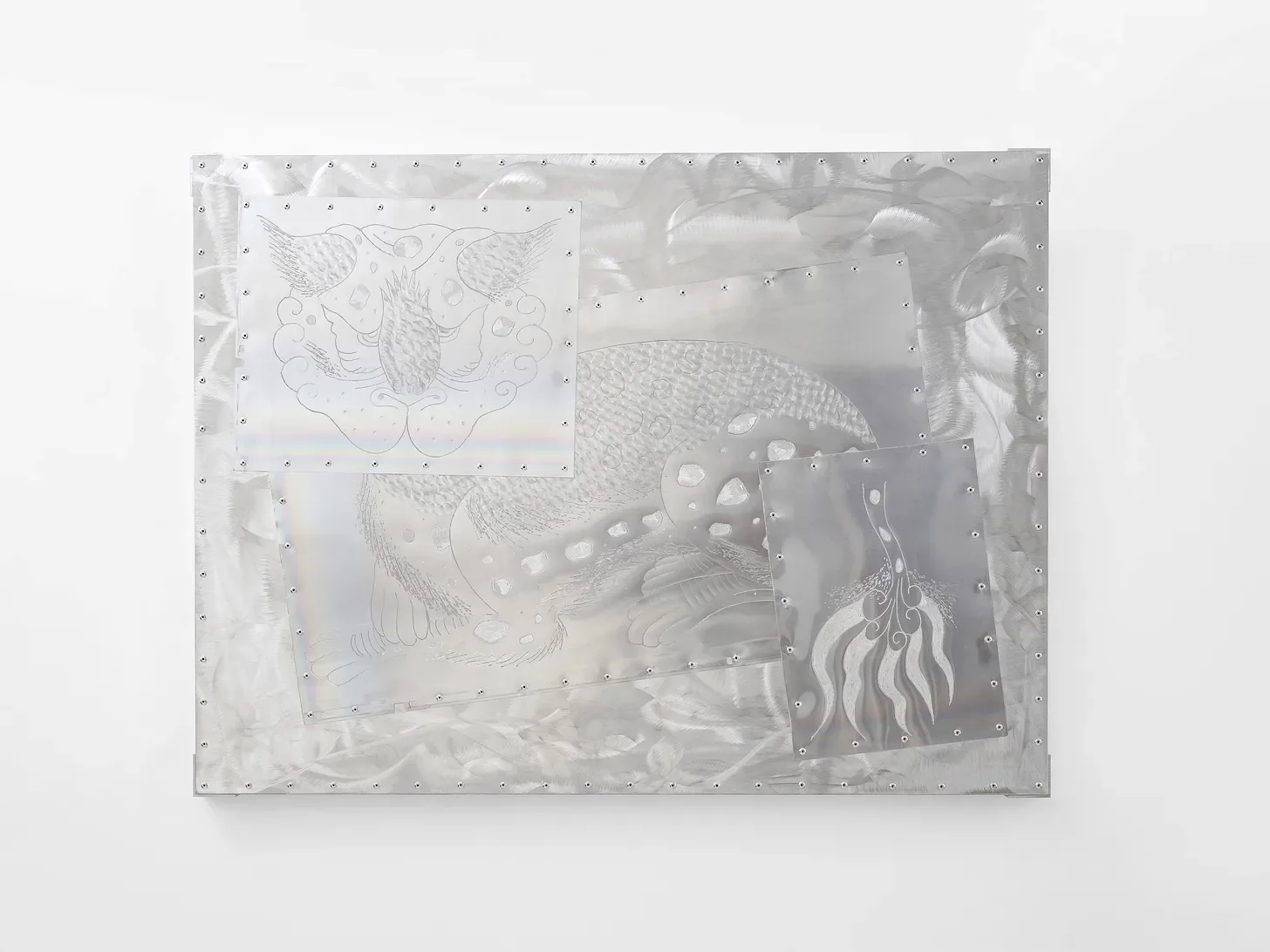
KNIKING, 2023, Engraved and riveted aluminum
On His Work
One of Kaïs’s most striking works, My Delicate Orchard, stands apart in his oeuvre for its use of color, vivid car-paint accents applied to etched aluminum. The work originated from a poem of the same name, an invocation that transformed into a shared visual offering:
From the smell only left the name
Dusk of sweetness in a terrible den
With no desire fear shall never flourish pain
To fade, aflame and gather again
The piece’s floral and serpentine motifs evoke both tenderness and transformation, a synthesis of the organic and the industrial, the lyrical and the metallic
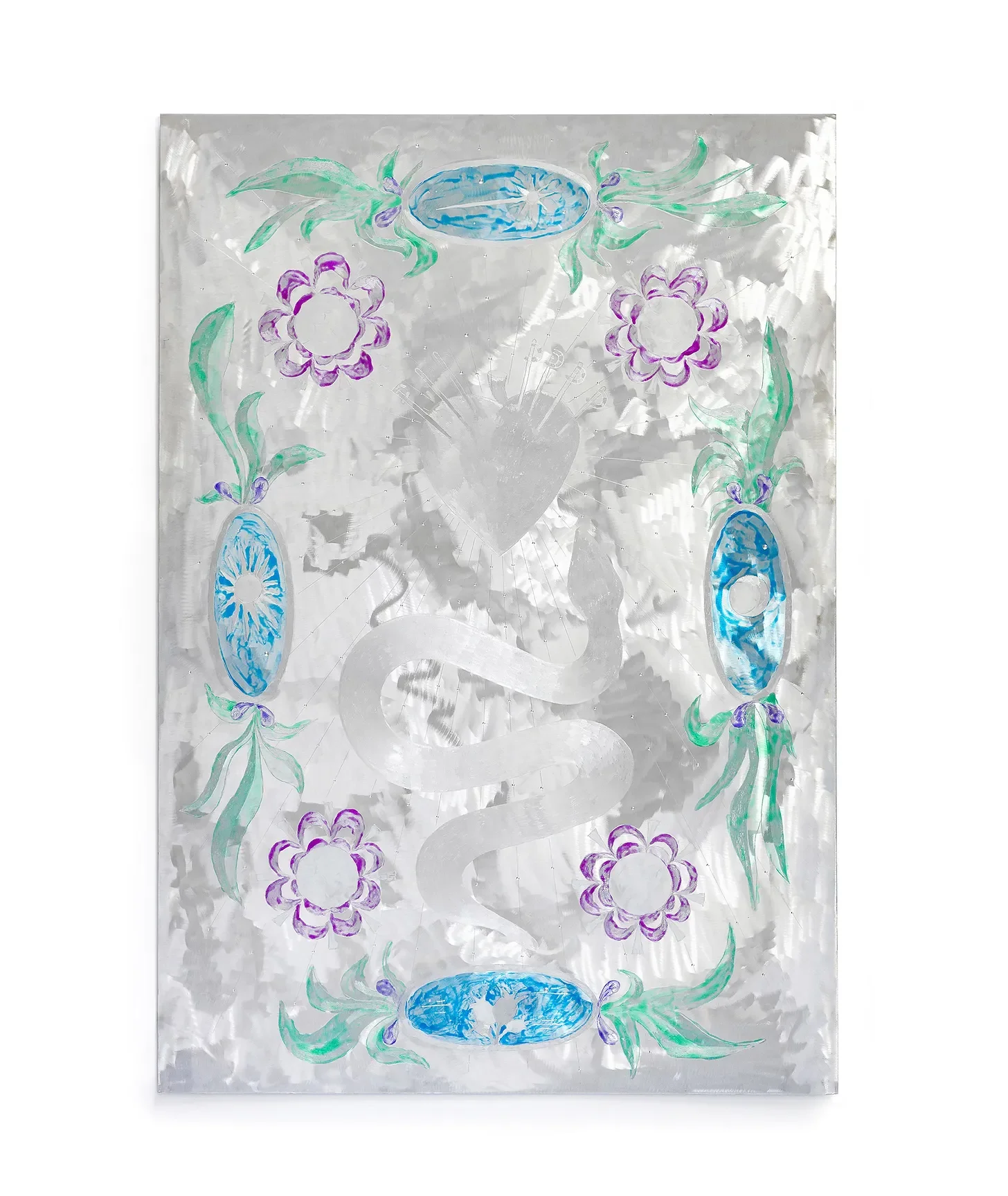
My Delicate Orchard, 2023, Engraved and etched aluminum, Car Paint
On Process
Inside his atelier, time seems to dissolve. There are no clocks, mirrors, or networks, only the rhythm of the hand and the hum of creation. “Each piece is crafted in an almost uninterrupted session of mindfulness,” Kaïs explains.
From freehand sketches on raw metal sheets to the final act of riveting, his process is both physical and spiritual. The rivets themselves, hundreds or sometimes thousands, become meditative marks of closure. “The subtlety lies in feeling when to stop,” he says.
For Kaïs, metalwork is a kind of irreversible painting where light itself is the final brushstroke, the revealer of form, emotion, and mystery.
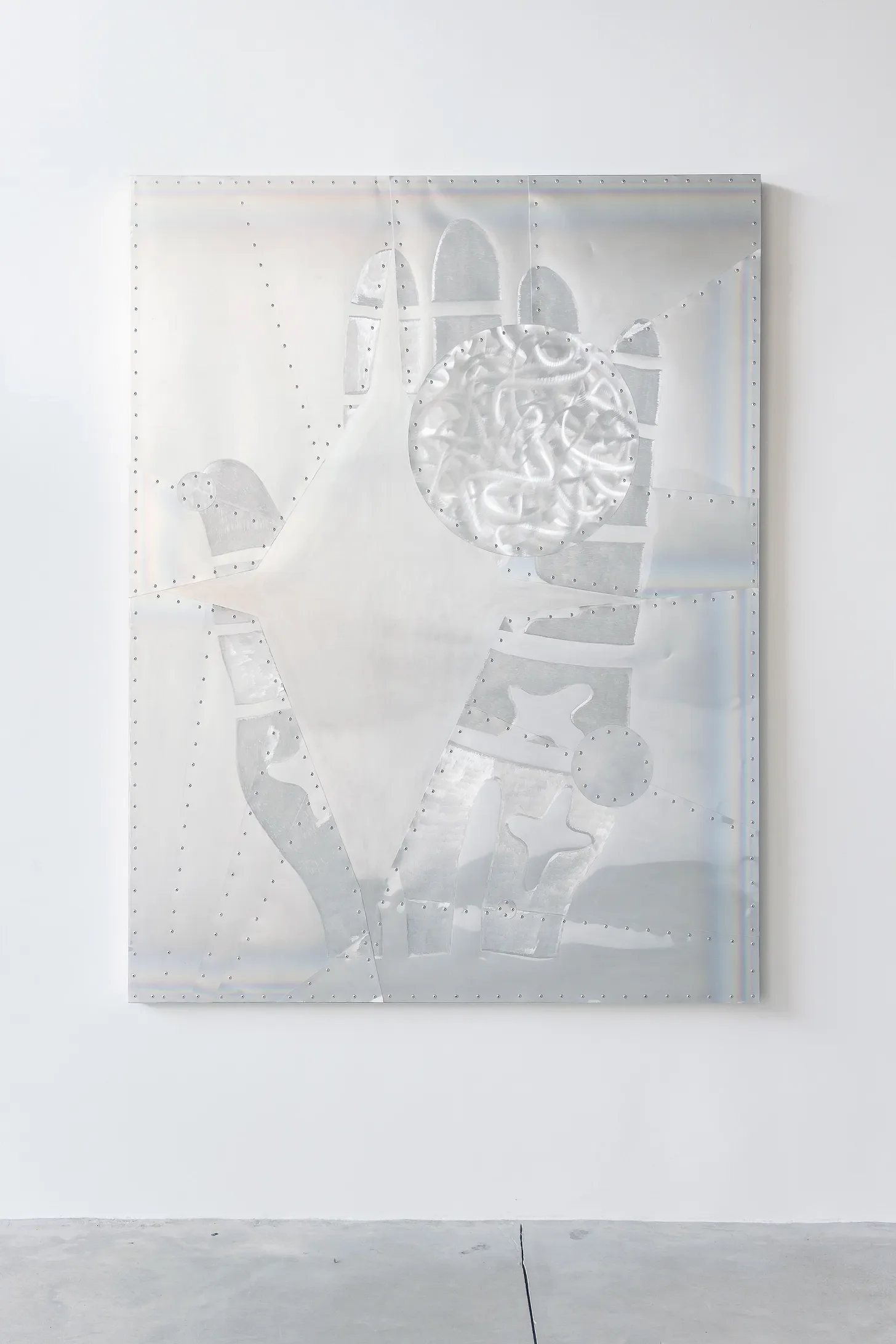
Untitled (Hand of the D), 2022, Engraved and riveted aluminum
On Next Steps
With exhibitions spanning Tunis, Dubai, Brussels, and Lyon, Kaïs has increasingly brought Metalia into dialogue with the wider world. Yet he insists that global exposure has not altered his vision. “It refines my methodology,” he says, “but never my intent.”
In 2024, his monumental Metalia Sound System, a 3.5-meter-high metallic sonic installation, was unveiled at the Fête des Lumières in Lyon. The project tested not only the technical limits of his craft but also the collaborative spirit essential to public art.
Looking ahead, he is developing Metalia Shelters, a series of land-art installations designed to merge with desert landscapes. These “plural experiences,” as he calls them, are less sculptures than thresholds, spaces where creation, myth, and environment converge.
Images Courtesy of the Artist.
Words Copyright of Naso Art Journal
