
Reem Aljeally
On Expanding Space & Holding Home
Written by Soraya
“For Aljeally, continuing to work is a way of sustaining presence. She articulated this simply, stating that it is “one way to keep Sudan alive” and “to remind people of what is happening.”
On Artistic Consciousness
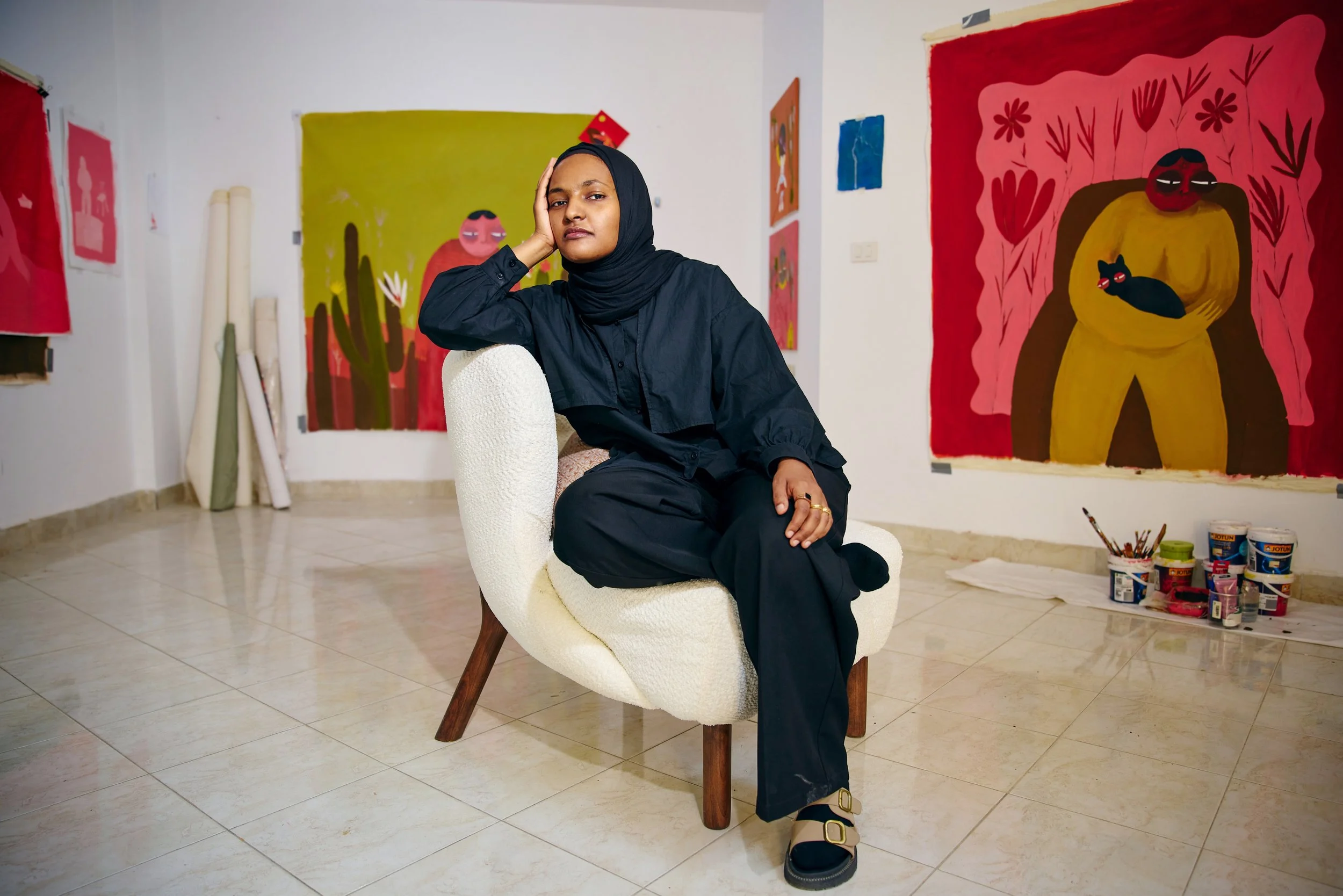
When asked to introduce herself, Reem Aljeally resisted the narrative of becoming. Art, she explained, did not enter her life as a choice or a professional pivot. It was always present. She had been painting since childhood and described the practice as something that simply remained with her, saying that “I’ve been painting my entire life… you start painting as a kid and then it stuck with me, even throughout architecture school.”
Her academic training in architecture did not replace this inclination, nor did it displace it. Instead, the two developed in parallel. After completing her studies, Aljeally actively sought engagement with Sudan’s art scene, enrolling in a short course at the Khartoum Arts Training Center. This experience allowed her to begin articulating a personal visual language. Still, she resisted framing this moment as an origin story. She recalled knowing that she “always wanted to paint and just keep painting,” even if art was not yet conceived as a sole occupation. Reflecting on that period, she clarified that she “wouldn’t call this a huge moment,” because “for me, art has always existed in my life.”
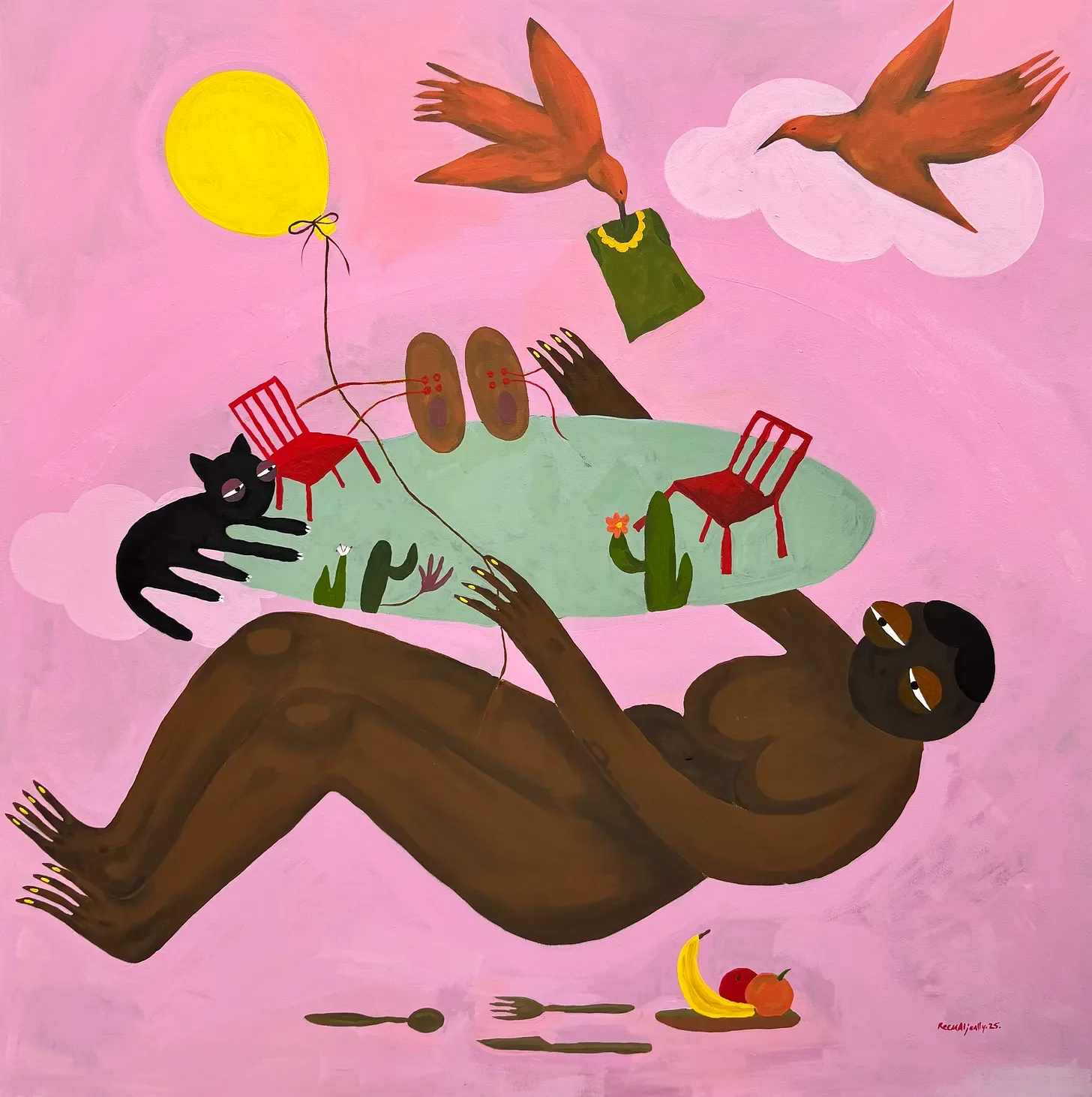
Melody in the Clouds, 2025, Acrylic on canvas
On Artistic Consciousness
When asked to introduce herself, Reem Aljeally resisted the narrative of becoming. Art, she explained, did not enter her life as a choice or a professional pivot. It was always present. She had been painting since childhood and described the practice as something that simply remained with her, saying that “I’ve been painting my entire life… you start painting as a kid and then it stuck with me, even throughout architecture school.”
Her academic training in architecture did not replace this inclination, nor did it displace it. Instead, the two developed in parallel. After completing her studies, Aljeally actively sought engagement with Sudan’s art scene, enrolling in a short course at the Khartoum Arts Training Center. This experience allowed her to begin articulating a personal visual language. Still, she resisted framing this moment as an origin story. She recalled knowing that she “always wanted to paint and just keep painting,” even if art was not yet conceived as a sole occupation. Reflecting on that period, she clarified that she “wouldn’t call this a huge moment,” because “for me, art has always existed in my life.”
On Architecture as Method
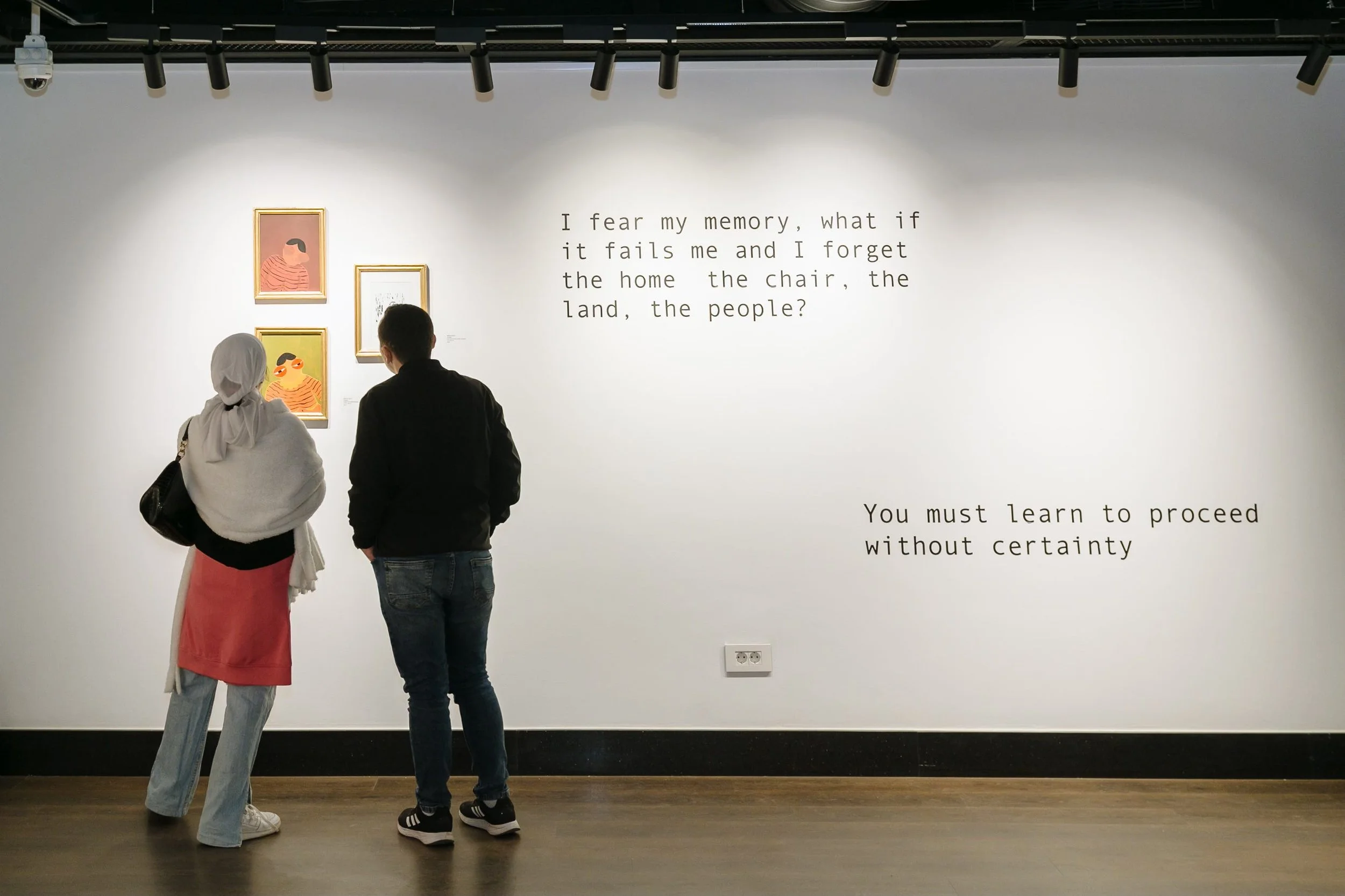
Although Reem Aljeally no longer practices architecture professionally, she understands it as a foundational mode of thinking rather than a closed chapter. Architecture, she explained, “really feeds into everything that I do,” providing not only technical skills but a way of approaching structure, space, and audience experience. She described it as a discipline that “gives you this huge set of skills that you can just adapt anywhere,” a perspective that continues to inform her work as an artist, curator, and organizer.
This became particularly evident when she ran a gallery in Sudan between 2022 and 2023. Exhibition-making, for Aljeally, required more than display. It involved an attentiveness to movement, perception, and affect. She spoke about thinking carefully through “what kind of journey do you want them to take within that exhibition,” emphasizing the emotional and spatial dimensions of curatorial work. Across design, publications, and programming, architectural training provided her with a framework that made these transitions feel natural. Coming from that background, she noted, made navigating these spaces “a little bit easier.”
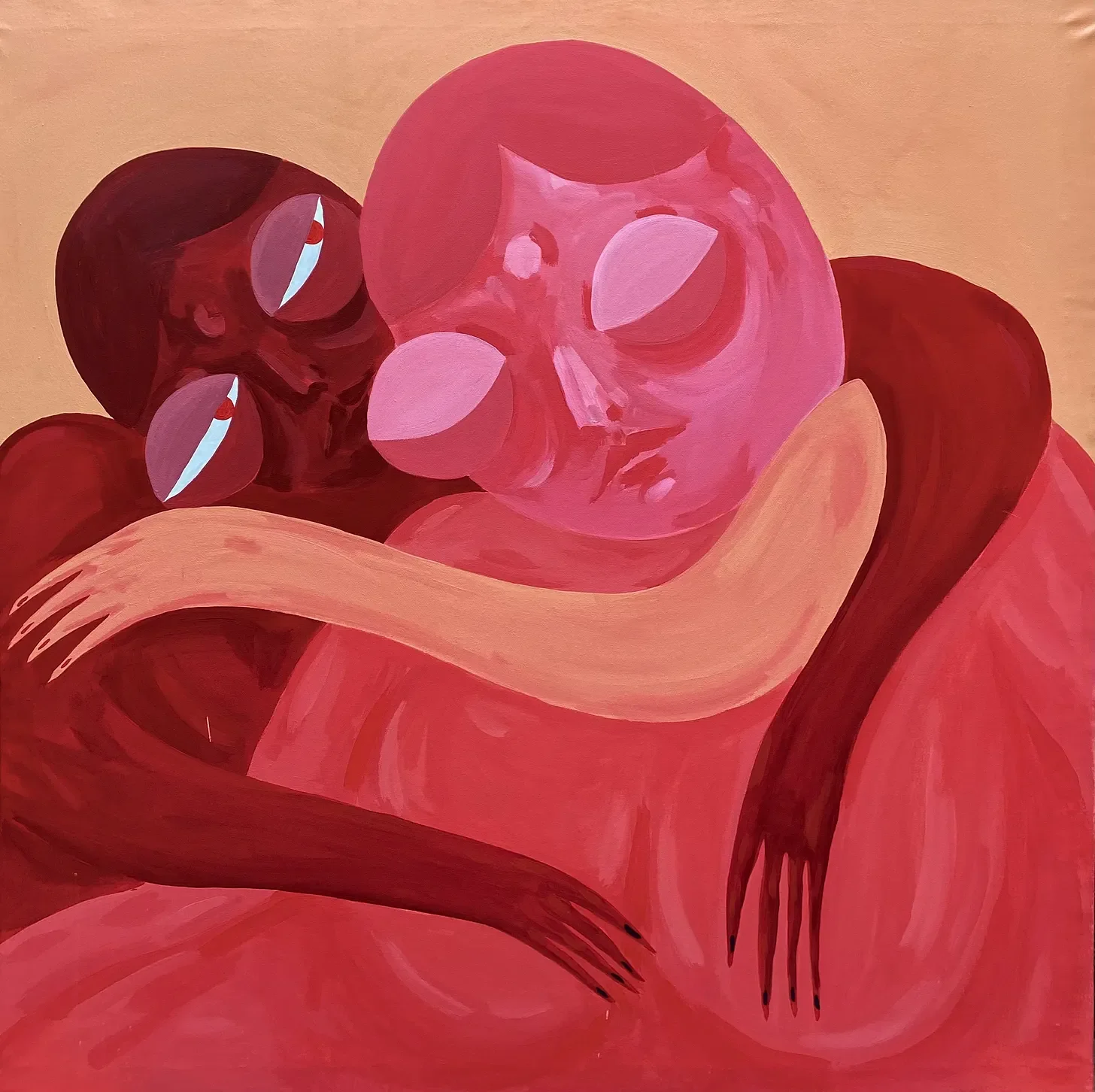
Red is not my favorite color, 2022, Acrylic on canvas
On Refusing the Singular Role
The notion of the full-time artist never fully aligned with Reem Aljeally’s understanding of practice. When asked about a decisive transition into painting, she responded that she did not think such a moment ever occurred. “I don’t think I really had that,” she said. Since 2019, she has been running “The Muse multi studio”, an art organization she founded shortly before the COVID-19 pandemic, alongside her own artistic work.
She described these paths as distinct yet simultaneous. “They’re two different processes, but I’ve been doing them at the same time,” she explained. Rather than viewing this multiplicity as a compromise, Aljeally framed it as a source of fulfillment. She moves fluidly between painting, curation, and organizational work, finding value in each. While she does not identify as a full-time artist, she was clear in asserting that she approaches her practice with seriousness and commitment. “I’m not a full-time artist,” she said, “but I take it very seriously.”
On Constructing a Painted Universe
At the center of Reem Aljeally’s paintings is a recurring female figure she refers to as the Girl with Fat Belly. Viewers often first notice the eyes, followed by the figure’s grounded yet enigmatic presence. For Aljeally, this character functions as the anchor of an imagined world rather than a fixed symbol. She described the process as “a journey of creating her own universe,” one that expands gradually across canvases.
Within this universe, the figure inhabits rooms, landscapes, and ambiguous spaces, accompanied by everyday objects, plants, and often a cat. The scenes are informed by daily life but remain deliberately open. As Aljeally paints, she asks herself intimate, observational questions: “What is she doing today? Where is she going? What is she feeling?” The work does not seek to resolve these questions. Instead, it allows them to coexist. She emphasized that the process is not about explanation or justification, stating that “it’s not even why,” but rather about “just letting her exist however it’s like.”
Themes of comfort, contemplation, and companionship recur throughout the work, alongside a quiet attention to the attachments formed between people, objects, and environments.
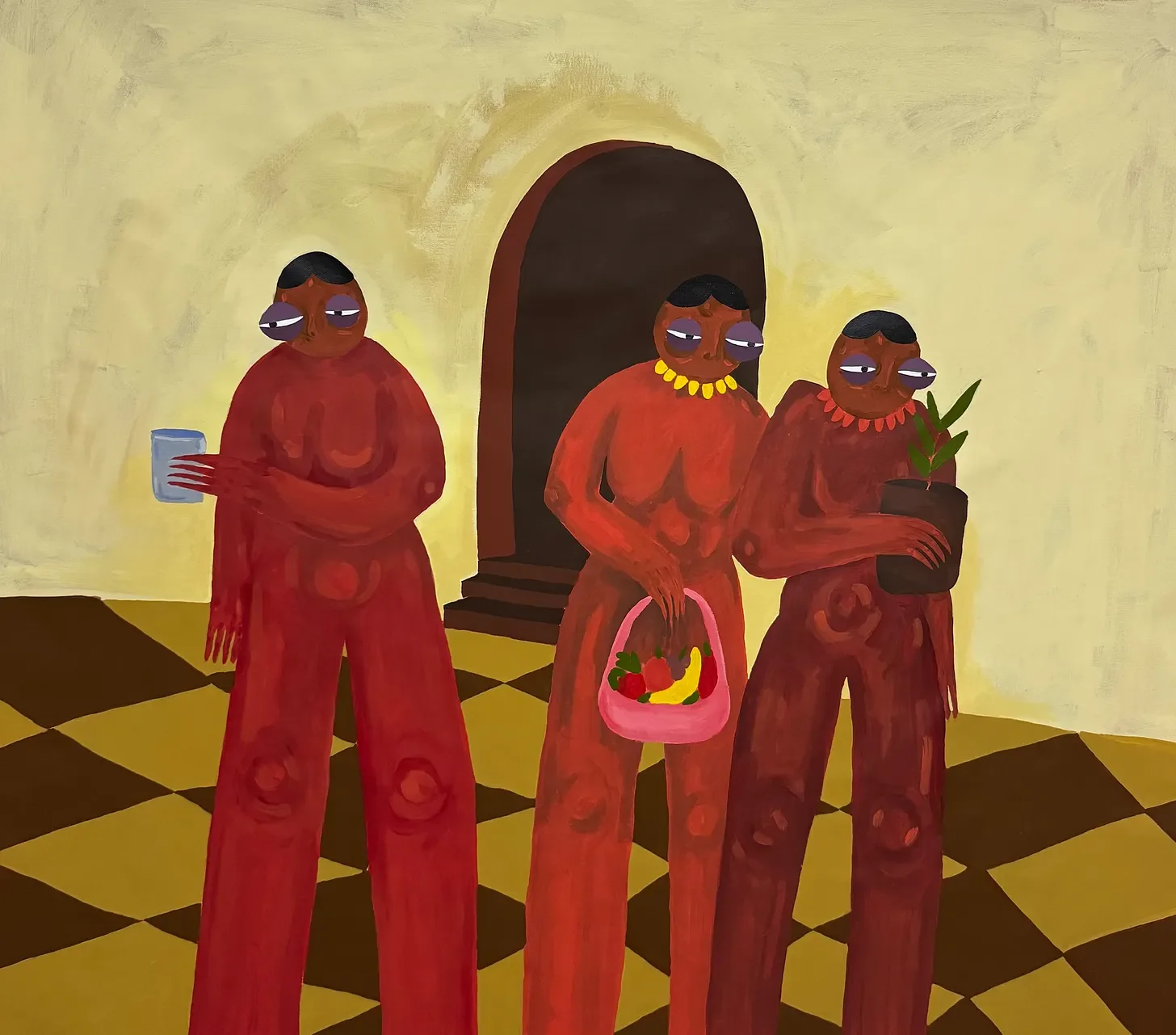
Never show up empty handed, 2025, Acrylic on canvas
On Intuition, Color, and Process
Reem Aljeally’s working process resists prescription. Sometimes she sketches before painting, particularly when time is limited. At other moments, she begins directly on the canvas. Even when she plans, she allows the work to shift direction. She explained that she might begin with a clear idea, only to “plan out a painting and then halfway just change the entire composition.”
Color emerges through intuition rather than premeditation. “With colors, it’s never like that,” she said. “The color is just within the canvas.” Her palette leans heavily toward warmer tones, particularly reds, pinks, and oranges. Red holds a specific intensity for her, which she described as unavoidable. “To me, it’s very confronting,” she said. “You cannot escape it. You have to look at it.”
On Painting From a Dream
One work, Mediterranean Dream Swim, stood out to Reem Aljeally as an exception in both process and palette. The painting emerged from a dream and unfolded with unusual clarity. She recalled that it “turned out exactly how I saw it in my head, or what I remembered of the dream.”
The surprise lay in the dominance of blue, a color she openly dislikes. “Ironically, I do not like the color blue,” she admitted. Yet the painting centers on the figure swimming through blue water, surrounded by elements that disrupt realism. Floating oranges, misplaced birds, and improbable spatial relationships create a sense of dislocation. For Aljeally, coherence was never the goal. She acknowledged that “the painting itself wouldn’t make sense,” but emphasized that “the kind of feeling I would like to put there, that would be the focus for me.”
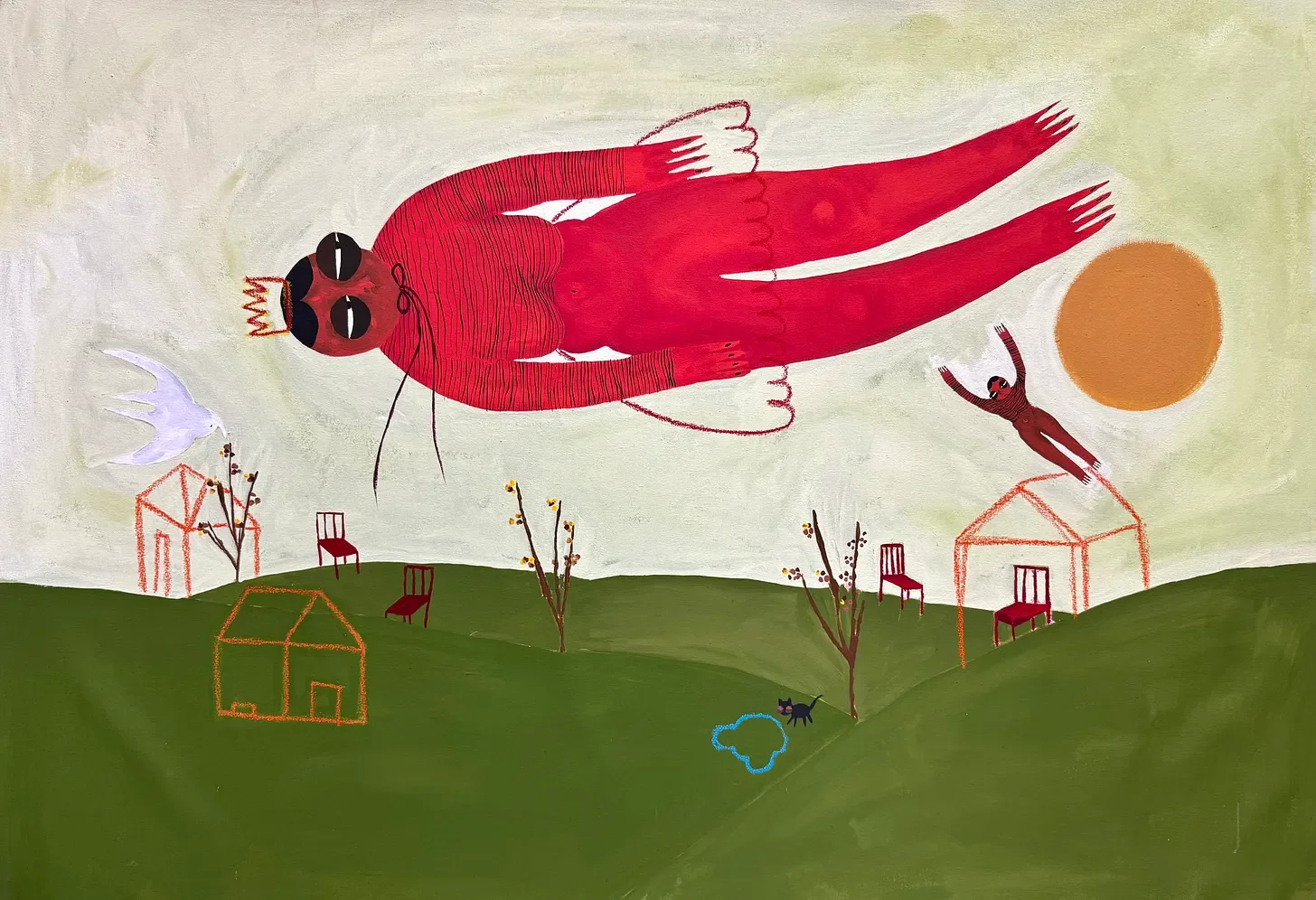
The Urge to Fly to the Sun, 2025, Acrylic on canvas
On Being Exhibited From a Distance
Reem Aljeally has participated in numerous exhibitions, many of them international, often without being physically present. While she values the exposure and dialogue these exhibitions create, she noted the limitations of absence. “Some exhibitions you can attend, and others you’re not able to,” she said, adding that when she cannot be present, “you’re not part of the experience.”
Audience responses often reach her indirectly, through messages and social media. She described these interpretations as both engaging and, at times, frustrating, but ultimately necessary. “It’s not the artist’s responsibility,” she said, acknowledging that meaning is co-produced by viewers.
One interaction, however, resonated deeply. At an art fair in Moscow, a visitor posed with her mother in front of one of Aljeally’s paintings depicting two women holding each other. The photograph was later sent to her. She described the moment as “very beautiful, honestly,” noting that the visitors “actually made the effort to send me the photo and look me up.”
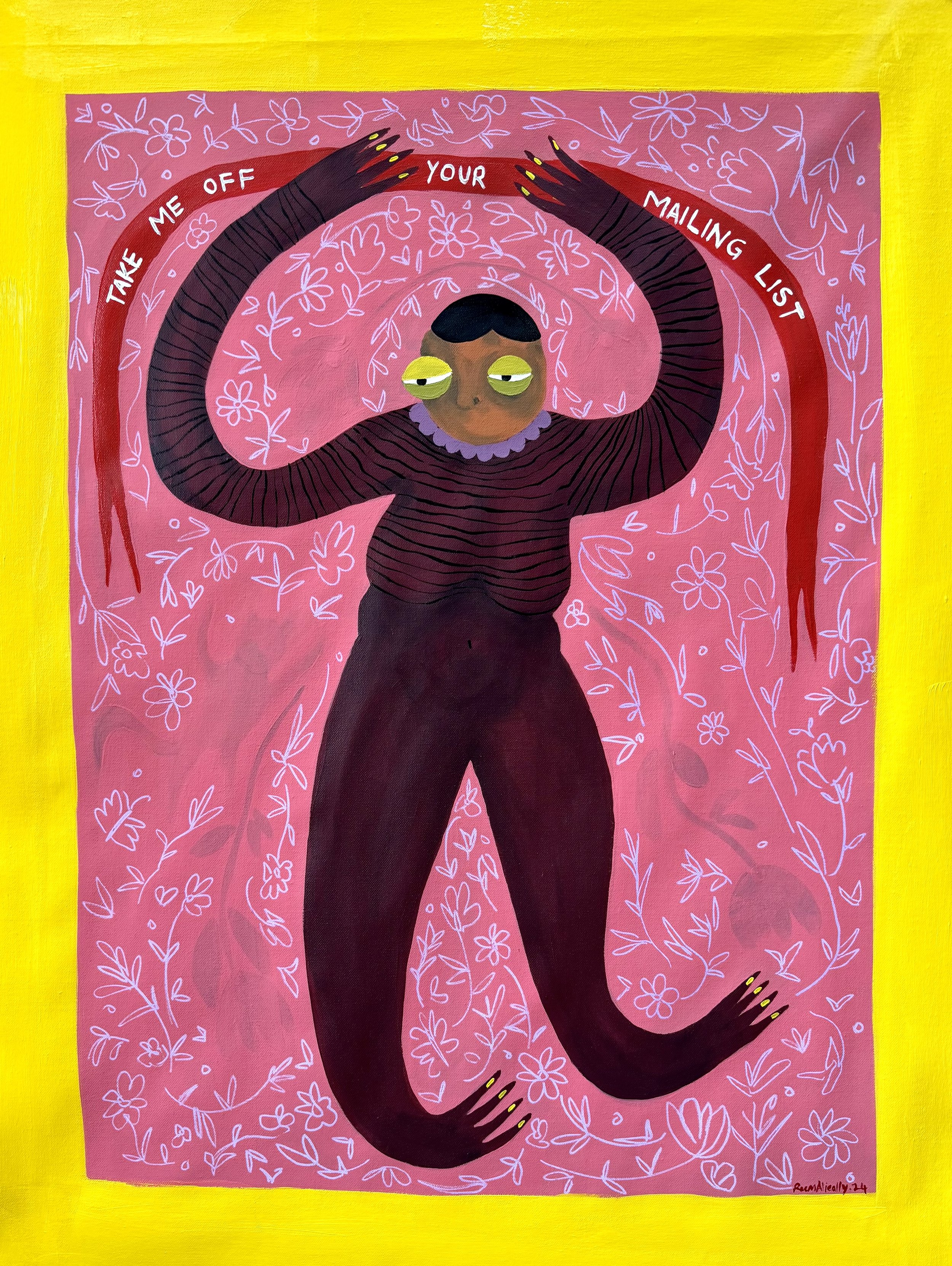
Take Me Off Your Mailing List, 2025
On Displacement and the Expansion of Space
Reem Aljeally’s recent work reflects a period of transition shaped by displacement. After leaving Sudan and relocating to Egypt due to the war, her environment changed dramatically. She explained that this shift “has shifted a lot in my environment and my way of life,” and that the impact has been visible in her paintings.
The enclosed, intimate interiors that once defined her work have gradually given way to open, undefined spaces. She observed that her central figure is “shifting from her existence in enclosed, intimate indoor spaces into the outdoors.” These new environments are often detached from time and place, described by Aljeally as landscapes and natural settings that “do not feel real.” This movement outward was not planned, but emerged organically through lived experience.
On Memory, Inheritance, and Accumulation
When asked about inheritance and transmission, Reem Aljeally framed her response around memory rather than explicit reference. “A lot of the elements I put within the paintings are of things that I have seen, I have remembered,” she said. Stories, observations, and fragments of daily life accumulate internally before resurfacing visually.
Some works draw from old photographs or from Sudanese histories, particularly practices shared between women. Living outside Sudan has intensified this relationship to memory. She reflected that having lived her entire life in Sudan means that it remains present within her work, stating that “that’s an entire life that I keep bringing into my present.”
Even recurring motifs that appear personal, such as the cat that often appears in her paintings, operate symbolically rather than autobiographically. Although she does not have a cat and is afraid of them, she noted that “there is a resemblance to something that exists within the symbolism,” rather than a literal translation of her life.
On Continuing as Necessity
When asked what it means to continue creating as a Sudanese artist in the current moment, Reem Aljeally’s response was measured and resolute. She described creation as both necessity and responsibility. “That’s the only thing I can do at the moment,” she said, referring to painting as well as her broader work through Muse Multistudios.
For Aljeally, continuing to work is a way of sustaining presence. She articulated this simply, stating that it is “one way to keep Sudan alive” and “to remind people of what is happening.” The interview concluded not with closure, but with openness. Like her work, the conversation remained unfinished, shaped by attentiveness, care, and the refusal to disengage.
Images Courtesy of the Artist.
Words Copyright of Naso Art Journal
