
Amina Yahia
On Ritual, Resistance, and the Body in Suspension
Written by Soraya
Cairo, Memory, and the Formation of a Visual Language
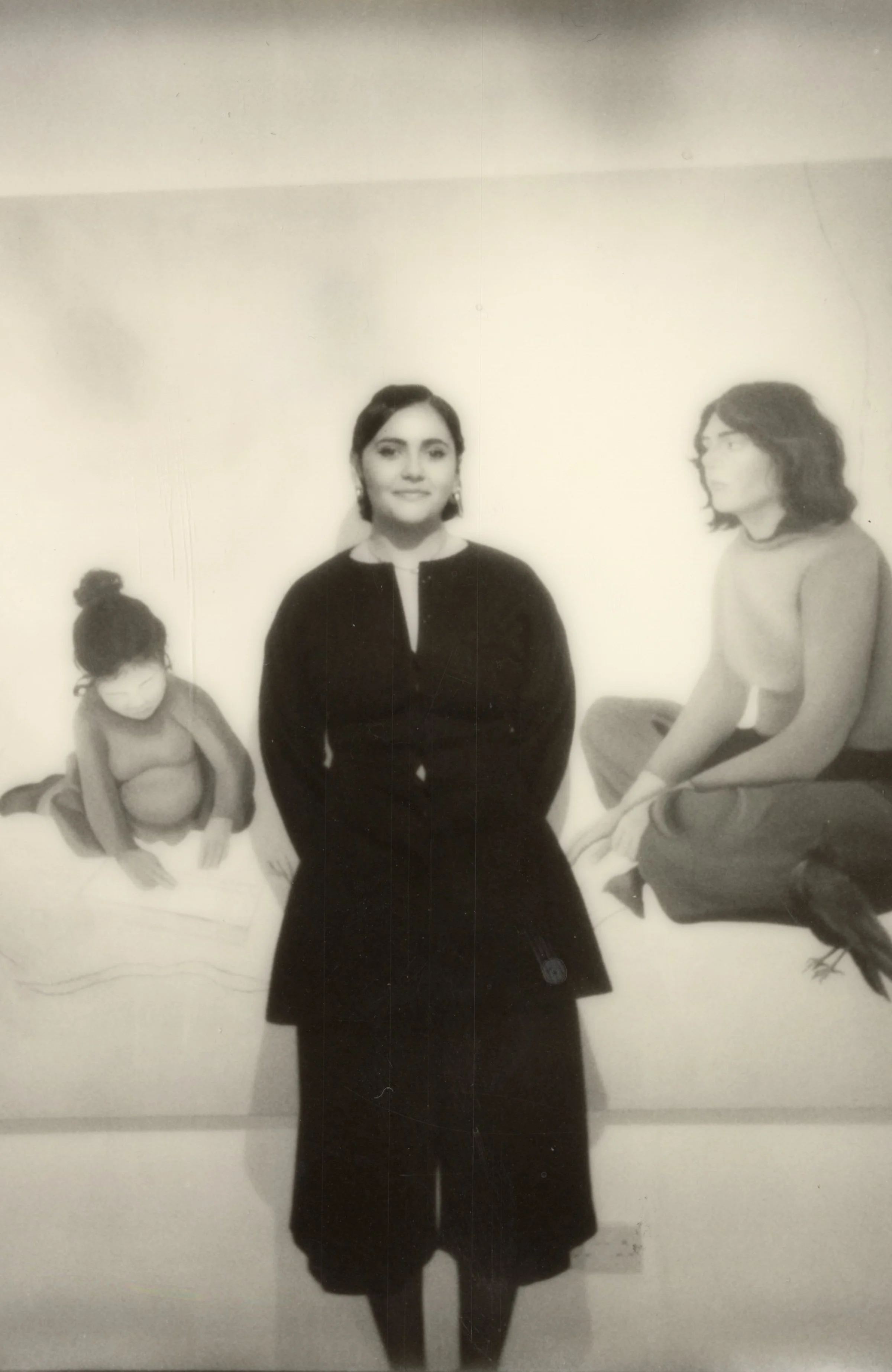
Amina’s practice is grounded in observation, shaped by the density of life in Cairo where the body becomes both subject and source. The city operates not as a passive setting but as an active generator of form, where gestures, proximities, and social interactions are continuously absorbed into her visual language. As she reflects, “The way people hold their bodies and interact with one another is where I draw my figures from.” Her figures emerge from this interplay between the immediacy of the street and the persistence of memory, particularly domestic environments that carry inherited rituals and cultural codes. These spaces reappear not as fixed narratives but as shifting frameworks through which broader social realities are negotiated.
Her commitment to art developed at a moment of uncertainty rather than clarity, just before entering university, when she had “yet to know anything about the art world.” This origin continues to inform a practice that resists institutional rigidity, remaining instead closely tied to lived experience. Identity, for Amina, is inseparable from production. Questions of gender, class, language, and belonging to the Global South are not external themes but embedded conditions that structure both her perspective and her method. These influences extend into more intangible realms as well, including belief systems rooted in spirituality, dreams, and unseen worlds, all of which permeate her compositions in subtle but persistent ways.
Ritual, Power, and the Politics of Collective Life
A central thread in Amina’s work is her sustained inquiry into collective behavior, particularly forms of celebration and ritual. This interest was catalyzed by a personal image - her grandmother performing with a flower-adorned hula hoop - which led her to reflect on the continuity of movement across generations. “The ways in which we move our bodies during celebration… are cyclical in nature,” she notes, identifying in these gestures a persistence that transcends temporal boundaries. What initially appears as repetition gradually reveals itself as a form of cultural preservation, one that approaches the structure of prayer.
However, Amina complicates the notion of celebration as a universal or neutral experience. She positions it as deeply stratified, shaped by class, geography, and access to space. The aesthetics of celebration - gesture, dress, scale, and sound - shift depending on who is participating and under what conditions. “What is perceived as ‘civil’ celebration often corresponds to particular markers of status,” she observes, pointing to the ways in which joy itself is regulated through social hierarchies. In this context, celebration becomes a site where power is both enacted and made visible. The state, too, is implicated in this process, defining the boundaries of permissible gathering and determining which forms of assembly are sanctioned or suppressed. Through this lens, ritual is not merely cultural but political, revealing the structures that govern collective life.
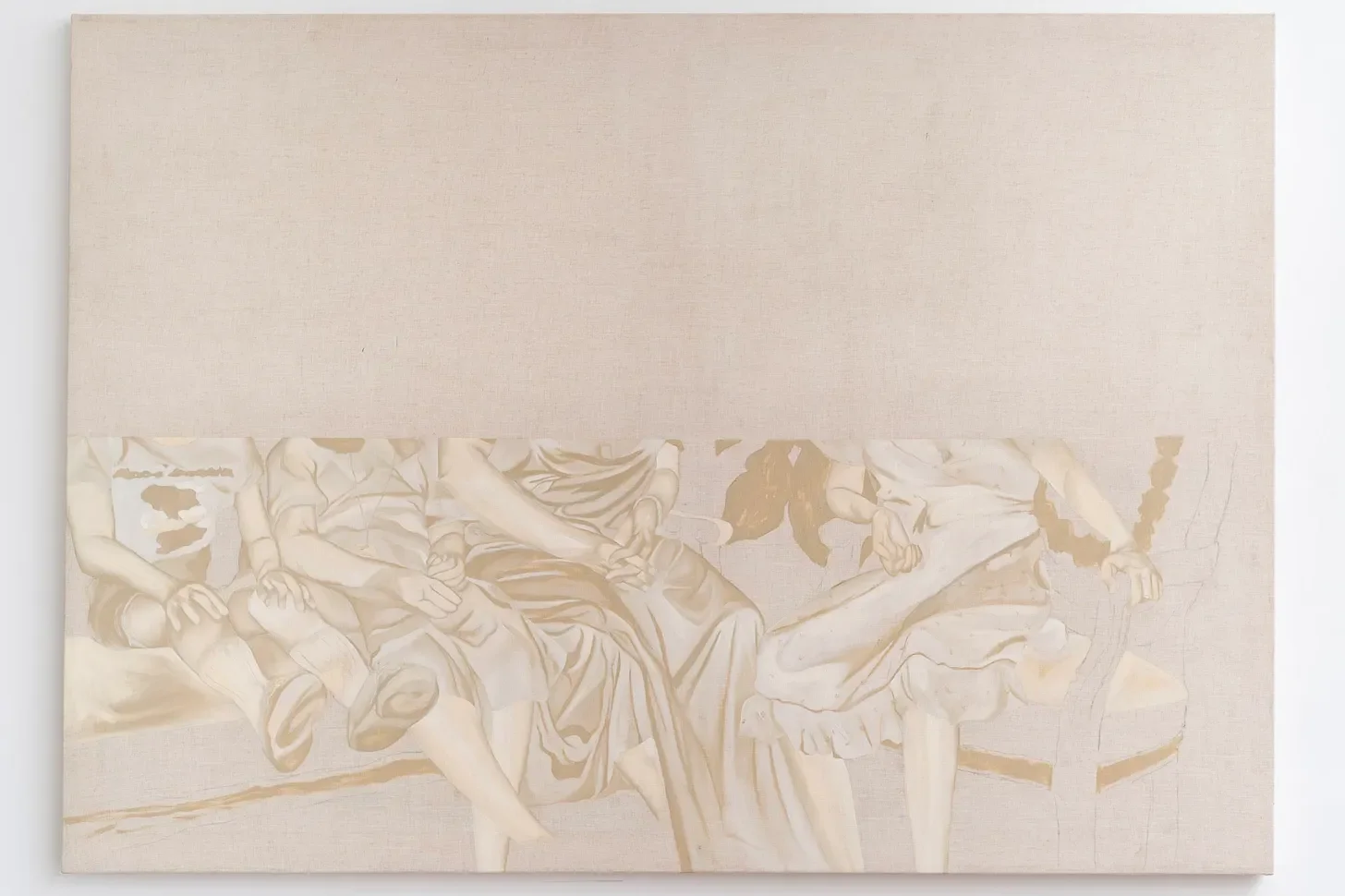
عرايس ('Arayes), 2022 - Oil on Linen - 142 x 199 cm
The Body: Scale, Fragmentation, and Subversion
The body occupies a central position in Amina’s work, functioning as both a site of intimacy and a terrain of control. Her use of large-scale compositions transforms the act of viewing into a physical encounter, where the viewer must navigate the work rather than observe it from a distance. “Once a painting exceeds the body’s proportions, it requires physical navigation rather than detached viewing,” she explains. This spatial engagement implicates the viewer, producing a heightened sense of proximity that borders on confrontation. The encounter becomes not only visual but embodied, carrying what she describes as an almost religious intensity.
At the same time, the body is frequently destabilized through fragmentation and suspension. In works such as Te’rafy? (2021), the disassembled figure becomes a means of addressing the surveillance and regulation of women’s bodies within contemporary Egyptian society. “A visual manifestation of the dissection and surveillance of women’s bodies,” she notes, linking formal rupture to social conditions of scrutiny and control. The fragmentation evokes a sense of precarity, reinforced through the notion of the “glitch,” a visual interruption that mirrors the instability imposed on these bodies.
Alongside this tension, Amina employs satire as a subtle but pointed form of resistance. “I use satire as a subversive tool… Humor does not neutralize violence; rather, it unsettles its authority,” she states. Through figures such as a crow acting as trickster - stealing something trivial from the elite - she introduces moments of irony that destabilize structures of power without direct confrontation. These gestures operate obliquely, allowing critique to emerge through nuance rather than declaration.
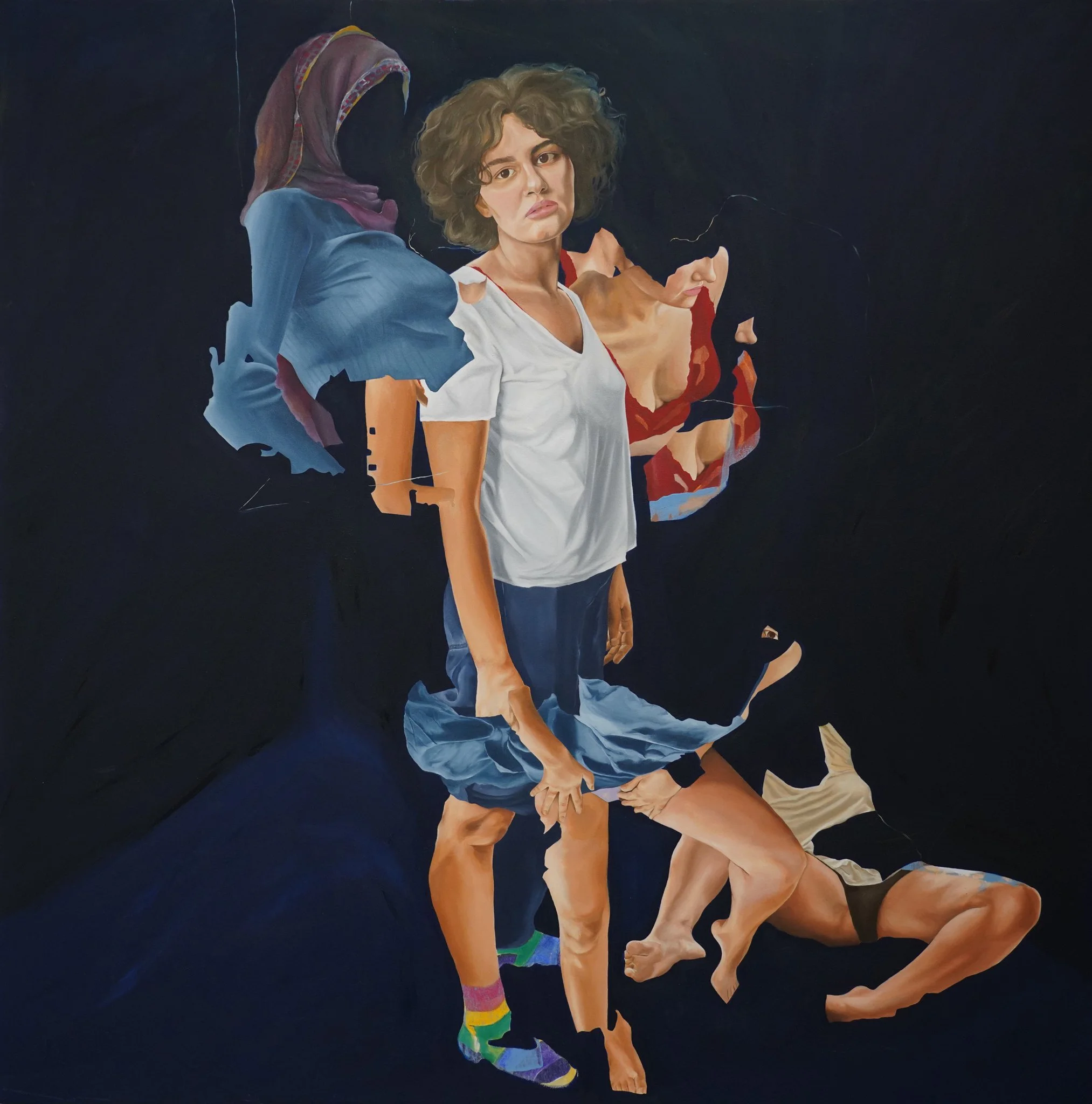
Te’rafy?, 2021 - Oil on Canvas - 150x150cm
Atmosphere, Suspension, and the Refusal of Closure
Amina’s recent work reflects a shift in atmosphere that parallels both personal and global conditions. The transition toward lighter, washed-out palettes marks a departure from earlier tonal density, functioning as an emotional register of instability and precarity. “This shift… reflects a direct response to the precarity of the world around me,” she explains, situating aesthetic change within a broader socio-political context. Color, in this sense, becomes less a formal decision than a manifestation of lived experience.
Her figures often exist in states of suspension, neither fully grounded nor entirely liberated. Traditional spatial logic gives way to psychological weight, as she prioritizes interior states over architectural coherence. “A traditional linear perspective frequently feels inadequate for the worlds I am trying to illustrate,” she notes, emphasizing the limitations of conventional representation. This in-between condition becomes a defining aspect of her visual language, reflecting both dream logic and the instability of contemporary existence.
Despite the density of references and themes, Amina resists prescribing interpretation. “I never really want the audience to think or feel a certain way… I just hope it makes them feel something,” she states. The work remains open, refusing closure and allowing meaning to emerge through encounter rather than instruction. What lingers is not a fixed message but a sustained affect, an unresolved presence that continues to resonate beyond the moment of viewing.
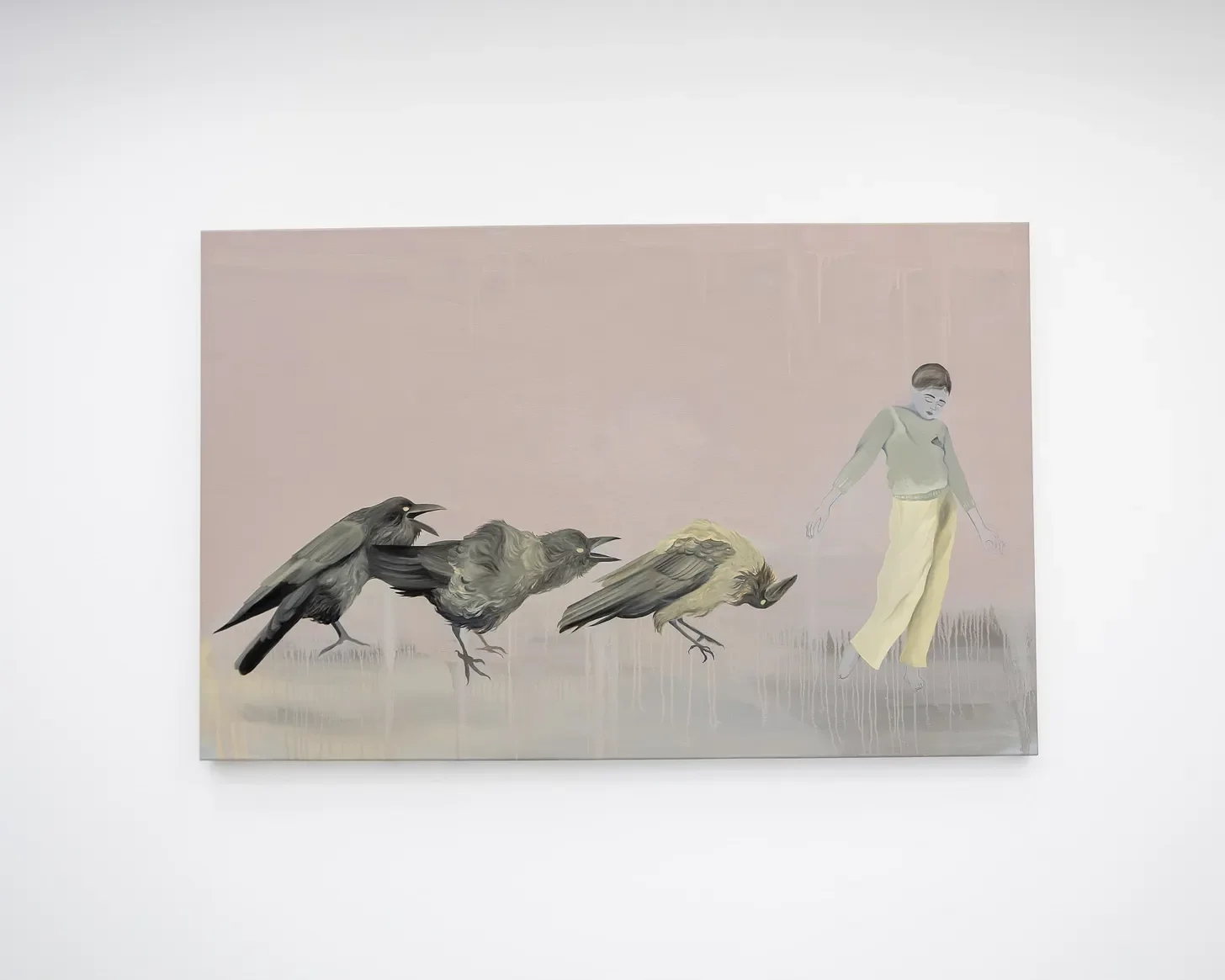
ياغراب، انت زعلان مني؟ (oh crow, are you upset with me?), 2025 - Oil on canvas
Images Courtesy of the Artist.
The full interview is exclusively in print, Issue 3.
Words Copyright of Naso Art Journal
