
Bady Dalloul
On Inventing Badland
Written by Soraya
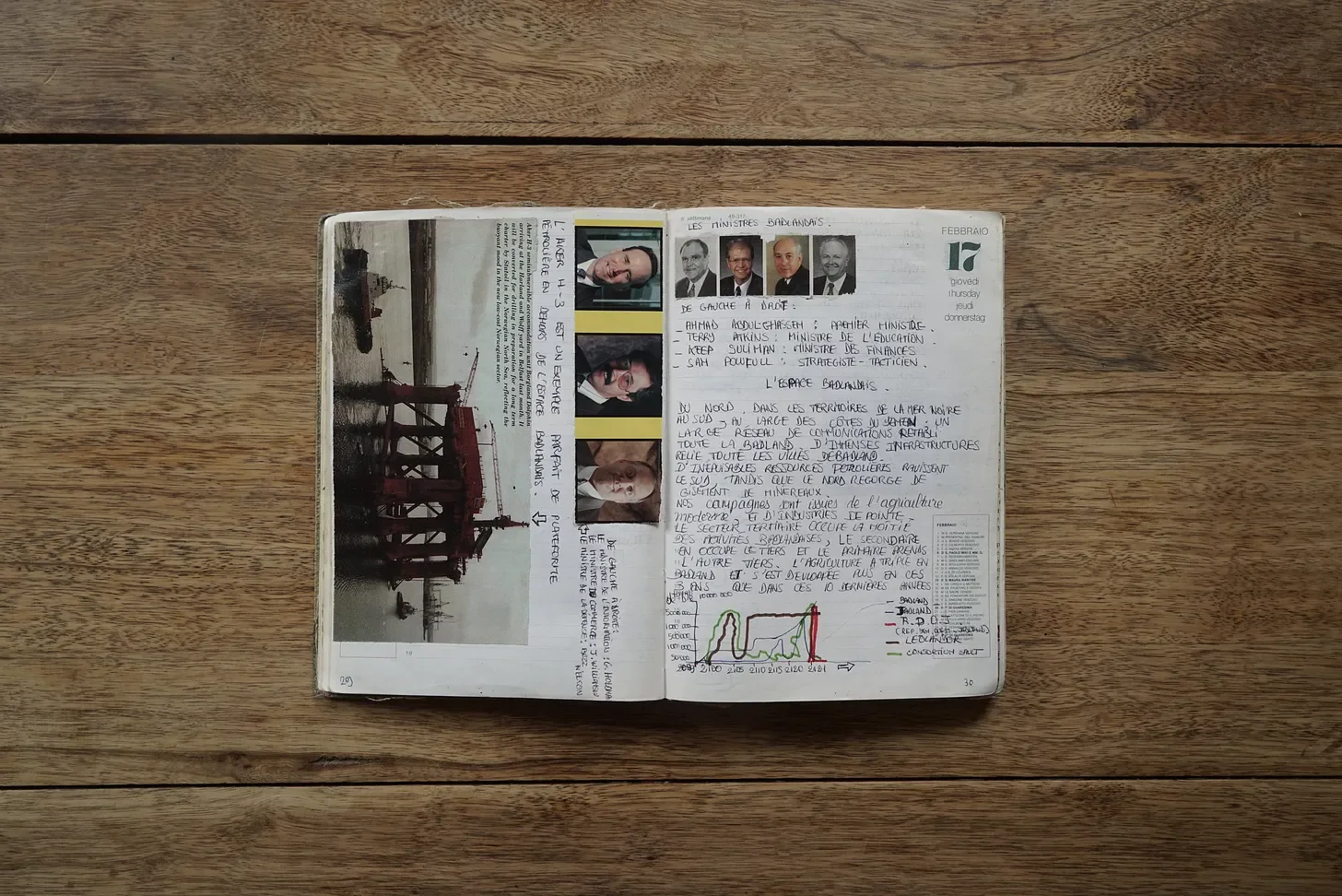
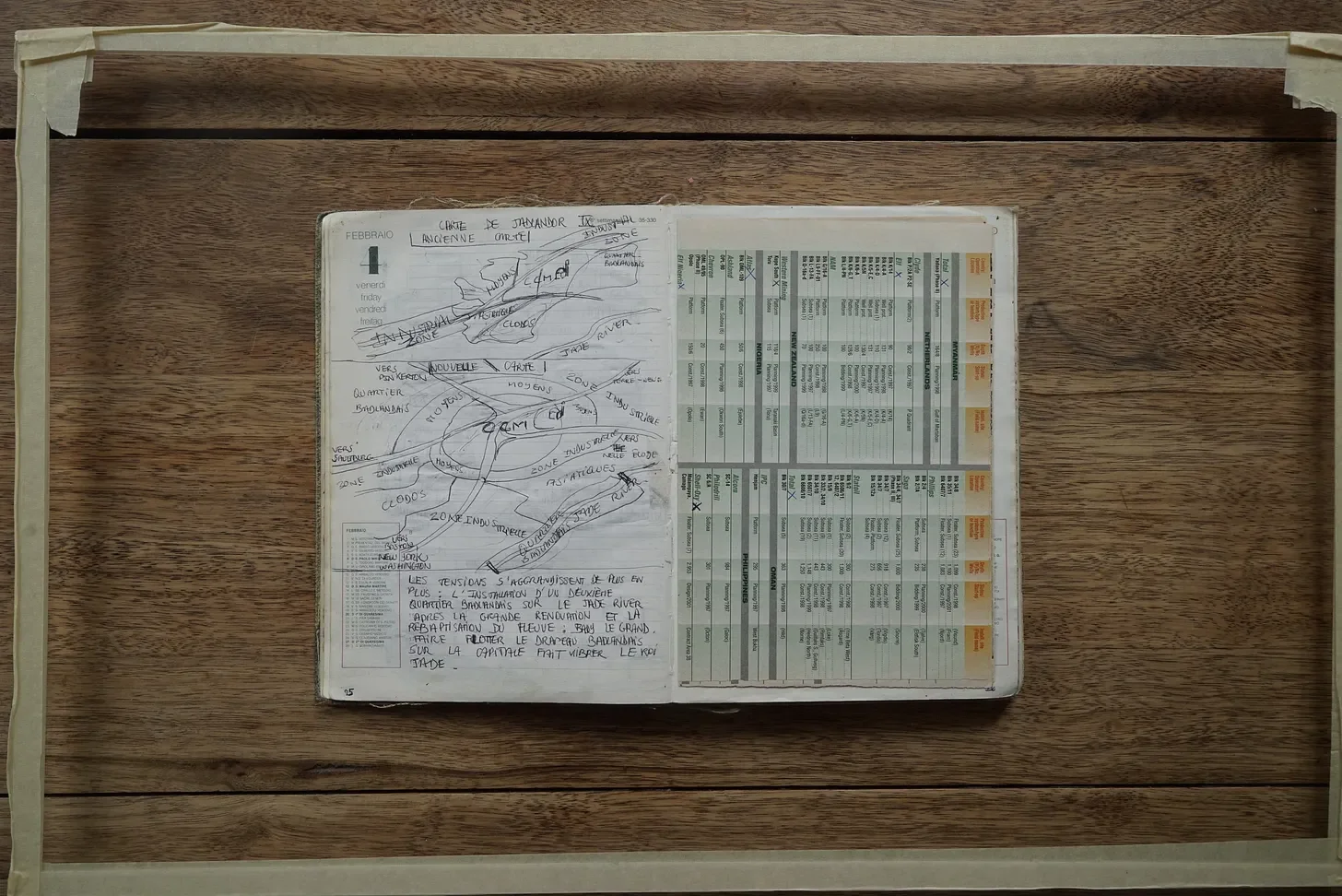
Bady Dalloul traces the origins of his artistic practice not to formal training, but to childhood games invented alongside his younger brother, Jad. Born and raised in Paris to Syrian parents, the two brothers spent their summers in Damascus, where long days indoors became fertile ground for imagination. “We found notebooks belonging to my grandfather,” Dalloul recalls, describing the leather-bound books that became the foundation for entire fictional nations. His brother ruled over “Jadland,” while Dalloul — still unable to properly speak English at the time — named his own kingdom “Badland.”
The notebooks evolved into elaborate systems of invented geographies, military structures, government officials, and fabricated histories. Filled with maps, graphs, stamps, television schedules, and collaged portraits of powerful-looking men clipped from magazines, the books became a means of constructing order and authority. Looking back now, Dalloul recognizes how these visual codes reflected inherited notions of legitimacy and power. “We were choosing elements that looked serious to us,” he says, “without understanding really what it means.”
What began as play gradually became methodology. Even after his brother lost interest, Dalloul continued filling notebooks obsessively, collecting images and constructing alternative realities. Yet it was not until entering the École des Beaux-Arts de Paris years later that he realized these childhood gestures became the foundation of a serious artistic practice. “I found out that this was, in fact, something that I was developing in a more serious way,” he reflects.
‘Badland’
Archives of Displacement
Books remain central to Dalloul’s practice today, functioning simultaneously as archives, fictional worlds, and political reflections. One of the artist’s earliest major works, Discussion Between Gentlemen, depicts anonymous hands repeatedly drawing and erasing fictional borders across a map of the Near East from the 1920s. As the lines accumulate and disappear, the paper itself begins to erode. “Drawing and erasing these borders are just destroying the map eventually,” he explains.
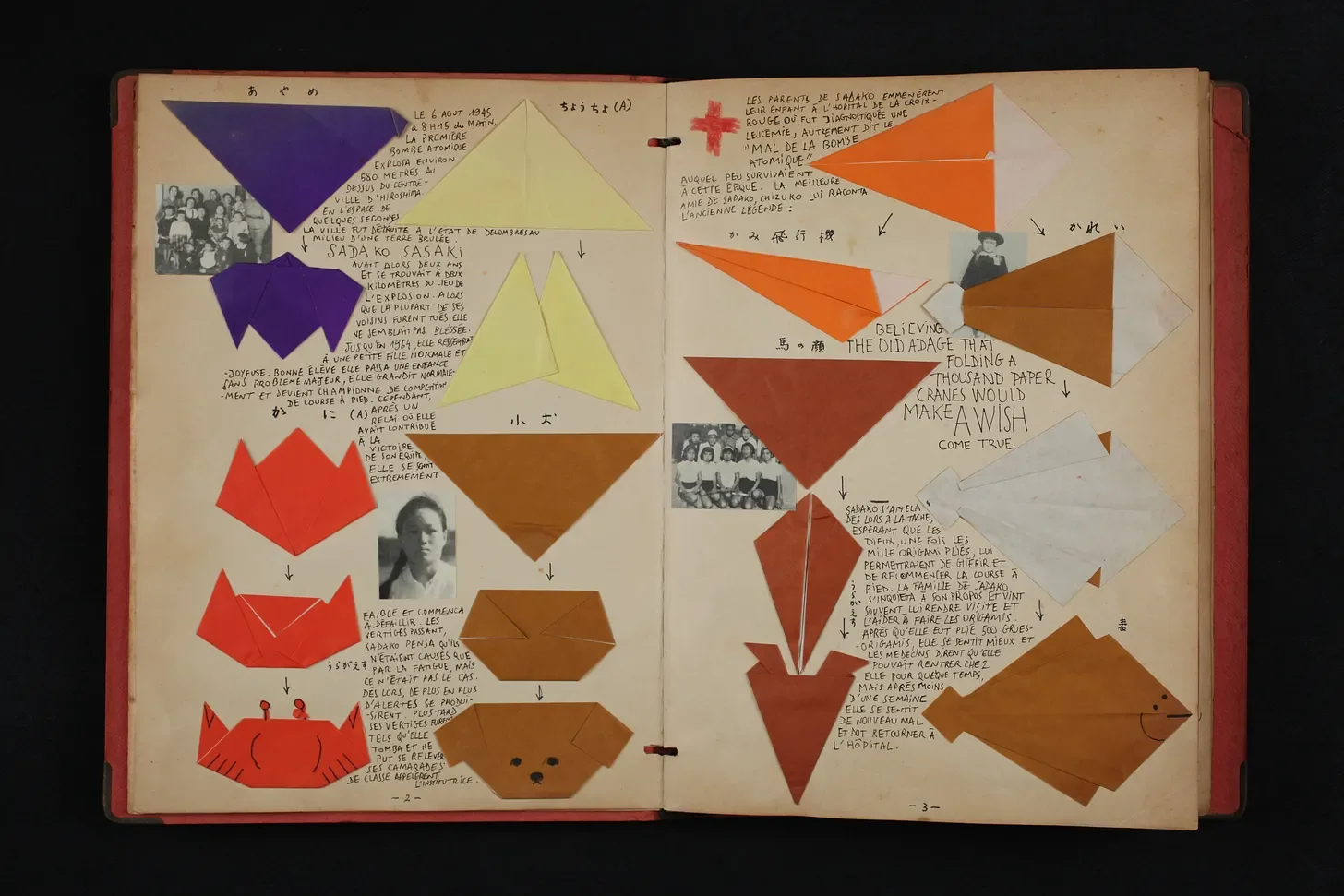
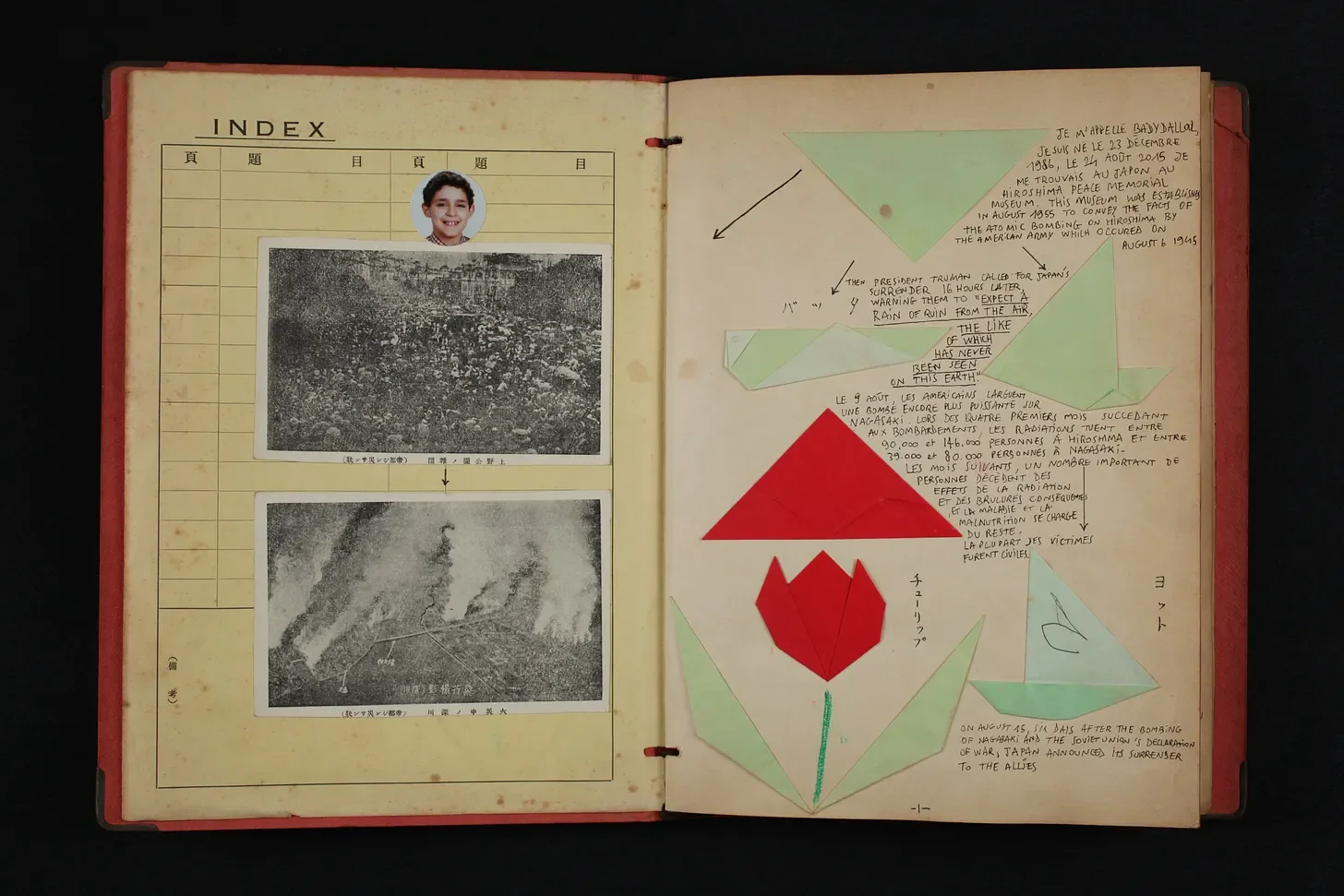
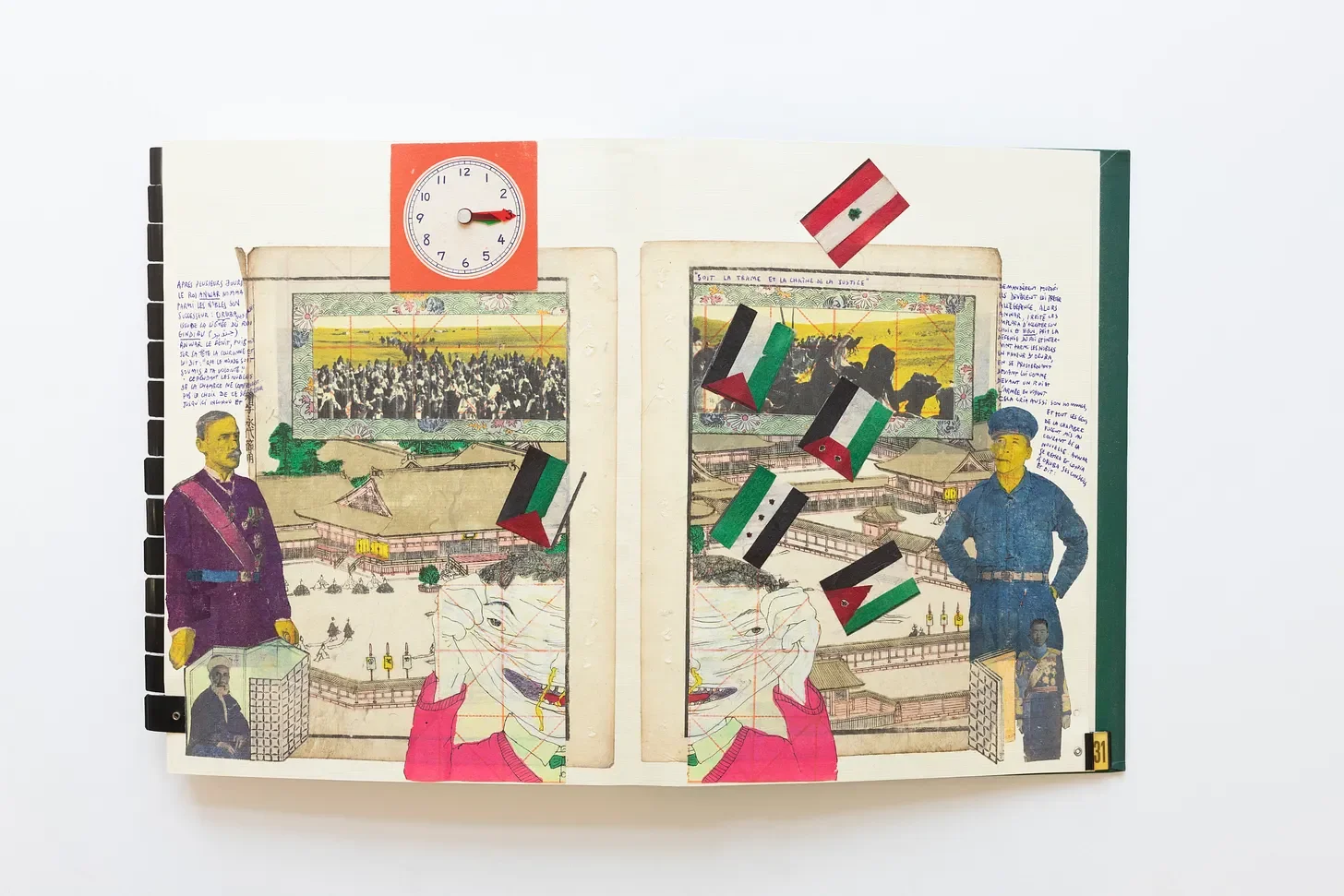
This concern with historical fragmentation deepened through Scrapbook, a monumental artist book composed of collages, found objects, writing, and hundreds of hand-folded origami cranes. Created after Dalloul’s travels to Japan and a transformative visit to Hiroshima, the work emerged from the story of Sadako Sasaki, the young girl who famously folded paper cranes while resisting from radiation sickness after the atomic bombing. Dalloul imagines her surviving into the present day and becoming a witness to the histories of the Levant. “She becomes the entry point,” he says, “the first-person viewer of the story of the Near East.”
Throughout the book, parallels emerge between Japanese and Middle Eastern histories: the collapse of empires, wars, displacement, surrender, and state formation. Dalloul juxtaposes archival imagery from Hiroshima alongside the Arab-Israeli wars, Syrian refugees, and environmental catastrophes in Japan, constructing unexpected visual echoes between geographically distant histories. “Children are always the victims of war,” he reflects, describing how the book ultimately centers those most vulnerable to political violence.
‘Scrapbook’
Fictional Kingdoms and Fragmented Worlds
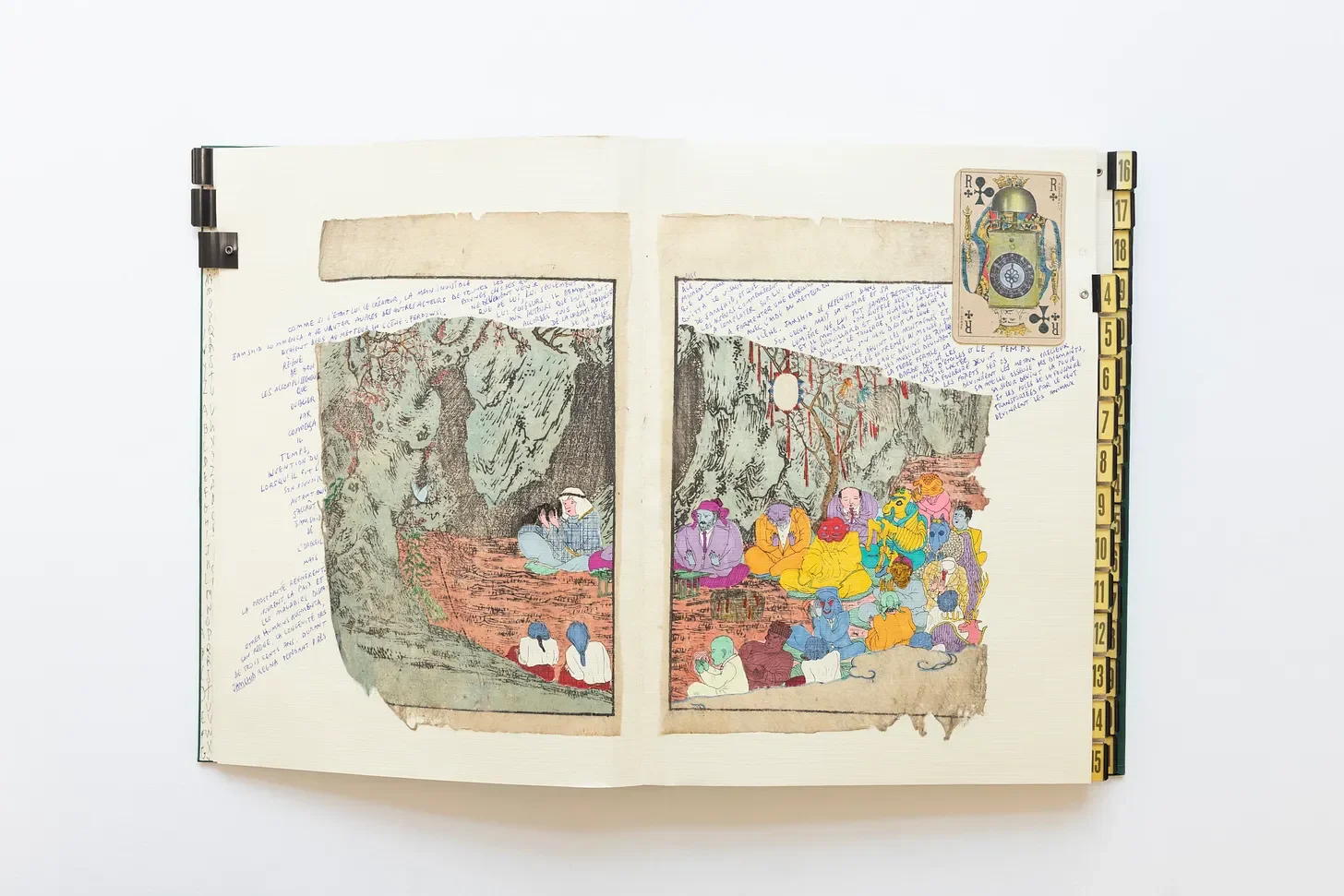
The logic of imagined nations and collapsing identities continues across Dalloul’s wider body of work. In Ordonator, an altered accountant’s ledger transformed into an epic narrative, Dalloul constructs an invented mythology where “the country is my room.” Drawing from sources as varied as Babylonian history, the Shahnama, Japanese culture, Greek mythology, Audrey Hepburn films, and Iraqi political history, the book assembles a fractured cosmology populated by heroes, neighboring territories, and shifting allegiances. “The heroes of the room fight the people of the next room,” he explains, describing the absurd intimacy through which identities are formed.
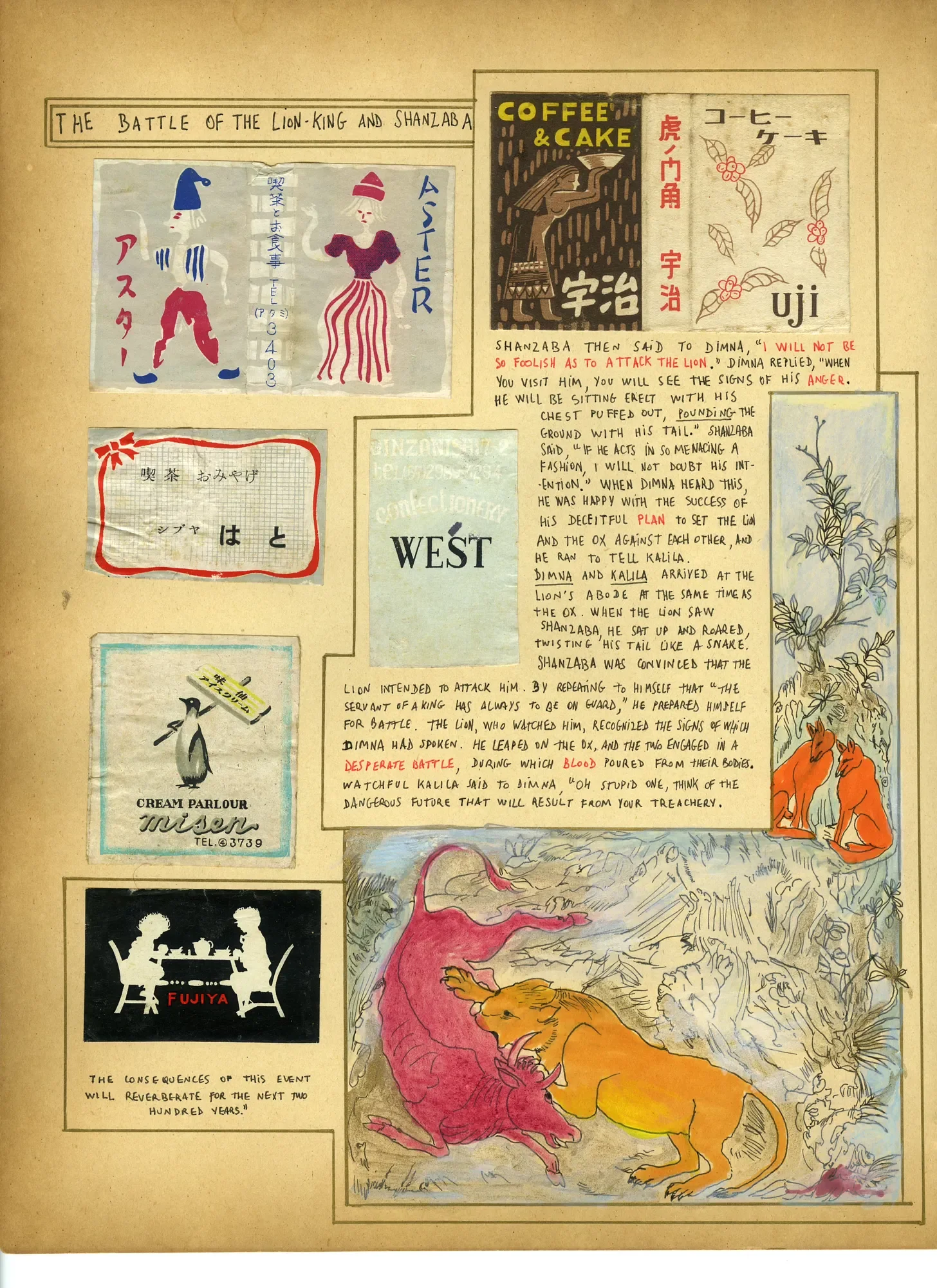
This strategy of retaining narrative structures while replacing their internal elements also appears in Dalloul’s reinterpretation of Kalila wa Dimna. Revisiting the ancient collection of animal fables through a contemporary lens, he became fascinated by the way the stories themselves historically shifted depending on who commissioned or retold them. “The structure was always the same somehow,” he explains, “but they replaced the elements within the kept structure.”
For Dalloul, storytelling is therefore never fixed. Histories mutate, migrate, and absorb new realities. The same tale can be continuously rewritten depending on geography, politics, or memory — much like identity itself.On Landscape and a New Visual Field
Drawing the News
Since 2015, Dalloul has also developed an ongoing series of miniature matchbox-sized drawings that now number in the hundreds. Emerging during the height of the Syrian war, the works began as a response to the overwhelming flood of violent media imagery circulating daily. “There was no way to escape it,” he says. Collecting these images became a way of coping with their omnipresence, while redrawing them transformed them into something more intimate and digestible. “It was my way to digest them and make them mine somehow.”
Their small scale is deliberate. Inspired by his childhood fascination with stamps and miniature imagery, Dalloul sees these dimensions as deeply political. “Such a small size can carry imagery or represent a country,” he says. The format forces viewers to physically move closer, isolating them with the image while also mimicking cinematic editing through clusters and sequences of drawings installed together.
Over time, the drawings expanded beyond Syria to encompass broader political and social realities unfolding across the region. Figures from space programs, refugee crises, revolutions, and contemporary geopolitics coexist side by side, linked through Dalloul’s associative visual logic. The works function simultaneously as archives, meditations, and acts of witnessing.
Syria as a State of Mind
Toward the end of our conversation, I ask Dalloul what it means to carry Syrian identity while living between multiple geographies. His answer is hesitant, reflective, and deeply moving. “My Syrianness now more translates into a Syrian accent when I speak Arabic,” he says. Since the outbreak of the Syrian revolution in 2011, Syria has existed less for him as a physical place than as a psychological and emotional condition. “Syria has been a state of mind for many years for me.”
Growing up in Paris before Syria occupied international headlines created, in his words, “a great room for imagination.” Later, his move to Japan in 2021 further transformed this relationship. In Tokyo, removed from the constant projections and assumptions surrounding Middle Eastern identity in Europe, Dalloul found himself able to speak about Syria, Japan, and France with equal intimacy. “I became a bit of a salad bowl,” he says laughing softly, “a mix and match of things today.”
Images Courtesy of the Artist.
The full interview is exclusively in print, Issue 3.
Words Copyright of Naso Art Journal
