
Malak Mattar
On Memories, Compassion, and the Stories that Remain
Written by Nayla
“Medium is only channeling,” she says. “It’s really the story that you tell that matters.”
Malak Mattar’s practice is shaped by an urgent commitment to memory. Across painting, drawing, installation, sculpture, printmaking, and animation, her work returns to the question of how a story can be carried, held, and made visible when the conditions around it are marked by loss.
At the centre of this practice is Gaza, present not only as a site of devastation, but as a place of life, culture, and collective memory.
On Beginning in Gaza
Mattar began painting in Gaza at the age of fourteen, during the 2014 attack. Painting became a way to survive what she was seeing, a means of processing trauma through image and colour when language alone could not hold it.
Just as important were the women around her. Mattar describes growing up in a society where much of daily life was shaped by women: girls’ schools, female teachers, family gatherings, Eid, Ramadan, and domestic spaces filled with female presence.
“Every time I paint a man, it just becomes a woman,” she says, reflecting on how naturally these figures entered her work.
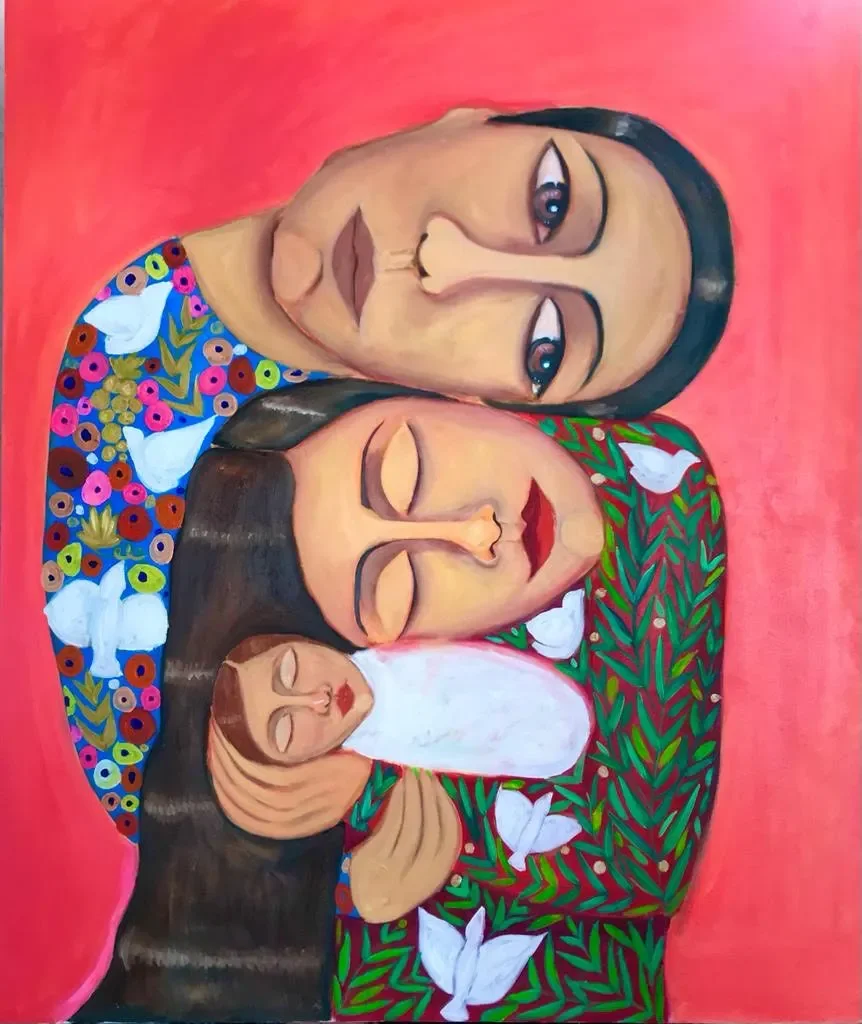
Palestinian family, 2021
On Story, Witness, and Memory
For Mattar, the story is what remains central, regardless of the medium through which it is carried. Painting, installation, video, sculpture, printmaking, and animation become different ways of asking how a story might reach the viewer with greater force.
This sense of responsibility became sharper after October 2023. In a phone call with her father, while he was still in Gaza and she had only recently left, he asked what painting she was making.
Out of this moment came No Words, a large black-and-white painting that she describes as a collective work.
“I’m in the process of grieving the place that I belong to,” she says.
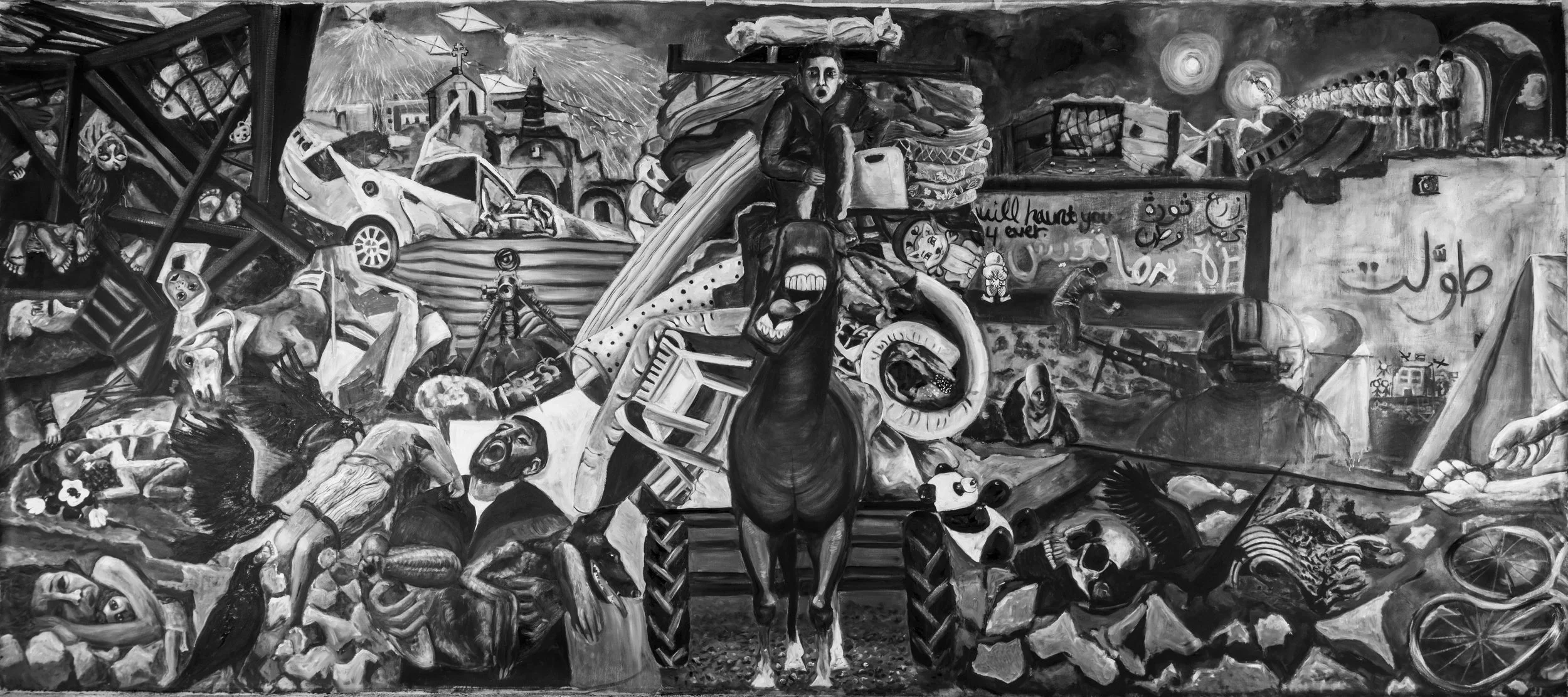
No Words, 2024
On Color and Darkness
Color has long been central to Mattar’s work. For many viewers, her palette became one of the most immediately recognisable aspects of her practice.
After October 2023, however, something changed. People around her remarked on the darkness entering the work.
“This time is shaped by darkness,” she says.
More recently, however, color has begun to re-enter the work. In Gaza is a Phoenix, Mattar brings together monochrome and color.
On Experimentation and the Story
Although painting remains central to Mattar’s practice, her work has expanded across mediums. During and after her master’s degree, she began moving into installation, sculpture, printmaking, and animation.
Painting still holds a particular weight for her. She speaks of canvas as a permanent medium, one that can outlive the human body.
Other mediums offer a different kind of encounter. Installation and video allow Mattar to think through space, duration, movement, and the viewer’s physical relationship to the work.
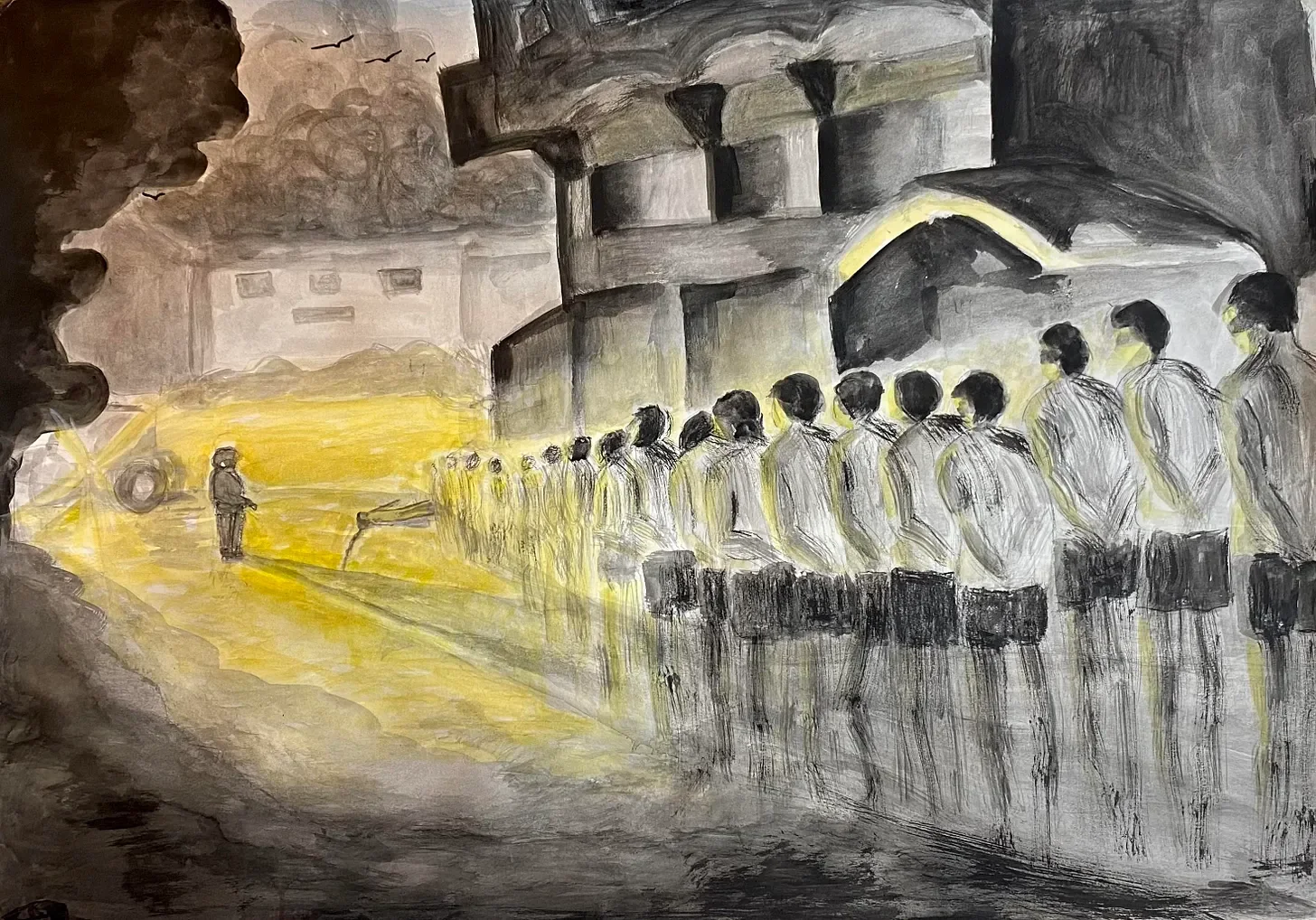
Death Road, 2024
On Compassion
At the centre of Mattar’s current thinking is compassion. She describes it with humility, almost apologetically at first, acknowledging that the word can sound simple.
Yet in her practice, compassion is neither decorative nor sentimental. It is a way of surviving, of relating to oneself, and of being able to remain open to others.
Images Courtesy of the Artist.
The full interview is exclusively in print, Issue 3.
Words Copyright of Naso Art Journal
