
Hicham Benohoud is a photographer who builds what he photographs. For Perchoirs, he had metal structures made that barely stand, and asked villagers to climb them and pose in their everyday clothes. For around thirty years, he says, he has been telling the same story about inequality in Morocco. His work will be shown at Paris Photo November 12-15th, with Gallery L’Atelier 21. Kalina asked him about it.
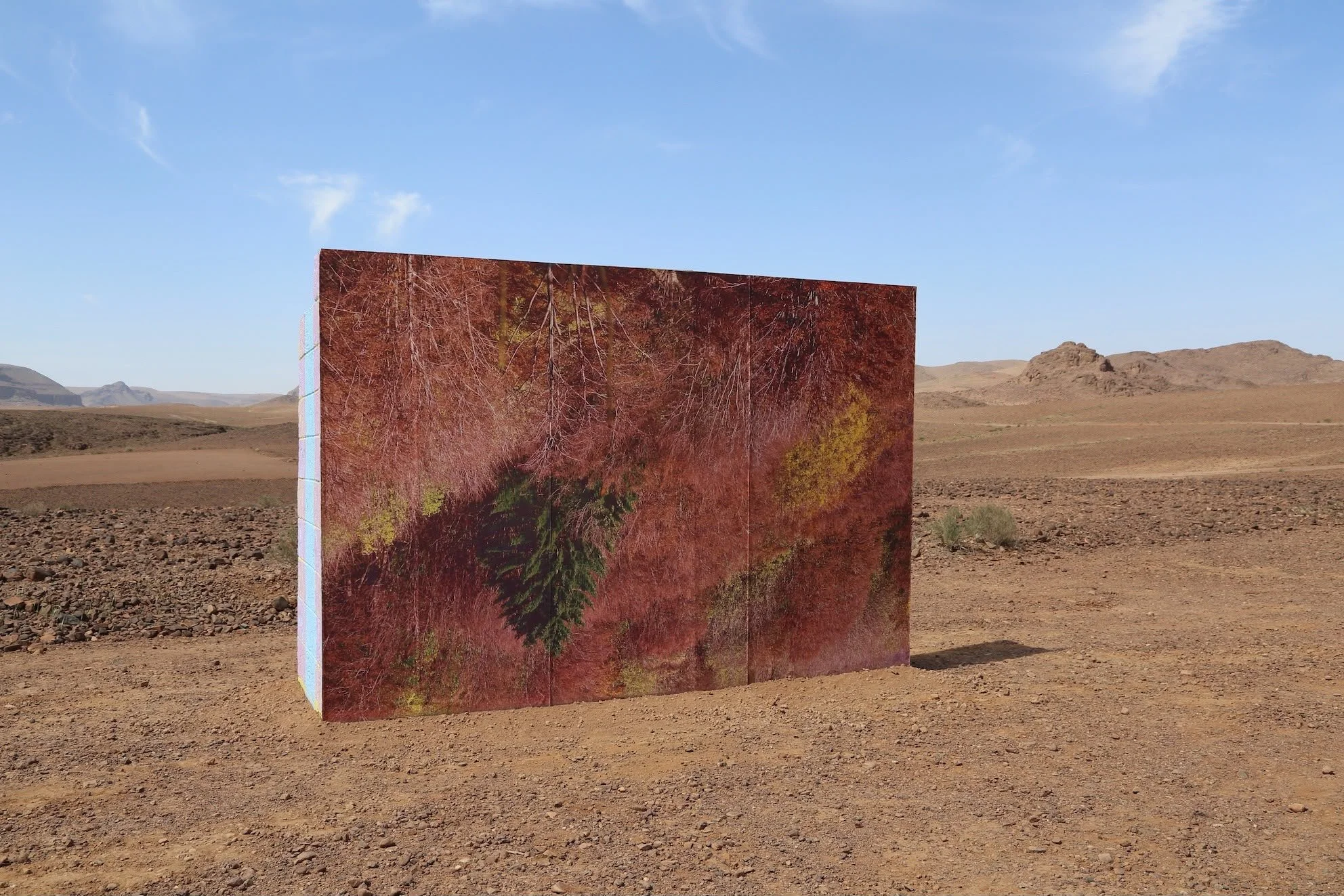
Papier peint #5, 2026
1. You say you photograph what you build. Which comes first, the image in your head or the object?
Form comes last. It is the content that shapes the form, and the form is the result of a long process of research. The idea comes first. For several years, I have felt the need to speak about the precarious conditions faced by people living in remote regions of Morocco. They struggle every day to survive because of drought, a lack of infrastructure, unemployment and other difficulties. These communities are left to fend for themselves. Despite the hardships of daily life, they retain their hope and dignity. They are “still” holding on, in a fragile, precarious and uncertain balance. Building metal structures that barely stand on the ground is my way of telling their stories without resorting to miserabilism.
2. Was there a moment when you stopped thinking of yourself as a photographer whostages things and started thinking of yourself as someone who builds?
I have never stopped being a photographer. The staged scenes and all the constructions Icreate are products of my imagination. Construction is not an end in itself. Sometimes I do not build anything at all. I simply take objects that are close at hand and arrange them differently to express an idea. I might, for example, turn an existing object upside down to give a photograph a different meaning.
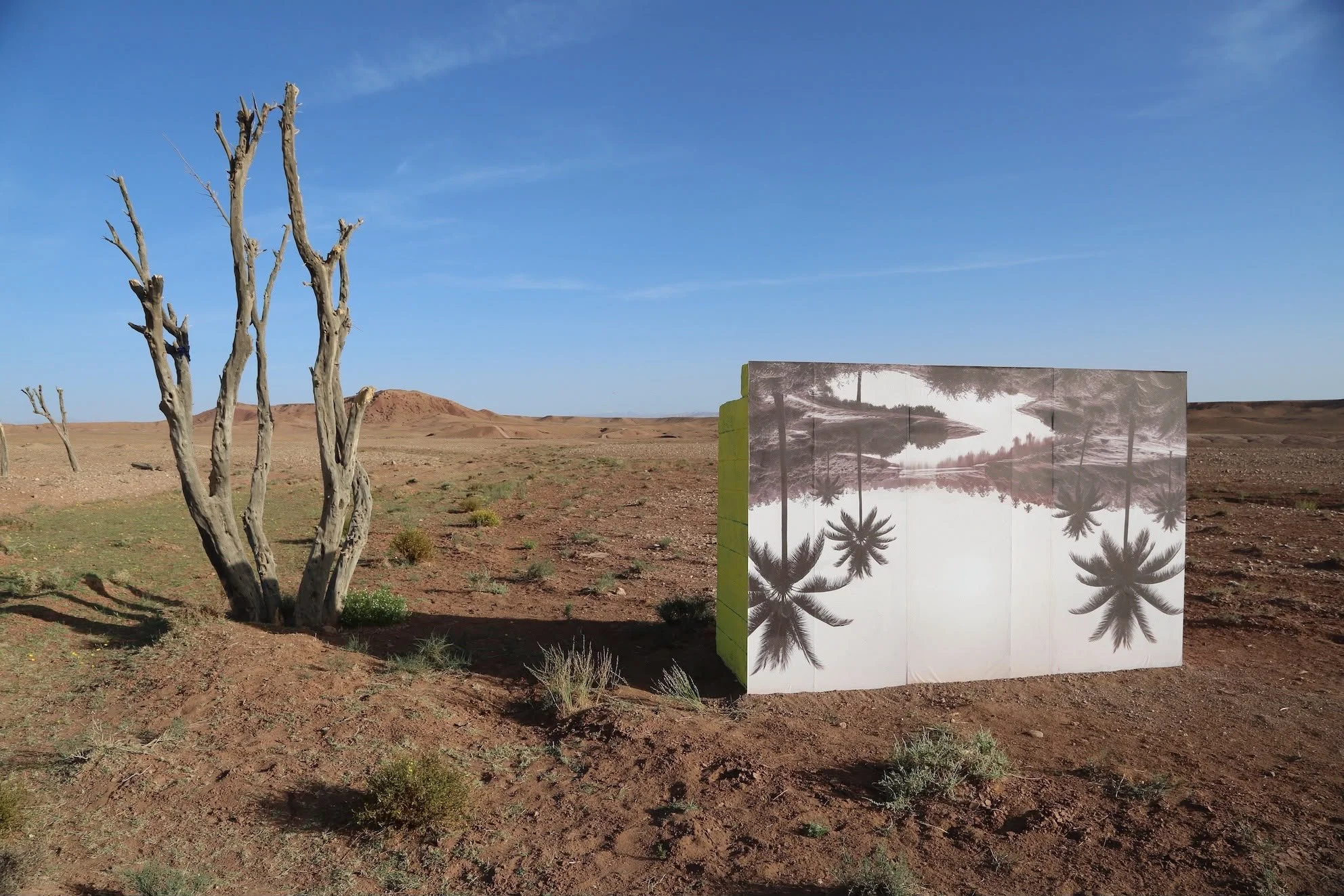
Papier peint #1, 2026
3. Do the people you photograph ever get scared to climb onto the built platforms/things? What do you tell them?
For this particular project, I was fortunate enough to work with a film production company. Thanks to its technical crew, I was able to build the structures in a short time. The technicians convinced these “extras” to pose for Perchoirs. At first, the models were afraid of falling or slipping. To reassure them, I always ask one of my assistants to climb onto the structure and stand still for a few seconds. Once the model has seen how it is done, they usually feel reassured. The entire team is there to help the model climb the ladder, which I remove before taking the photograph. We stay close by, but outside the frame, in case of danger. The team is also there to help the model back down until they are safely on the ground. The whole process is documented in photographs and videos in my archives.
4. The figures only hold the pose for a few seconds. Are you waiting for something specific in those seconds?
A few seconds are more than enough to take several photographs. Once the structures are in place, the models are ready, my camera is set up and I have chosen the framing, I ask my team to help the model climb up, with great patience and care. All I ask is that they stand, or in some cases sit, facing me, in profile or with their back to me. I give them no other directions, and I do not interfere with their facial expressions. I do not ask them to wear anything special either. They are invited to pose in their everyday clothes. I don’t do any casting.
5. The catalogue of the exhibition describes the bodies as “elevated and vulnerable.” Is that what you want people to feel, or is it more ambiguous?
There is a considerable difference, both visually and emotionally, between photographing someone on a solid structure and on one that appears vulnerable. It is the latter that captures the viewer’s interest. We do not know what might happen next. With a firmly anchored structure, there is no risk. Everything has already been said, leaving little room for theimagination. It is this precarious, fragile balance that gives the photograph its meaning and interest, and makes us ask questions.
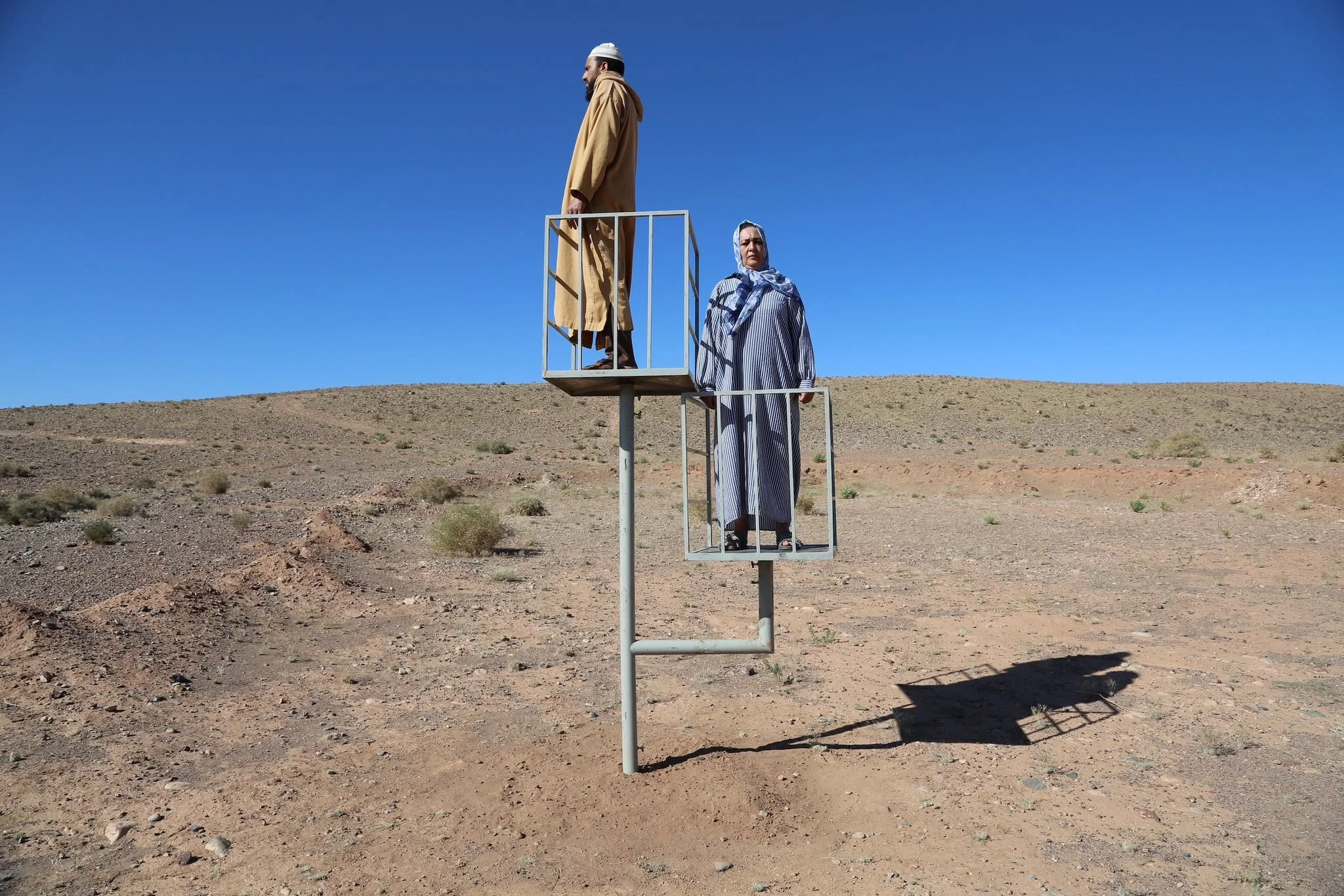
Perchoirs #4, 2026
6. Landscaping began in 2018, several years before Papier peint and Perchoirs. What has changed in the meantime, specifically in how you think?
Nothing has changed since I began practising photography. For around thirty years, I have been obsessively telling the same story, but in different visual forms. I take a critical look at my society. The subject remains the same because the situation has not changed much: we still have a two-speed Morocco, if not more. The inequalities between a city and its outskirts are already frightening, let alone those between cities and the most remote villages in the country. This economic and social situation lies at the heart of my various photographic projects. Only the form changes, depending on the budget I have available, since I sometimes finance my projects myself.
7. You work with blacksmiths, masons, painters and villagers. How much of the work is collaboration, and how much do you control?
Many artists work collaboratively with their models and teams. I take a different approach. I have a radical position on this, and I openly stand by it: my way of working is to carry out the entire photographic process myself. If it were technically possible to do without my team, or even without the people I photograph, I would. In fact, I have already made two series of self-portraits in this spirit. I control the entire creative process and leave very little to chance. Every project is carefully worked out before I even find the funding to produce it. I simply adapt to the constraints and unforeseen circumstances that may arise during a shoot.
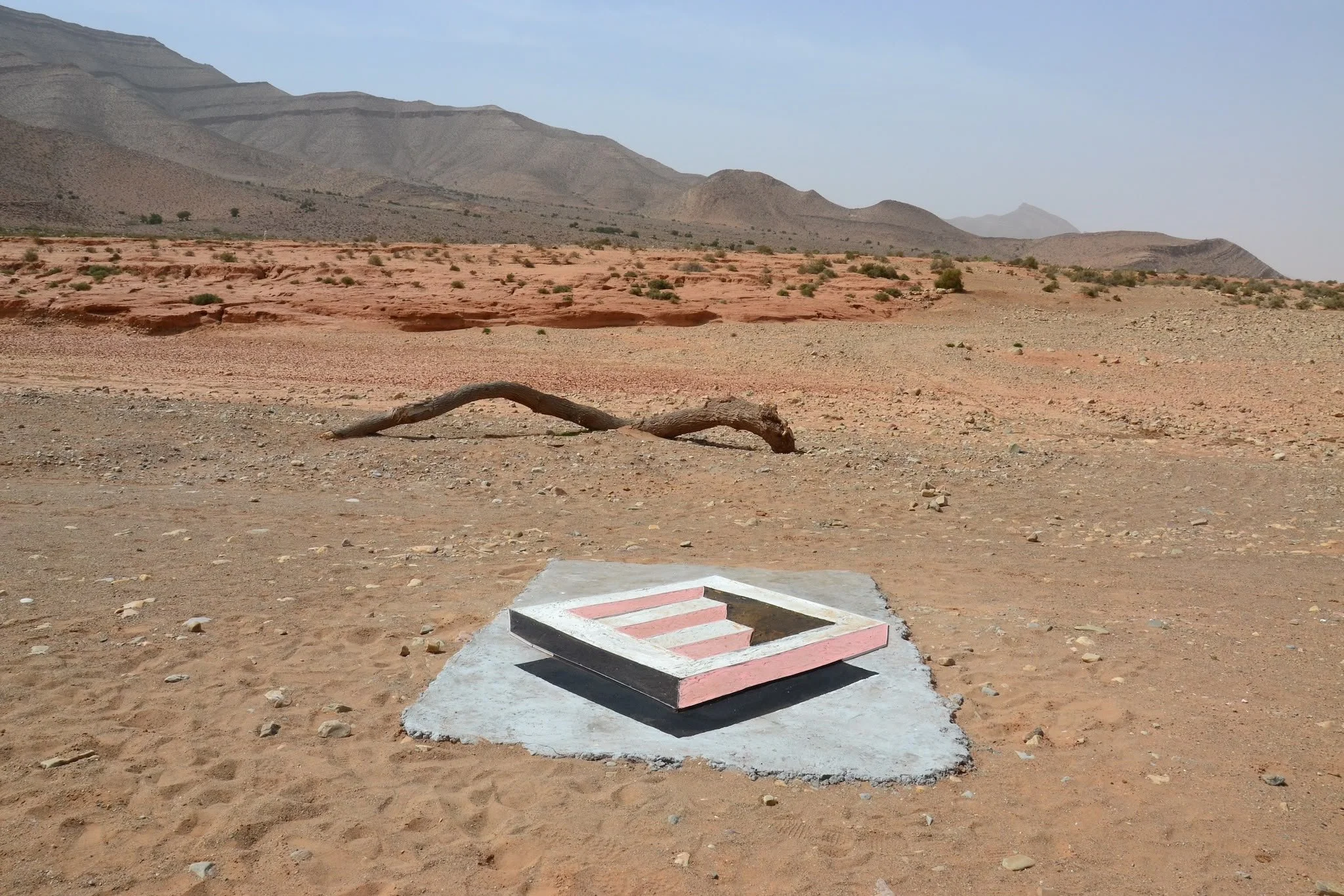
Landscaping #3, 2018
8. Who are the people on the platforms, and what do they think of the project?
Whenever I go to a village, I ask its residents to pose for my photographic projects. There is no need to look further afield. As I am introverted, I often ask my assistants to explain the project to the models, who are briefed before each shoot. I deliberately avoid forming a direct relationship with my models because it distracts me. After the shoot, I thank them personally, but I do not share anything else with them. During the shoot, even though they take their role seriously, they think what I am doing is strange. They do not understand how I can spend so much money and hire an entire professional crew to make unusual images that may, in their eyes, be of no interest at all.
9. Do you want people outside Morocco to read the work differently from people inside it?
My work is to produce images without worrying about how they might be received. I accept invitations to exhibit both in Morocco and abroad, and I am always happy to do so. I simply notice that I exhibit more often in Europe, in particular, than in Morocco. I also find that, because we do not share the same cultural and artistic codes, my work is often received differently from one country to another.
10. Looking at the works presented in this exhibition, what would you like us to notice or understand about them? Is there a way of looking at them that you would like to suggest to the audience?
I do not try to direct the way visitors look at my work. Every photograph is a window onto the world. Each person can open it, leave it slightly ajar, or choose not to open it at all, and look at whatever interests them. Through a window, we might see a detail or the whole view. We might close it immediately, or leave it open and reflect. We are all different, each with our own history, sensibility and background. The best way to present this work is very simply, without any particular effects or elaborate exhibition design. I invite the public to discover what I hope is a distinctive body of work, because I have always refused to be influenced or to follow trends in contemporary photography.
Written by Kalina
Images Courtesy of the artist and L’Atelier 21
