
Racha Khemiri’s bond with Liên Hoàng-Xuân
Written by Racha
Foreword
This year Naso Art Journal opened its pages to writing we had not commissioned. The call asked for critical writing produced in the MENA region, or written about an artist from it, and it had one purpose: to encourage a form that has rarely been embraced here. Exhibitions open and close, careers are built, and much of the writing that accompanies them never travels far from the press release. Criticism does what a press release cannot. It takes a work seriously enough to argue with it, and it leaves a record of how something was seen at the moment it appeared. Without it, a scene has a market and an archive of images but no account of its own terms. What we hoped to receive was harder to name: texts willing to argue with the categories they inherit — hybridity, diaspora, the South as a fixed position on someone else’s map — and to treat criticism as a form capable of its own invention rather than a service to the work it describes.
The essay that follows was among the first to convince us. Writing on Modernity Garden, Liên Hoàng-Xuân’s first exhibition in Tunisia, curated by Hela Djebby at 32bis, Racha Khemiri draws on a year of conversations with the artist to set aside the language of mixture that so often attends artists of mixed origin. Mutation takes its place: change as a condition of survival rather than a completed event, and a South that works as an orientation rather than a destination.
Outliving the Present
Maps and compasses often promise arrivals. North is presumed as fixed. South appears somewhere below it, but Liên Hoàng-Xuân’s work starts by undoing that promise. A garden appears, and the ascent begins before the exhibition does. Palm fronds spiral around the staircase, climbing almost imperceptibly towards the upper floor. Butterflies shimmer with the chromatic memory of early messaging platforms, peacocks unfurl their tails, cars acquire wings, airplanes circle trees. Computer monitors glow with the solemnity of altarpieces. It takes time to realise that nothing in the exhibition is organised according to the familiar divisions between the organic and the technological. The garden is already digital, and the interface has become landscape.

Haïku n°22 - photo credits: © Mehdi Ben Temessek
On Orientation
Perhaps this is what it means to tread the South of No North. Borrowed from the title of Charles Bukowski’s short story collection, the phrase bears a bond to Hoàng-Xuân’s exhibitions, shedding its literary origin to become a radical device of orientation. It names a South emancipated from the burden of representing itself, from the folkloric expectations and projections that have accompanied certain geographies. “You don’t need to carry with you the weight of this imagination,” Hoàng-Xuân told me during one of the many conversations we had over the past year, long before the exhibition Modernity Garden opened in Tunis. Over those months, our conversations returned obsessively to the same words: mutation, sentimentality, the South, literature.
Dust settles differently in certain cities. It softens concrete, lingers on television screens, dulls chrome without erasing its shine. It clings to satellite dishes, to palm leaves, to the lacquered surfaces of cars that seem older than they are. I recognize it before I recognize the places themselves. Liên Hoàng-Xuân speaks of urban landscapes as though they were never entirely built and never entirely natural. They are composed of cosmetic palettes passed from one generation to another, ageing interfaces, decorative excess and industrial outskirts. Satellite dishes turn towards the same point in the sky like mechanical sunflowers. In her first exhibition in Tunisia, curated by Hela Djebby at 32bis, the geography drifts from Tunis to Saigon to Beirut, from a peacock’s tail to the static of an old television.
On Mutation
It would be tempting to call these worlds hybrid. However, she resists the word.
Raised in Paris with Tunisian and Vietnamese roots, and shaped by four years of living and studying in Beirut, Hoàng-Xuân has often found herself read through the vocabulary of mixed diasporic identity. In a Western context, such a biography can seem to demand a category: Tunisian-Vietnamese, here and there, between one place and another. The question of where she belongs is made to appear as though it were a question she must answer about herself, a premise that she has refused. What interests her is the idea of Métissage that, in this sense, is not a neat arithmetic of halves, it does not produce a stable compound from two pre-existing elements, but rather dissolves the expectation that a person, like a map, should have clearly delineated borders.
Hybridity implies that the mixture has already taken place, with parts remaining visible enough to be named. Mutation, on the other hand, belongs to the tense of becoming. It describes forms that continue to change because change has become their condition of survival. In Modernity Garden, everything enters this logic. Butterflies acquire the improbable anatomy of angels. Aeroplanes sprout wings only to resemble birds. And birds drift towards peacocks, whose splendour in Sufi literature has always carried the sadness of exile from Eden. Brides are not as gendered as we might imagine. They are figures suspended between one life and another, inhabiting the inextricable interval where ritual has already transformed the promise of ideal love into the edge of deception, and perhaps of reality. In Hoàng-Xuân’s Haïku n°22, the poem repeats: “Forever a bride forever a bride”. It then proceeds: “Forever a bride a flower a car / I got lost online for a thousand years online”. The temporal scale suddenly expands, moving from the intimacy of the body to the almost absurd duration of the digital. The self circulates between forms, between bodily warmth and technological estrangement, between the road and the screen. The direction of travel is unhinged. “As I was driving south I cried,” she writes, before the final imperative: “So to the south I’ll ride”. South becomes a sanctuary yet to be reached, a movement produced through longing. The poem therefore seems to condense the logic that to mutate is also to remain in motion, carrying sentimentality, desire and disorientation.
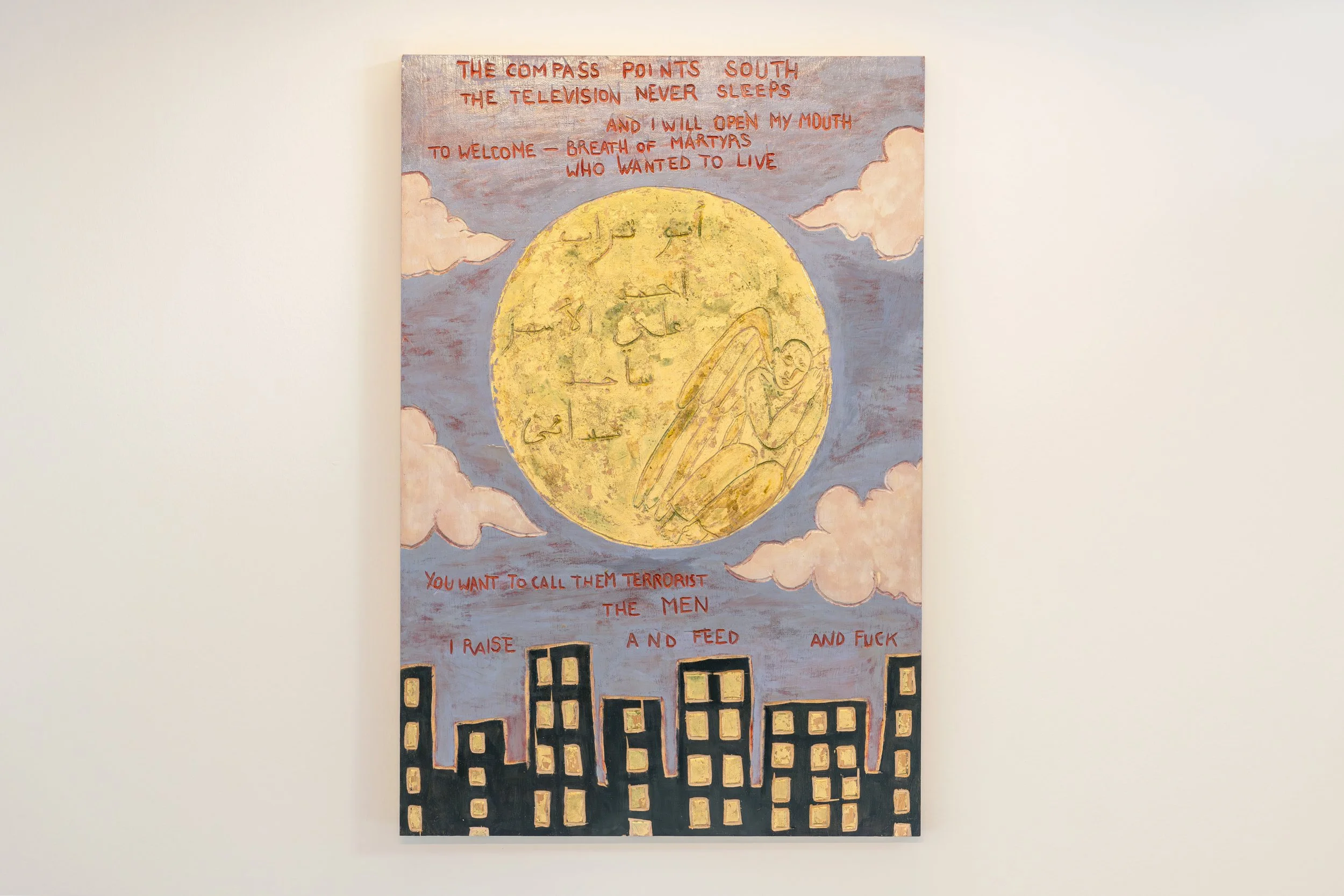
Oeuvres Liên Hoàng-Xuân 32 bis © Mehdi Ben Temessek
Contemporary subjectivity no longer assembles itself from stable inheritances. It mutates through continuous exposure to migration, catastrophe, digital saturation, inherited memory and algorithmic circulation. “Sometimes mutation makes you monstrous,” Hoàng-Xuân once remarked. The word is striking because it refuses to domesticate fear. The monster has long been the figure through which the non-Western body, the foreign body, the body that exceeds categories has been imagined. Rather than correcting that image, her figures survive because they refuse to remain recognisable. That same refusal is inscribed into the exhibition’s material language.

Racha Khemiri
© Maram Nairi, image courtesy of Racha
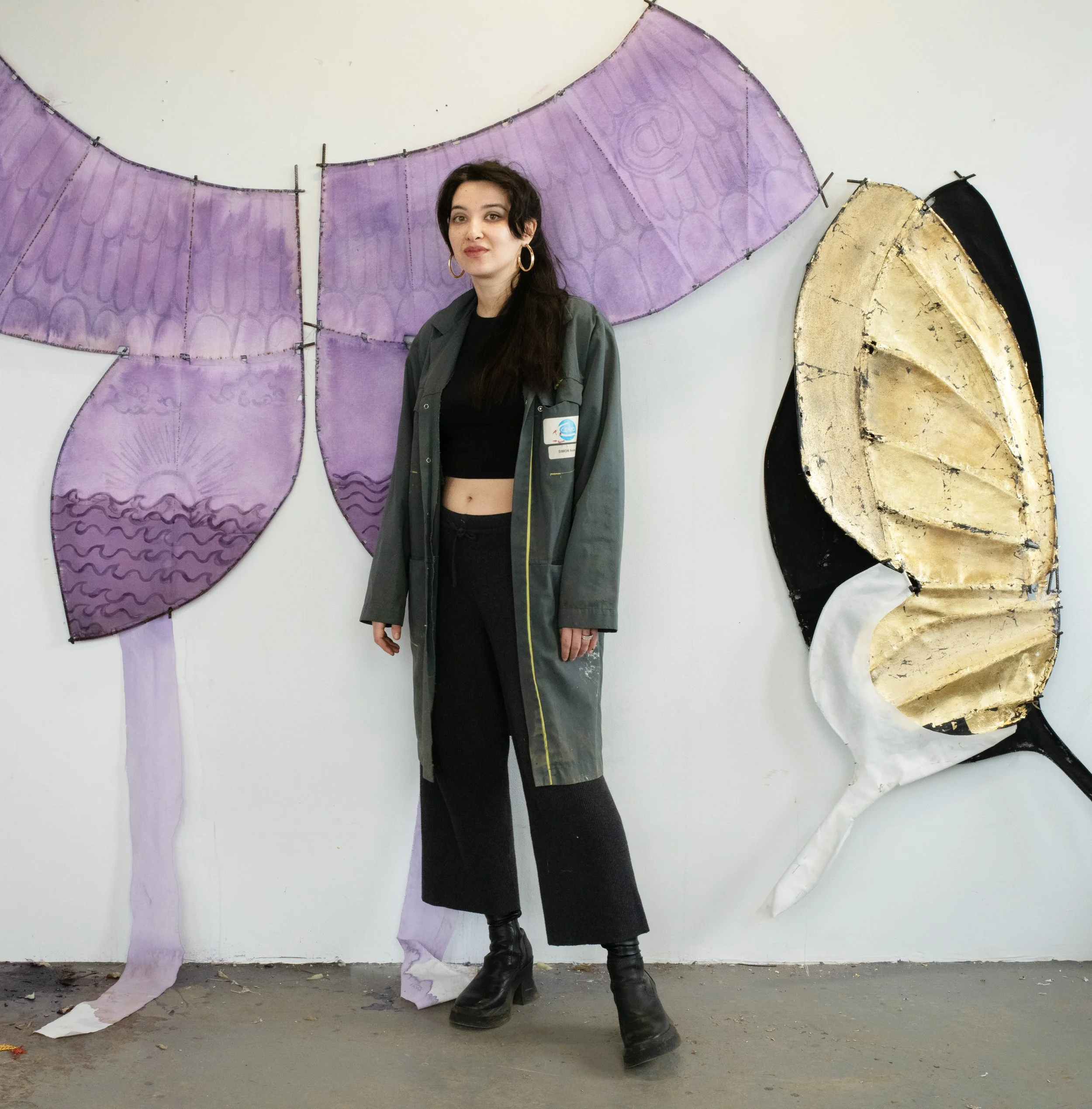
Liên Hoàng-Xuân
Portrait courtesy of the Artist.
The full article will exclusively be on print in Issue 4.
Images courtesy of Racha Khemiri
Words copyright of Naso Art Journal & Racha Khemiri
