
Choukri Mesli and the Legacy of Aouchem
Written by Nayla
Born in Tlemcen, into a family of intellectuals and musicians, Choukri Mesli moved with his family to Algiers in 1947 and the following year entered the city's École des Beaux-Arts, where he studied until 1951 under the miniaturist Mohammed Racim. Algiers at the turn of the decade was full of young people imagining another country, and Mesli fit in easily among them: in 1950 he helped launch the magazine Soleil, and with the poet Kateb Yacine and the painter M'hamed Issiakhem he founded Groupe 51, a circle of writers and artists drawn to the ideas of emancipation then circulating around the newspaper Alger républicain.
In 1954, the year the war of independence began, Mesli enrolled at the École des Beaux-Arts in Paris. He held his first solo exhibition the following year at the cultural centre of the Cité universitaire. Two years teaching drawing in Rabat carried him through to the end of the war, and in July 1962, the month Algeria became independent, he came home. By October he was teaching painting at the École des Beaux-Arts in Algiers, and in 1963 he was among the founders of the Union nationale des arts plastiques (UNAP).
The idea most closely tied to his name took shape in 1967, when Mesli and the painter Denis Martinez founded Aouchem, a word for tattoo. Mesli organised the group's first exhibition that March at the UNAP gallery in Algiers, and its manifesto, signed by Mesli, Martinez, Mustapha Adane, Saïd Saïdani, Mohammed Ben Baghdad, and Baya among others, traced the group's birth back thousands of years to the painted walls of a cave in the Tassili. Its members built their abstraction from that long inheritance, from tattoos and rock paintings, Amazigh motifs, calligraphy and the geometry of everyday ornament. In 1969 Mesli oversaw the art exhibitions of the Pan-African Festival of Algiers, placing that same argument before the continent, and in 1971 Aouchem mounted what would be its final exhibition before the group dissolved.
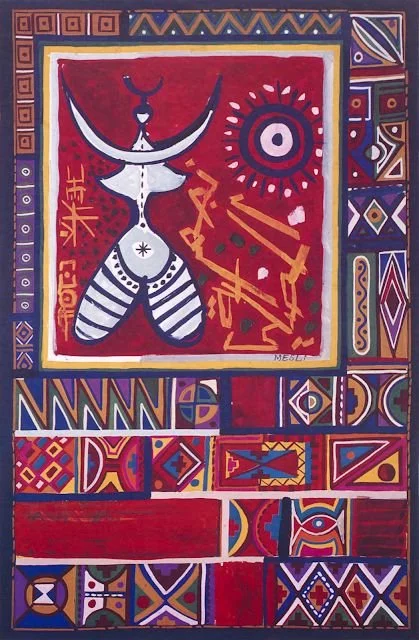
Choukri Mesli, Femme, composition [Woman, Composition], 1986, oil on plywood, Courtesy Liassine, Françoise. Choukri Mesli. Alger: Enag Editions, 2002.
Women became central figures in Mesli’s paintings, drawing on the legacy of Tin Hinan, the ancestral queen of the Tuareg. Rendered in bold, flat expanses of colour, their bodies incorporated the symbols and forms that were central to the artistic language of Aouchem and its manifesto. In 1990, the writer Tahar Djaout titled his seminal review of Mesli’s work The Geometer of Desire, reflecting the interplay between the geometric precision of his compositions and the expressive quality of his figures.
In 1994, amid escalating violence against artists and intellectuals in Algeria, Mesli left the country and settled in the suburbs of Paris. He died in Rueil-Malmaison on 13 November 2017. Through his paintings and the generations of artists he taught, he left behind a lasting contribution to Algerian modern art, one rooted in the visual traditions and cultural inheritance he had spent his career exploring.
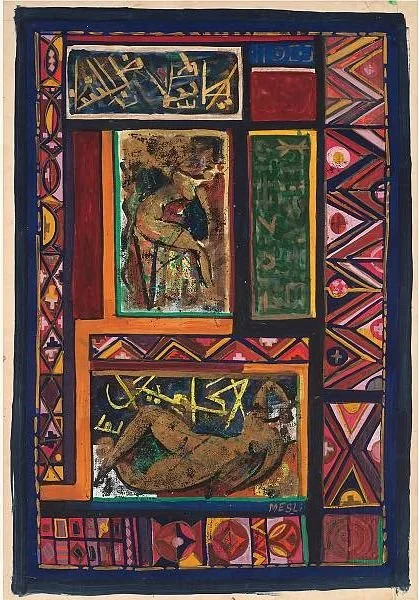
Choukri Mesli. Les Protectrices. 1991. Mixed media on cardboard, ©️ Donation Claude et France Lemand. Courtesy of Musée de l’Institut du monde arabe, Paris.
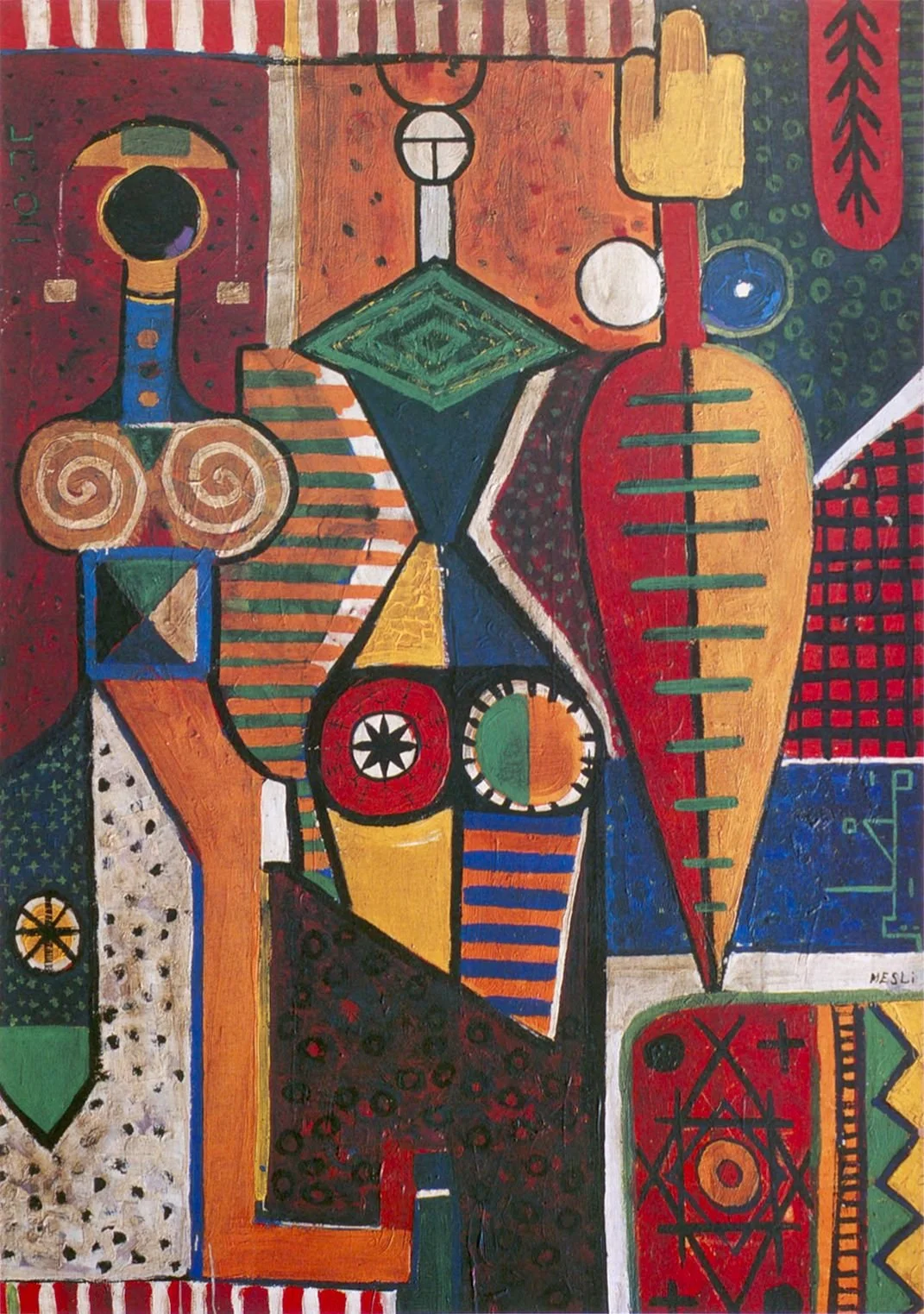
Choukri Mesli, Femme symbole [Woman Symbol], 1990, oil on canvas. Corutesy Liassine, Françoise. Choukri Mesli. Alger: Enag Editions, 2002.
Words copyright of Naso Art Journal.
