
Amine Habki
Please Mind the Gap
Written by Soraya
Foreword
Asked which question nobody had put to him yet, Amine did not reach for anything grand. "Maybe a simple question like, 'What kind of music do I listen to while I'm working?'" His answer: "music with long, atmospheric chords, almost like a film score." Max Richter, for example, but also PNL, the French rap duo of North African descent, and Lana Del Rey. It is a small question, and a good place to start.
Soraya came to the work of Amine Habki through Kayen, who had worked with the artist on Emergence. The introduction led to a studio visit at the end of August, a few days before Please Mind the Gap opened at Mennour's space on rue du Pont de Lodi. Amine was working at Poush, and the afternoon moved between his family, his training, his poems and the works that were about to leave the studio for the gallery walls. The aim was simple: to understand how the show had come together, and what the gap in its title actually refers to.
The women's houses
Amine grew up in Cergy, in a family that has lived in the Paris region for three generations. Asked where the needle came from, he resists the tidy answer. "I wish I could say that it was my grandmothers who taught me this textile practice, but the story is a little more complex than that."
What he remembers is their homes. Visiting his grandmothers, great-aunts and "the women of that first generation," he was surrounded by textiles he rarely saw anywhere else: "sidari adorned with fringes and pom-poms, lace curtains, and many other objects that were simply part of their homes and everyday lives." Most of these women were comfortable with a needle, some with crochet too. Embroidery reached him, he says, "less as a technique that was directly passed down to me, and more as an aesthetic influence rooted in the visual environment of my family."
That environment has since become a way back in. The artist can now recognise which regions certain carpets, embroidery techniques and motifs come from, and he describes textile as "a language through which I connect with my Arab identity." He is quick to add that the learning is far from finished: "There is still so much for me to learn."
Some of it still happens in the most literal way. He can spend an entire day gathering his fabrics and looking at the patterns that emerge between them, "much like when I used to daydream while looking at my great-grandmother's curtain fabrics as a child."

Secret Garden, 2026 - Photo. Archives mennour
From the line to the thread
At the École nationale supérieure d'arts de Paris-Cergy, Amine drew. Drawing was what he had always loved. Sculpture appealed to him but felt intimidating, with "the materials, the machinery, the potentially dangerous tools, all of that." Embroidery arrived "at a moment when I simply wanted to experiment." He began by stitching flat areas of colour, then started working directly from his drawings. "Little by little, that is how it all developed, and how my visual world began to take shape."
The work eventually came off the wall and into sculpture. Today he moves between embroidery, painting and drawing, "adjusting the balance between them depending on the effect I want to create." A work he remains particularly fond of, I Burned My Field/Feels, brings almost all of it together on a single piece of lace: embroidery, painting and drawing, with the patterns already in the fabric folded into the composition. Parts of the figure's heart are consumed by pink flames, which in the artist's work stand for "passionate desire, something that burns and eats away at you from within." His figures are often incomplete, and here the absence is physical. "I like creating these kinds of interactions between forms and colours, as well as playing with erasure and disappearance, because they allow me to give poetic form to that feeling of absence."

Icarus warned us but we don't care (Act I), 2026 - Photo. Archives Mennour

Detail - carus warned us but we don't care (Act I), 2026 - Photo. Archives Mennour
Recognition has come quickly, from the Salon de Montrouge to the Centre Pompidou-Metz and an exhibition in Stockholm, before Mennour. "I always believed I would reach this point because I've always believed in myself, but I didn't expect it to happen so quickly," he says. Each setting has shaped the work differently. At Pompidou-Metz he could try something "more interactive and immersive," while a gallery tends to call for "more traditional formats." He finds both equally exciting.
A stomach like a fortress
Much of Amine's imagery starts in writing. "I often turn to my poems, as they tend to generate images for me," he explains. A series of poems usually grows into a body of work of its own, and Please Mind the Gap began that way.
One line from those poems works as a rule for everything else: "If the eyes are the windows to the soul, then my stomach will be a fortress." For the artist, it means the work can be accessible without explaining or revealing everything. "I decide what I want to give and what I choose to keep for myself, particularly in a context where racialised artists have too often been expected to serve up their intimacy on a platter."
Alongside the music, podcasts fill the studio hours: artist profiles on Présente, and programmes on gender and decolonial questions such as Histoire Crépus and Le Jins Podcast.

Je dormirai pas à la maison, 2026 - Photo. Archives mennour
Minding the gap
The title is lifted from a public-address warning, delivered in English, and hung in a Paris gallery. For Amine, the gap is several things at once. "For me, thinking about the gap means thinking about the disparities between the suburbs and central Paris, or the emotional gap between two bodies, or even the distance between reality and unreality." He calls it "a very down-to-earth idea, but one that has acted as a guiding principle in my life: to remain lucid and stay conscious."
The embroidery that gives the exhibition its name does not, in his view, hold the whole idea on its own. He is comfortable with visitors taking in the work first for its beauty, since the aesthetic is a major part of what he does. What he hopes they also see is that "the gap is represented in so many ways in this installation."
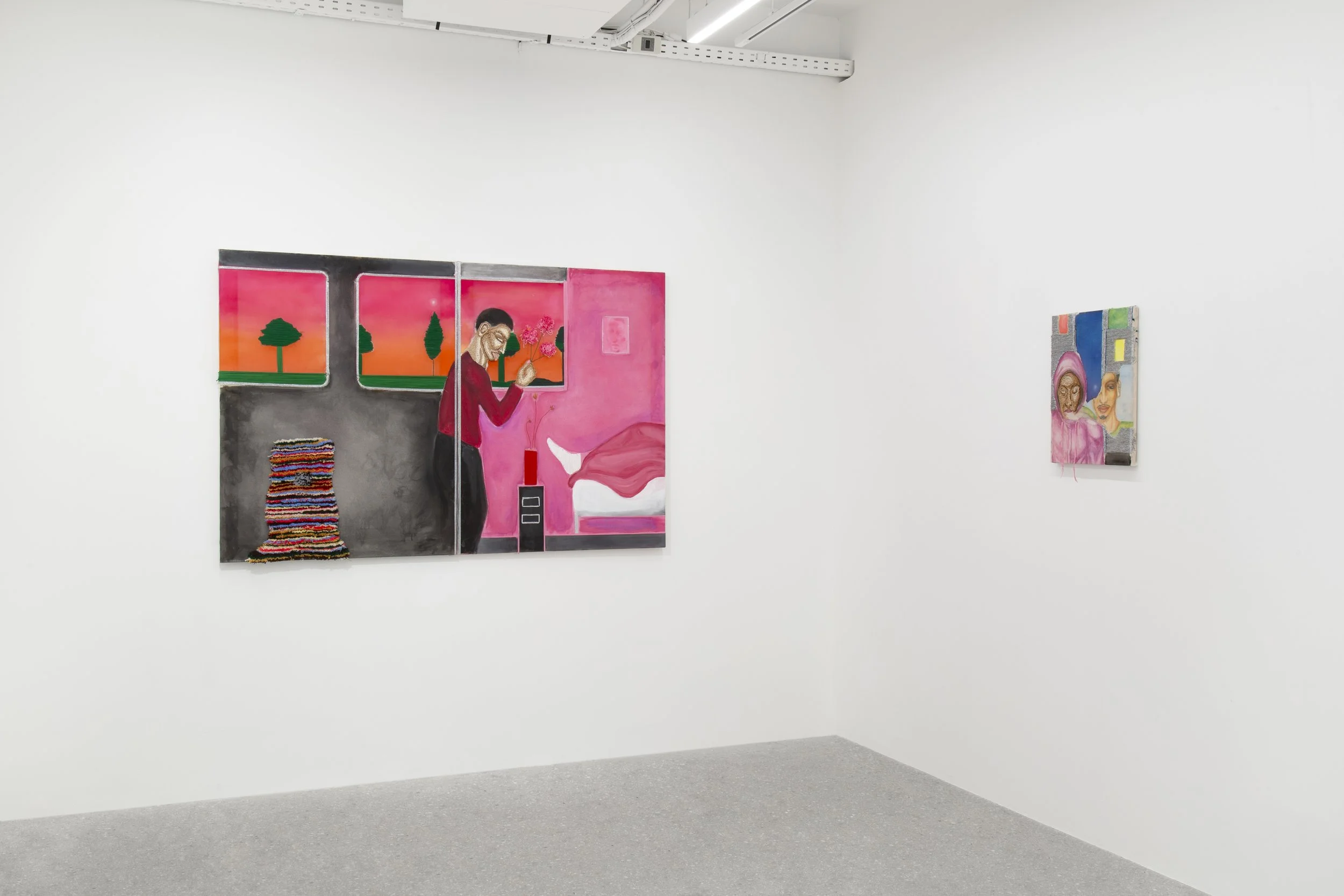
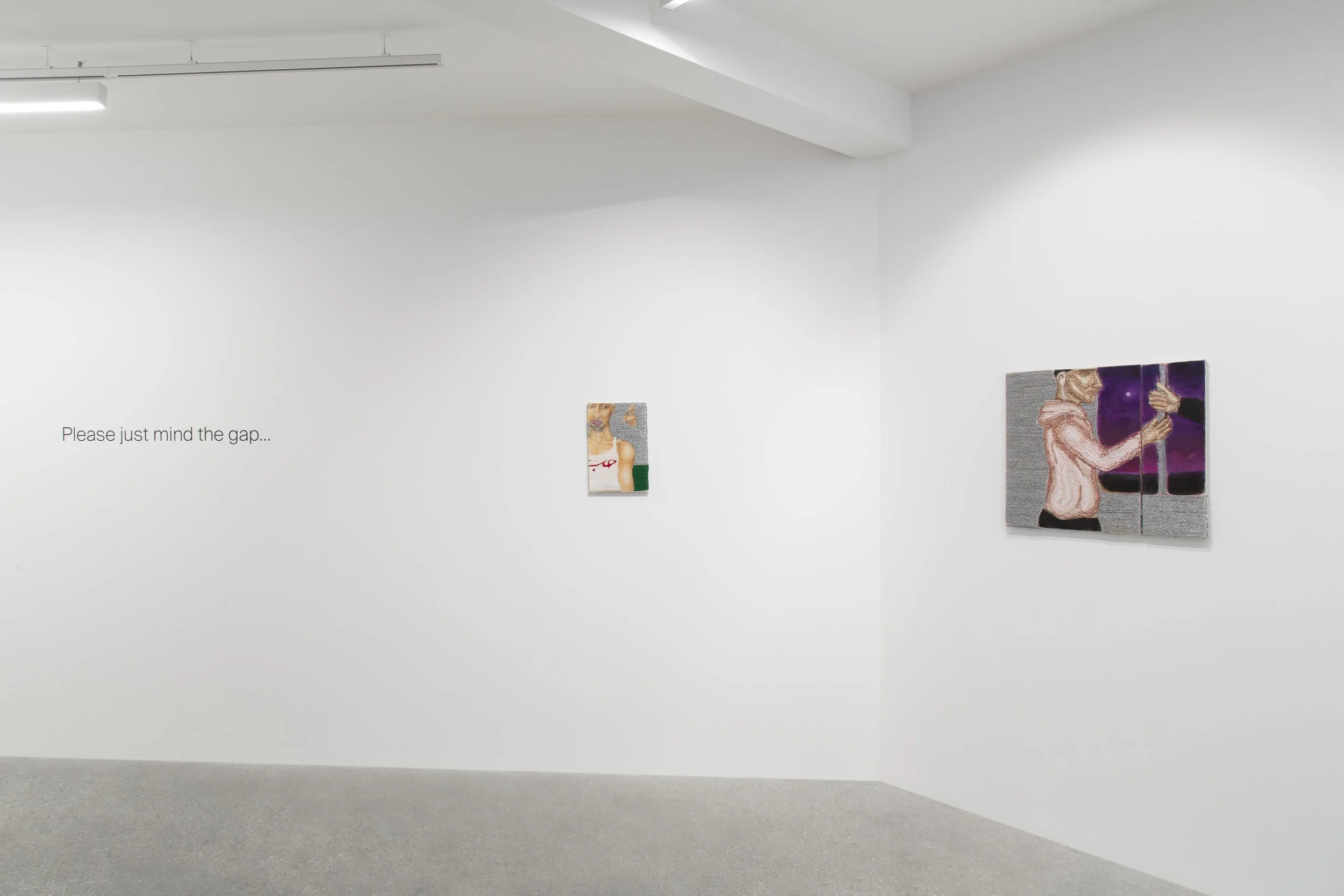
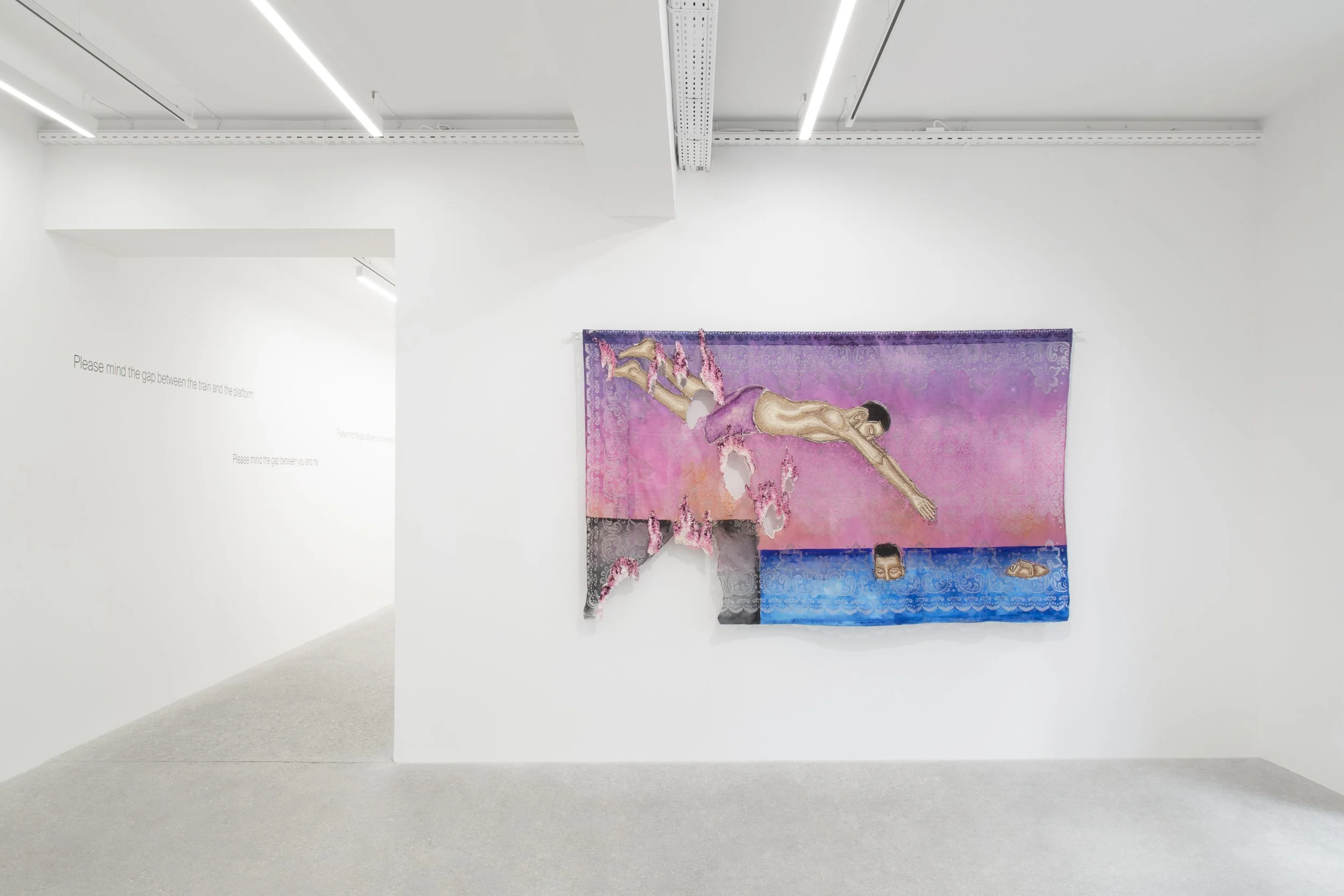
Vues de l’exposition / Exhibition views, « Amine Habki, Please mind the gap », Mennour (5 rue du Pont de Lodi, Paris), 2026. © Amine Habki. Photo. Archives Mennour. Courtesy the artist and Mennour, Paris.
Opening night, and after
Soraya returned to rue du Pont de Lodi for the opening. Seeing the works with people in the room added something the studio could not: the pieces were no longer being described but encountered. Embroidery asks to be seen up close, and visitors moved between stepping in to follow the thread and stepping back to take in the whole figure. The responses were mostly quiet ones, people lingering in front of a work or returning to it after a first pass through the gallery.
When the conversation turned to the next twelve months, the artist was clear about his priorities. "I think I need to rest and research," he said. He is enjoying a period without a studio and plans to take a new one, but not yet. In the meantime he wants new experiences he can bring into the work alongside research, including more time in Morocco to meet craftspeople, and more time with friends and family.
Please Mind the Gap is on view at Mennour, 5 rue du Pont de Lodi, Paris 6e, until 3 October 2026.
