
Fatemeh Heidarhosseini
On The Shape of Remembering
Written by Soraya
Painting the Distance Between Memory and Place
When speaking with Fatemeh Heidarhosseini, it quickly becomes apparent that certainty has little place in her practice. Her paintings resist fixed narratives just as she resists fixed definitions—of landscape, of memory, even of what it means to be an artist. Born and raised in Tehran and now based in London, Heidarhosseini paints places that exist somewhere between observation and recollection, where weather, atmosphere and emotion become inseparable.
Rather than depicting specific locations, her paintings occupy an unstable terrain shaped by remembrance, erasure and reconstruction. Clouds dissolve into architecture; horizons emerge only to disappear. Painting, for her, is less an act of representation than a way of thinking through questions that remain unresolved.
Throughout our conversation, she returned repeatedly to one idea: that intuition is not the opposite of knowledge, but another form of it.
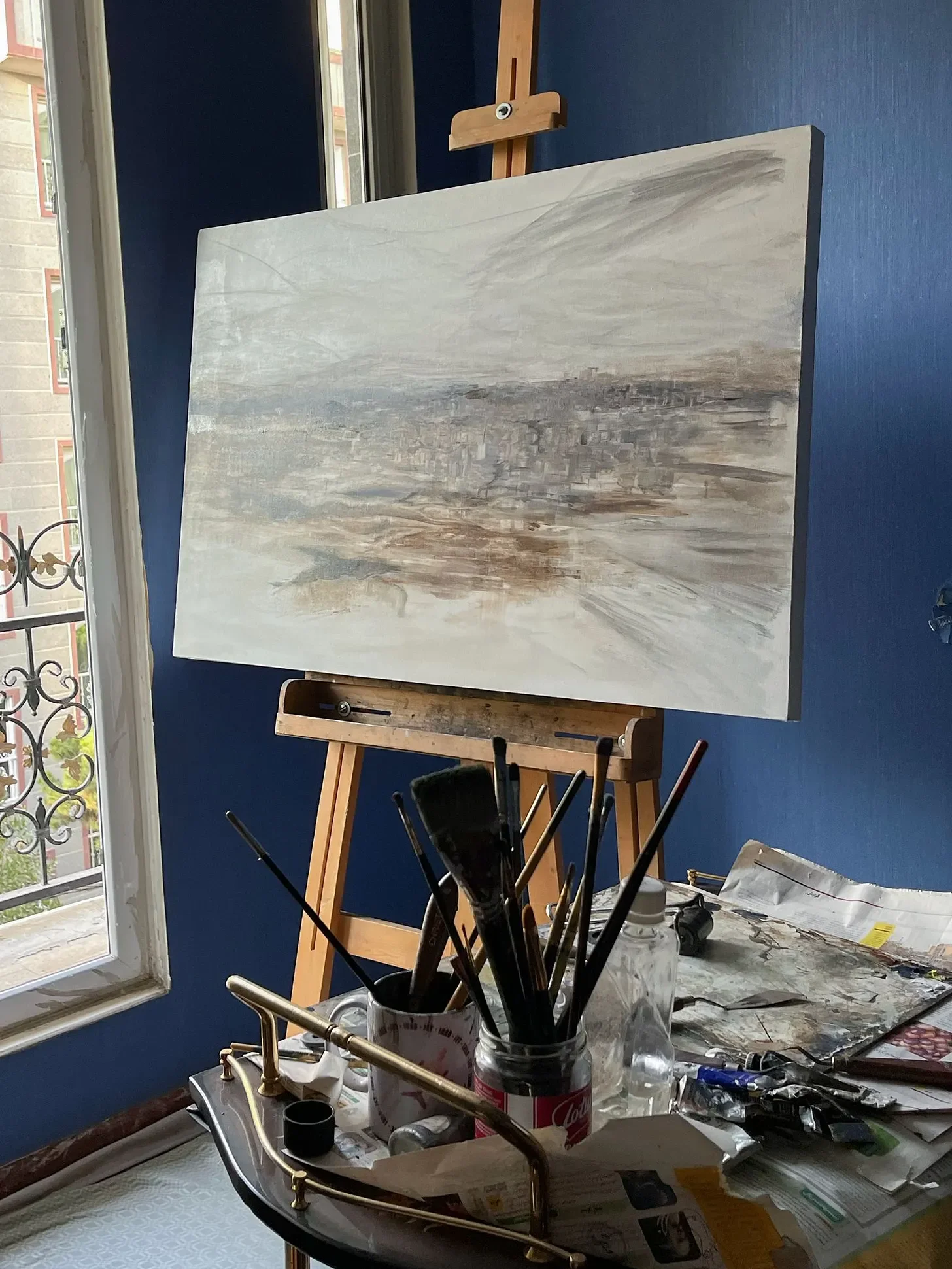
Image of art work in Iran
Bonded to Home
Although Heidarhosseini has lived in London for almost two years, the idea of home remains rooted elsewhere.
“I do not understand home simply as a geographical place,” she explains. “It is a condition of inner ease, familiarity, and emotional recognition.”
For her, Tehran continues to exist less as a city than as an emotional geography.
“It is something I have been trying, and often failing, to fully access over the past few years. Still, if home exists anywhere for me, it is in my hometown, where my family and friends continue their ordinary lives, and where a part of my own life still feels suspended.”
That feeling of suspension quietly permeates her paintings. Rather than documenting either Tehran or London, they occupy an in-between state where belonging is continually negotiated.
Becoming a Painter
Interestingly, Heidarhosseini hesitates to describe herself as an artist.
“I have never settled on a stable definition of what an artist is,” she says. “Those ideas have continuously shifted throughout my life.”
Instead, she identifies with something more concrete.
“What I can say with certainty is that I am a painter.”
The distinction matters. Painting, unlike identity, has remained constant.
“When I decided to apply for an MA, painting remained the only future that felt non-negotiable. It was not necessarily a rational decision; it was the recognition of something I could not imagine abandoning.”
Her fascination with art began during secondary school, when teachers noticed she spent more time drawing in the margins of notebooks than paying attention in class. Yet the deeper commitment arrived later, after encountering Renaissance painting and Giorgio Vasari’s Lives of the Artists.
“What moved me was not only the artworks,” she reflects, “but the possibility of a life organised around making them.”
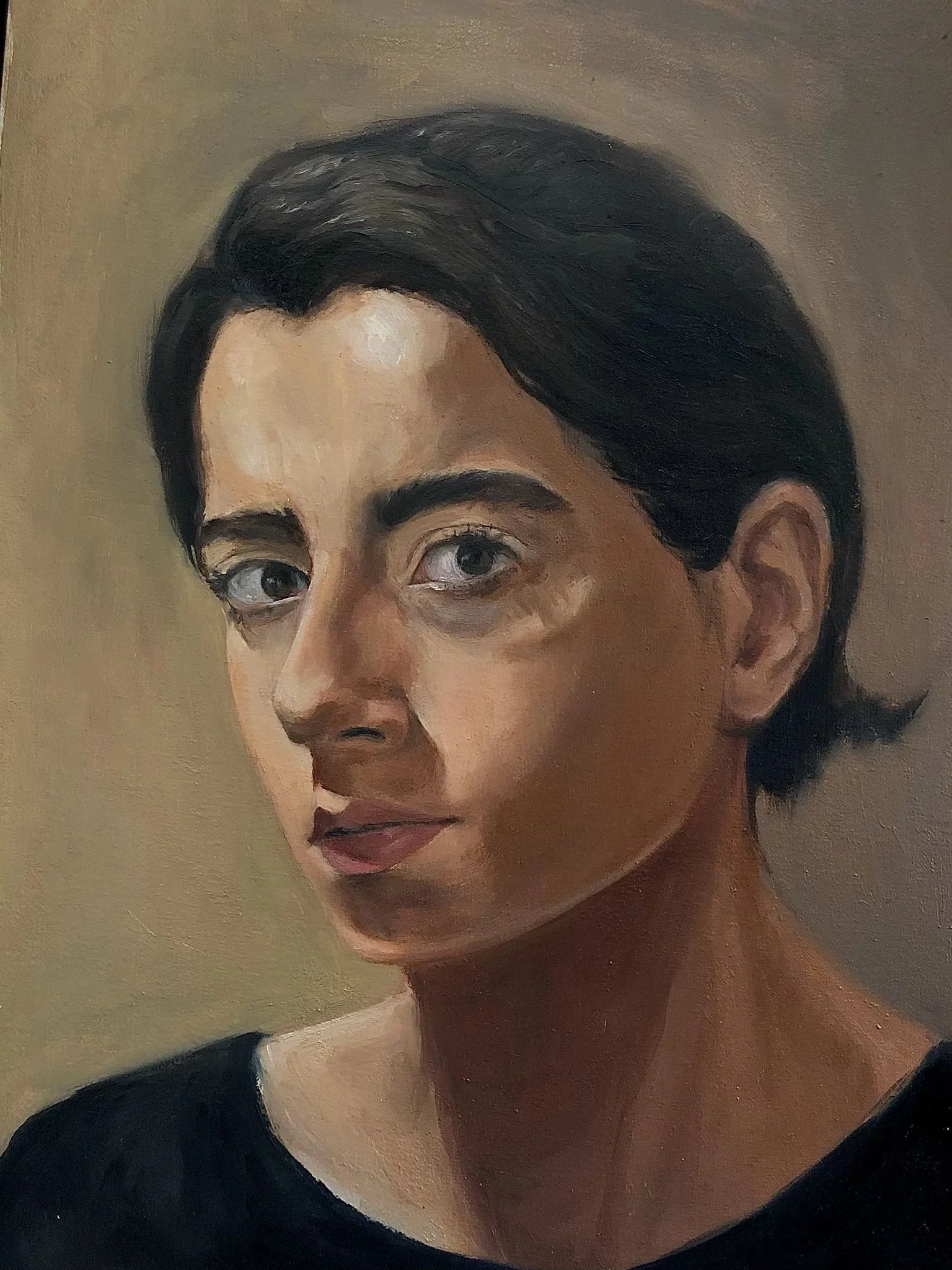
Early Works
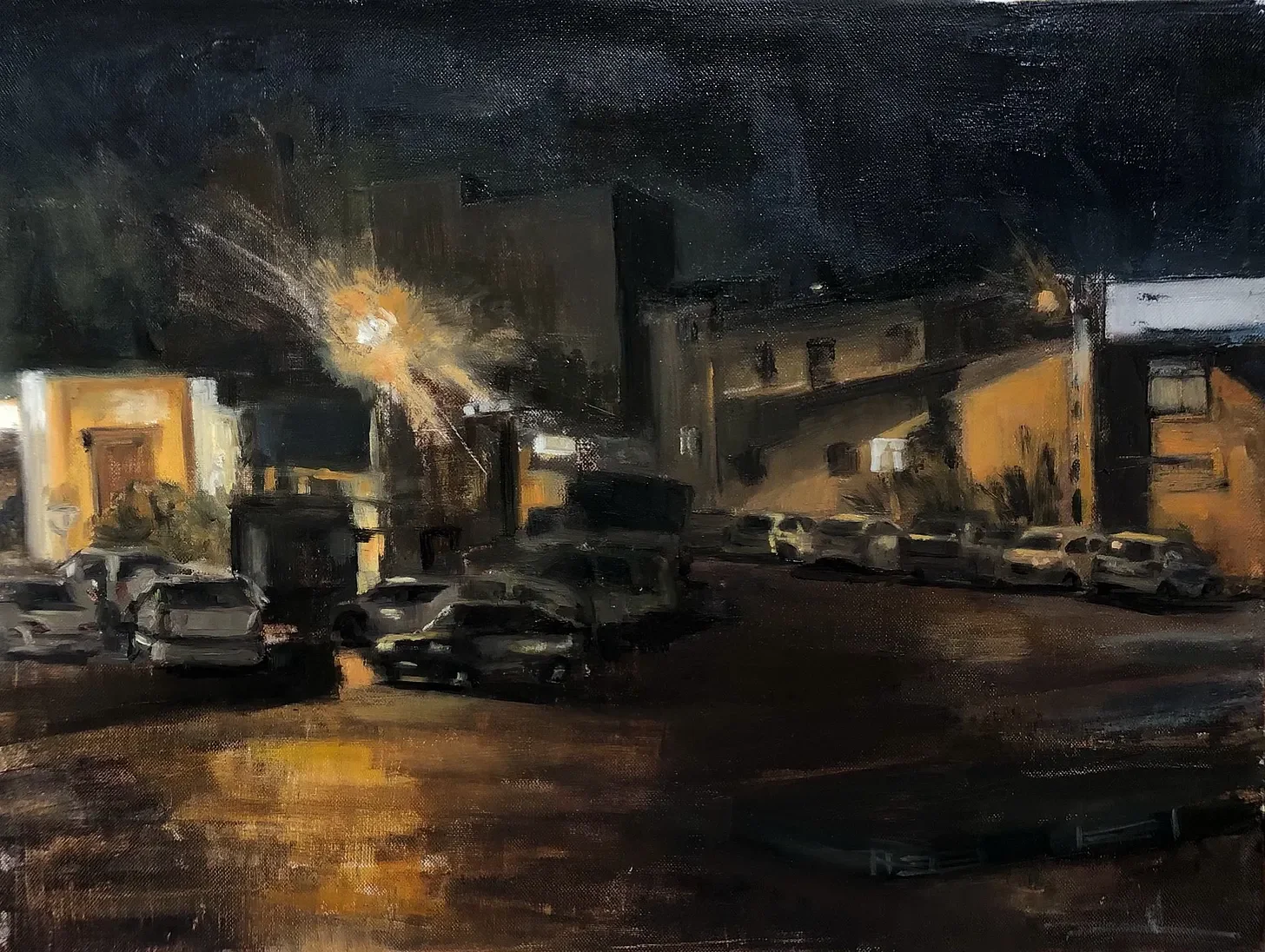
Early Works
Intuition Is a Form of Knowledge
One of the most striking aspects of Heidarhosseini’s practice is the role intuition plays within it. Yet she rejects the common assumption that intuition is spontaneous or irrational.
“It has taken me a long time to regard intuition as a legitimate form of knowledge.”
Instead, she describes it as something accumulated.
“It is built from years of looking, reading, remembering, observing, and painting.”
For Heidarhosseini, the hand possesses its own memory. Experience allows it to solve pictorial problems before conscious thought catches up.
What interests her, however, is interrupting that familiarity.
“I often wipe the surface repeatedly during the process, creating uncertainty and instability. It is usually when the painting becomes difficult—when it presents a problem rather than a solution—that something unexpected begins to emerge.”
Those moments, she insists, are anything but mindless.
“They come from knowledge operating beyond deliberate thought.”
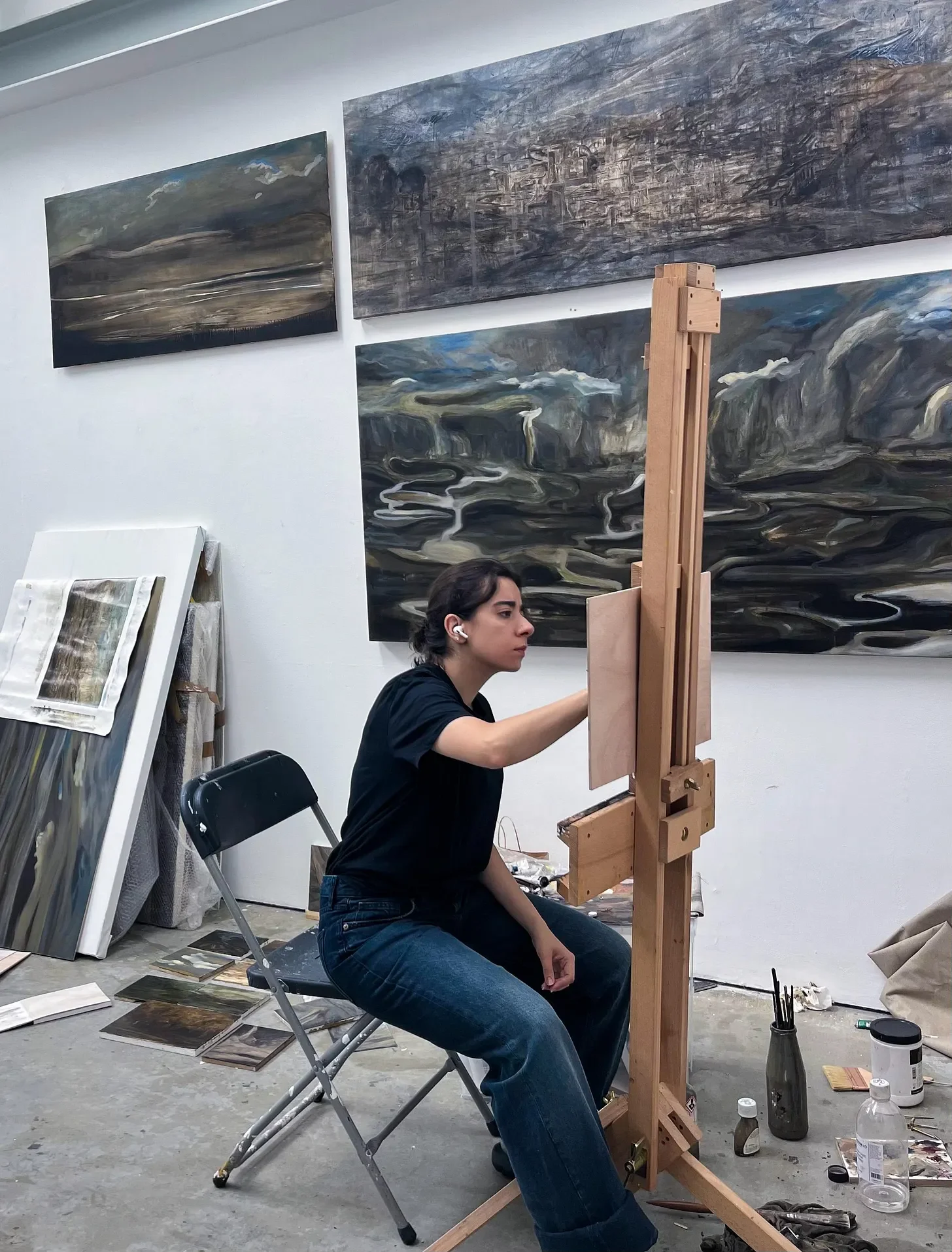
Painting at Royal College of Art, London, UK (RCA)
Images Courtesy of the Artist.
The full interview is exclusively in print in Issue 4.
Words Copyright of Naso Art Journal
