
Sarah Al Mutlaq
The Architecture of Curatorial thinking
Written by Soraya
Sara Al-Mutlaq, an architect and curator based in Riyadh, works in a field that resists easy definition: across institutions, exhibitions, fellowships, and speculative narratives, her practice proposes the curator not as a solitary tastemaker but as a translator - between research and experience, speed and depth, the region’s self-narration and the world’s projections onto it. She returns repeatedly to an ethics of positioning, asking how a community enters global conversations through what it chooses to fund, exhibit, archive, and teach; in this sense, her daily prompt - “If I could do anything with this day, what would I do?” - functions less as routine than doctrine, a refusal to confuse urgency with importance and a commitment to make exhibitions not merely visible but intelligible. What emerges is a discipline of the in-between, one that bridges curatorial thinking with spatial experience and treats speculation not as escape but as responsibility.
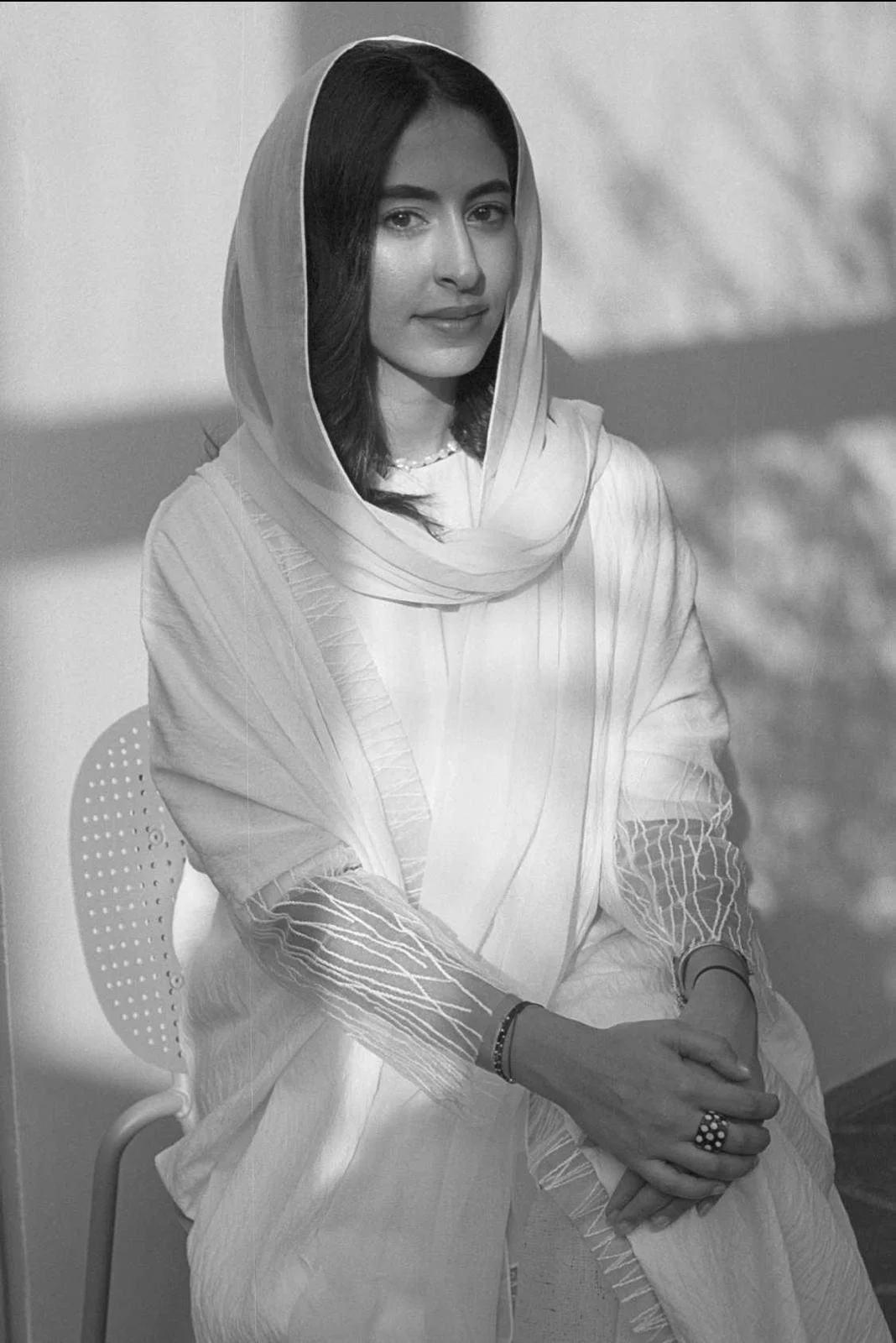
Portrait courtesy of Sara Al Mutlaq
Tempo and Agency: Curating Against the Tyranny of the Calendar
Al-Mutlaq speaks about time not as a neutral container but as a curatorial material. She avoids morning meetings, she says, because “I really believe that those first two hours are a time for you” to locate the day’s intellectual orientation. The refusal is structural: a curator who cannot think cannot curate, only manage.
Later, when the conversation turns to funding and institutional velocity, she makes a striking inversion: money, she implies, is less scarce than time. “Yeah, I think there’s enough funding, for sure. I think maybe the main risk is time.” The region’s pace, she suggests, can become an aesthetic in itself - an unspoken pressure that narrows what counts as possible. “We’re at a moment that is so high speed that it becomes very difficult for creatives to really come up with things that will push the boundaries of what we’re developing.”
Her response is pragmatic rather than romantic: build continuity into your practice. “We should look at each project as a continuation of a previous one,” she says, describing a method for “circumventing” speed by maintaining a living research base - “an article that you’ve written, a project that you’ve developed” - that can be activated when institutions demand rapid reaction.
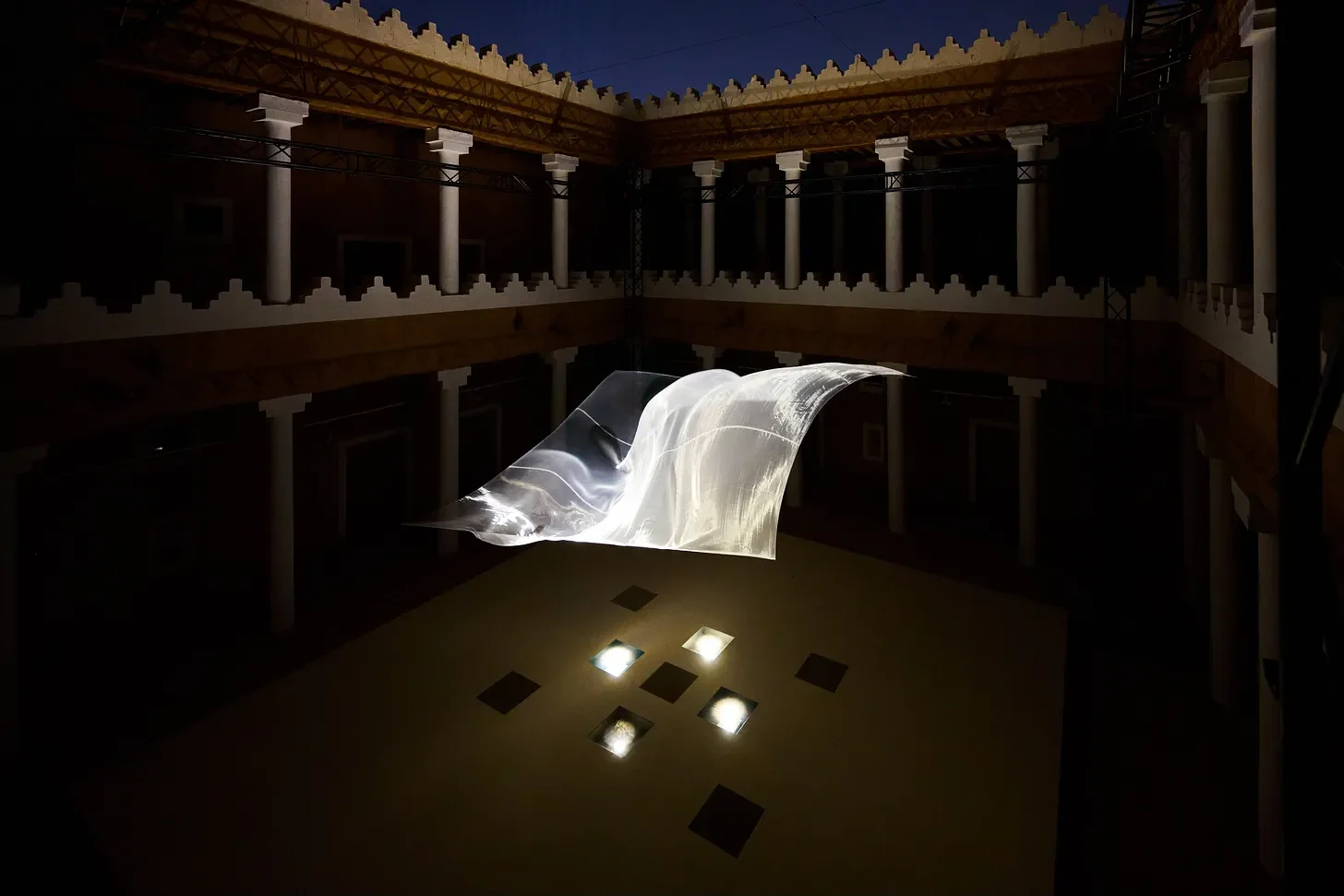
Liminal Air Space-Time by Shinji Ohmaki for Noor Riyadh, 2025
When Architecture Stops Being a Building
Al-Mutlaq’s curatorial approach begins in architectural training, but not in the way institutions typically expect. She describes her master’s at GSAPP in New York as “a pivotal subconsciously pivotal” formation precisely because the program emphasized theory and research over construction. GSAPP, she notes, is “very known to be a theoretical school very interested in research, rather than implementation.”
Her examples are telling: not a studio about form-making, but a seminar built from a speculative text - “The City in the City” - and the task of imagining “a state house for two communities that are in contrast.” The point wasn’t the building as a solution. It was architecture as a way of staging contradiction.
When she later worked within Saudi Arabia’s Ministry of Culture - “with the Museums Commission with the Architecture and Development Department”—she discovered that the conceptual work she cared about lived elsewhere. “Rather, there was this stage that happened prior to that called cultural strategy.” It was there, she says, that the real questions were asked: “Why are we building this museum? What is the meaning of this exhibition in the larger context of the GCC, but also the globe?”
If architecture is often tasked with materializing vision, Al-Mutlaq is interested in the pre-vision: the research that makes a vision legible and accountable. “I wasn’t necessarily interested in the output, but rather the research that created the output.”
The “In-Between” Problem: Bridging Intentions and Spatial Experience
Her central critique is structural and familiar to anyone who has watched exhibitions lose their thesis somewhere between proposal and floor plan. “There’s this gap that happens between cultural strategy and design, where your intentions… does not transfer into the built spatial experience.”
This is where her curatorial practice becomes architectural again - less about objects and more about systems. “How do we bridge curatorial thinking with spatial experience?” she asks, positioning scenography not as decoration but as translation. She is “very involved with scenography in all of my exhibitions,” reviewing it “in detail,” and extends the same attention to brand identity: “I prepare a package… like this mood board, visual feeling, but also a prompt” for teams, whom she insists on treating as co-authors - “I consider them as creatives too.”
In her “optimal case scenario,” the exhibition is not a sequence of downstream departments but a collective thesis conversation: “You bring together these artists and creatives… including scenographers and brand identity and have a conversation about the thesis of the exhibition. And so they’re all players in the final output.”
Speculation as Responsibility: Knowledge Production in the GCC
When asked how she balances critical speculation with cultural responsibility, Al-Mutlaq refuses the premise. “I think critical speculation is cultural responsibility.” For her, speculation is not futurist style; it is a method for locating the region’s “positionality” in the world. “There is a cultural responsibility that you have towards the positionality of the community you’re working with in the larger context of the world.”
Her language becomes sharper when she describes the institutional shift of cultural production toward the Gulf. “It seems this idea of cultural production is pivoting into the GCC, whether it’s Qatar, the UAE and Saudi Arabia.” And with that pivot comes a mandate: treat institutions as platforms for building a durable knowledge base. “Through funding, you’re platforming knowledge production.” The ethical test, then, is longevity: “This funding is a funding that future generations can use to really build up our own knowledge base.”
She also names a methodological tension that many practitioners feel but rarely articulate so plainly: “Very often primary research comes from the Western canon,” she says - then calls for deliberate complication: “How can I complement my primary research with resources from the region in order to really complicate and develop this context?”
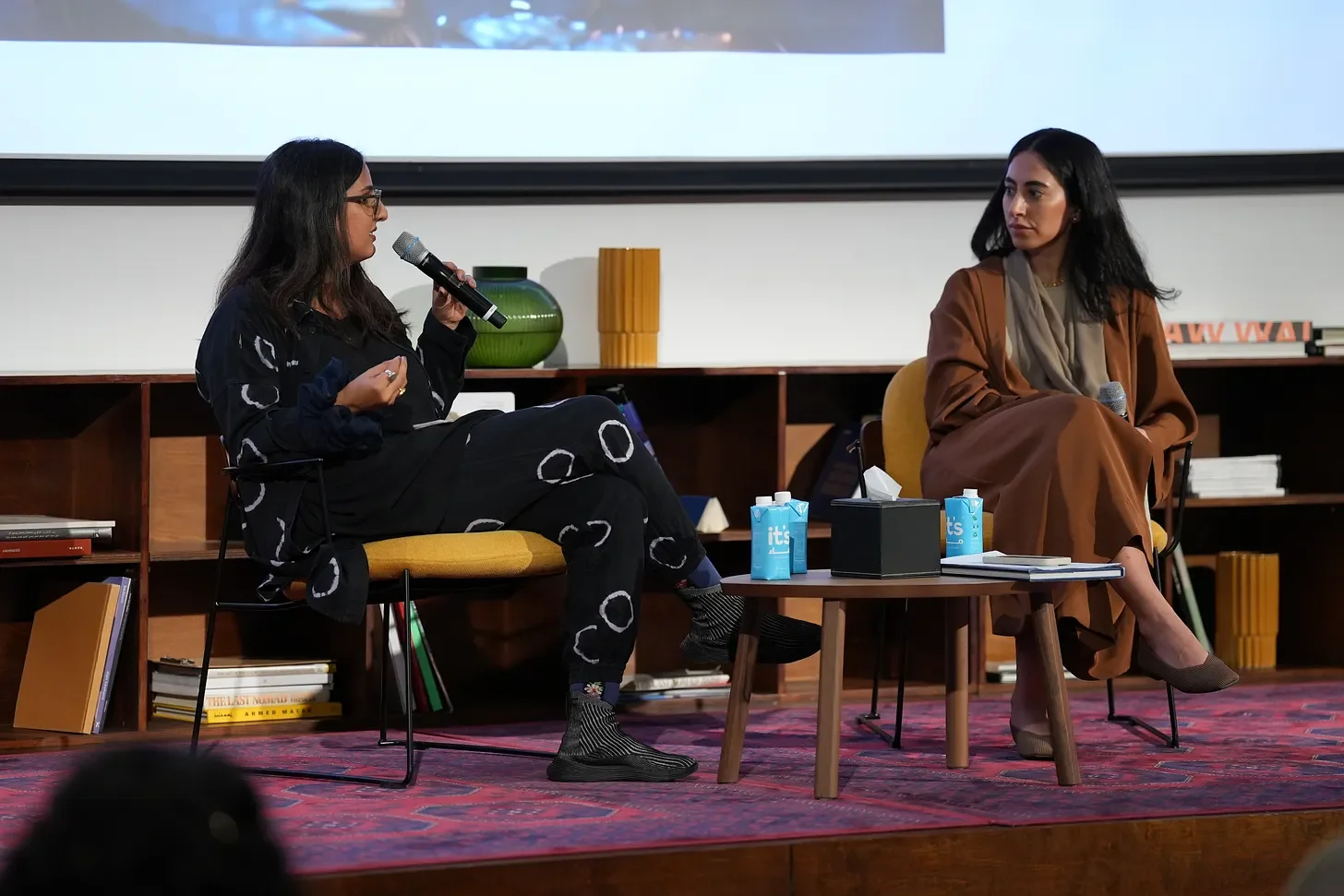
Courtesy of Sara Al Mutlaq
Diriyah Art Futures: Alternative Education, New Media, and the Neutral Tool
In Diriyah Art Futures (DAF), Al-Mutlaq’s interest in research and pedagogy becomes institutional form. She introduces it first as infrastructure: “Diriyah Art Futures is primarily an educational center.” The exhibition space is “about 1,200 square meters,” but the building’s meaning is in its classrooms and labs, “multiples of that… probably like 20,000 square meters.”
DAF, she explains, emerged from an urgency around “alternative education”: programs “not as short as a residency, but rather more like a fellowship program.” The structure is designed to build critique over time: a year-long program for emerging new media artists that culminates in an exhibition; jury review mid-year; plus two fellowships and a writing program that connect cultural practice to Saudi Arabia’s transformation - “to really reflect on the larger economic political transformation that is happening in Saudi today.”
Her most provocative claim is about new media as a kind of tool-politics. “Technology is really a very modern tool… continuously changing. And so it doesn’t relate to the histories of a certain society.” In that sense, it can be “neutral” - a means for artists to create interventions “that don’t necessarily depend on Western history or Western views.” She contrasts it with painting, which is difficult to detach from Western art-historical saturation: “It’s a little bit difficult to exit the histories of painting.”
But neutrality here doesn’t mean emptiness. DAF’s curricular ambition, as she describes it, was to prevent new media from collapsing into tool-fetishism. “New media art is not about the tool
that you deploy… It’s not about using AI to create an artwork.” Instead, it is an inquiry into infiltration: “Speculating on how technology today is infiltrating our very existence… and using art form to speculate on how that technological tool is infiltrating our world.” Her conclusion is almost a manifesto: “That’s what I love about new media art… [it is] a very critical and speculative art form.”
Fiction, Truth, and the Embassy as Device: “Unfolding” as Immersive Thesis
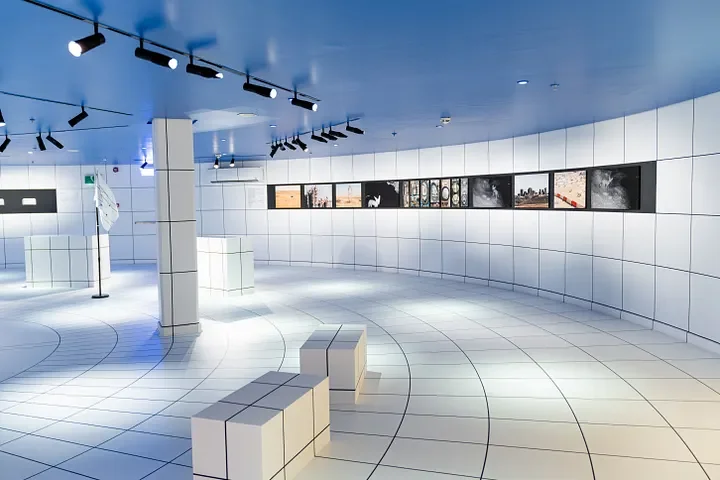
Al-Mutlaq’s research circles questions of simulation, identity, and visual culture in a present she describes as already futurist - an era shaped by global interconnectedness and saturated with projected imaginaries, where “visual media is not neutral” and self-perception becomes a political terrain. She turns to fiction as a curatorial instrument: in a multidisciplinary workshop imagining Riyadh in 2050 - houses as malls or towers, even speculative sixth senses - she produced the fabricated lecture The Blue Lotus Affair, presented as real research so convincingly that “everyone believed it,” revealing how belief now travels faster than verification. This methodology informed Unfolding (May–September 2023) at Fina’ al-Awwal, where she rejected the white cube and staged the exhibition as a speculative embassy orbiting Earth in 2040, blending Kubrick-like spatial systems with the subconscious rituals of waiting rooms - flags, landscapes, bureaucratic thresholds - to open inquiry rather than resolve it. Visitors inscribed their feelings about visas onto glass blocks, and artworks invoked statelessness through ubiquitous yet unwanted symbols, positioning interpretation itself as civic participation: exhibitions, she insists, are research made public. Immersive rather than highbrow, the project became a gateway across disciplines - from film to engineering - demonstrating her ambition to create spaces that speak widely while sharpening the questions of truth, fiction, and collective imagination.
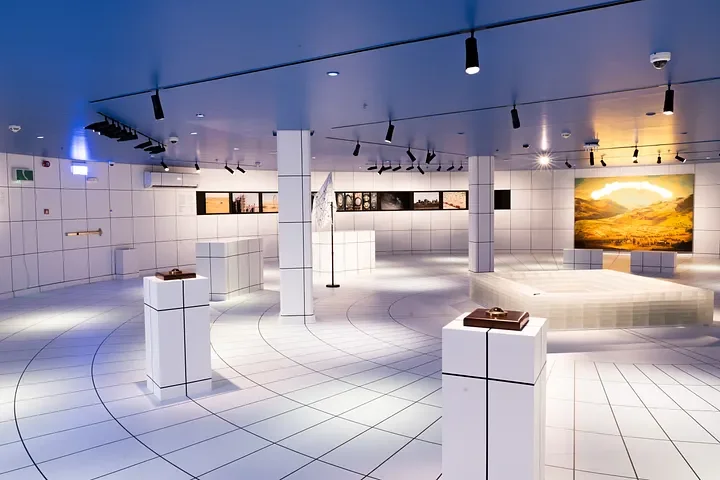
Fina’ al-Awwal: The Power of Smallness and the Politics of Audience
Al-Mutlaq’s praise for Fina’ al-Awwal is a praise of scale. “What’s really incredible… is truly its scale.” Smallness is not limitation but strategy: a space “between 200 and 500 square meters” could not prioritize international audiences as its main target—though it mattered, given its Diplomatic Quarter context and “relationships with different embassies.” The result was a rare institutional condition: a publicly funded space that could behave “like grassroots.”
“Because of its scale, there was an opportunity to really engage with local curators and local audiences,” she says, naming local exhibitions and workshops as evidence of a platform that, at its best, supported “younger emerging practitioners” and treated the local public as primary. Its “superpower,” as she puts it earlier, was that it “wasn’t really interested in the international audience… rather… the local audience.”
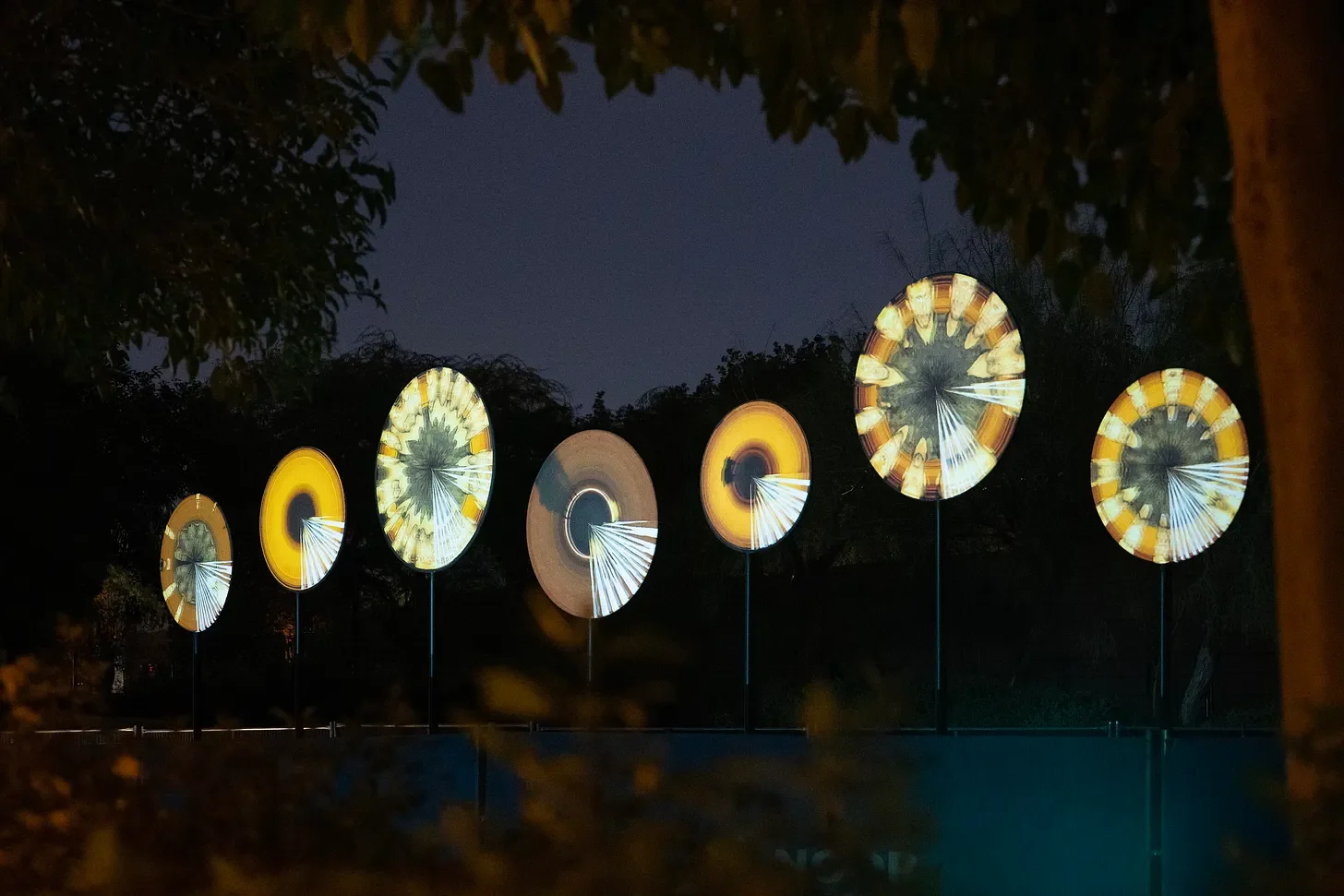
Seven Axes by Obaid Al Safi for Noor Riyadh, 2025
Noor Riyadh: Public Space, the Metro Line, and Memory as Medium
When the interview shifts to Noor Riyadh, Al-Mutlaq is candid about constraints - especially around selection remits. Yet she finds conceptual clarity in the 2026 theme: “In the Blink of an Eye.” It is a framework for reading “this sense of rapid transformation,” symbolically tethered to “the opening of the Metro line that happened in 2025.”
The curatorial geography follows infrastructure. Sites were chosen “along the blue line,” moving north-to-south, and that movement becomes historiography: “it’s actually the temporal movement of the expansion of the city of Riyadh in time.” Southward, the line reaches Deera and Qasr al-Hukum - “the birthplace… of the city” - a site of mud architecture, early urban life, and national memory. There, the placement of works foregrounded “memory and nostalgia.” She describes a neon intervention spelling “Ahibbik,” “stretched… onto the facade,” as an act of loving remembrance - “remembering it in love.”
At the National Museum and the King Abdulaziz Dara Archive, the 1980s boom re-enters the narrative through institutions: “the first museum, the biggest National Archive.” Here, she observes, local artists used “new media art… to think about collective memory… archive… identity, and where we’re going.” She offers a detailed example: an artist with computer science training created an algorithm that captured faces and “visually edit[ed] it, and then over impose[d] it onto…” circular forms, linking the present-day visitor to “these landscapes of memory” from farmlands - “a state of remembrance between the person… today… and these landscapes of memory.”
Her conclusion refuses the easy narrative that today’s transformation is unprecedented. The longing for memory, she suggests, is also a response to an earlier acceleration: “not… a reaction to the contemporary shift… but rather… to the 1980s boom, and this rapid expansion that we already witnessed.”
Words copyright of Naso Art Journal.
Images courtesy of Sara Al Mutlaq.
