
Slowly I Have Become A Spoil Heap
Pinault Collection Artist Residency, Lens. Open studio and group exhibition, curated by Matti Ullrich
Written by Soraya
I got to Lens sideways, the way the best things arrive. Joanna Chevalier, whom I interviewed recently for Naso, mentioned Anhar Salem and said I should definitely interview her. A few messages later I had an invitation to come see the residency exhibition for myself. What followed was one of those afternoons that reorganizes your week: a train north, a walk through a town built on coal, and several hours surrounded by art and creativity.
The first thing I did was stop. Just inside the entrance, a video by Salem was playing, and I watched it before I'd taken my coat off or looked at a single label. In hindsight, it was the right way in. Salem is the current resident, and the exhibition is built around her open studio. The studio brings together a number of her projects. She developed some of them on her own, and others with her network of artists and with people who live in Lens. Starting with her video meant starting with the voice the rest of the building answers to.
Ullrich's curatorial text sets the frame plainly. The exhibition, he writes, is conceived as "an exploration of images and stories as ancient fossils." By that he means memories and scrap material left behind between the earth's layers while people mined for coal and other riches. The idea is that making images is itself an extractive industry, and that it leaves the same kind of residue behind: "spoil heaps of ones and zeros." Digging and accumulating become artistic gestures. They show up in the brushstroke and in the kneading of clay, and also in capturing images and in collecting and cataloguing media.
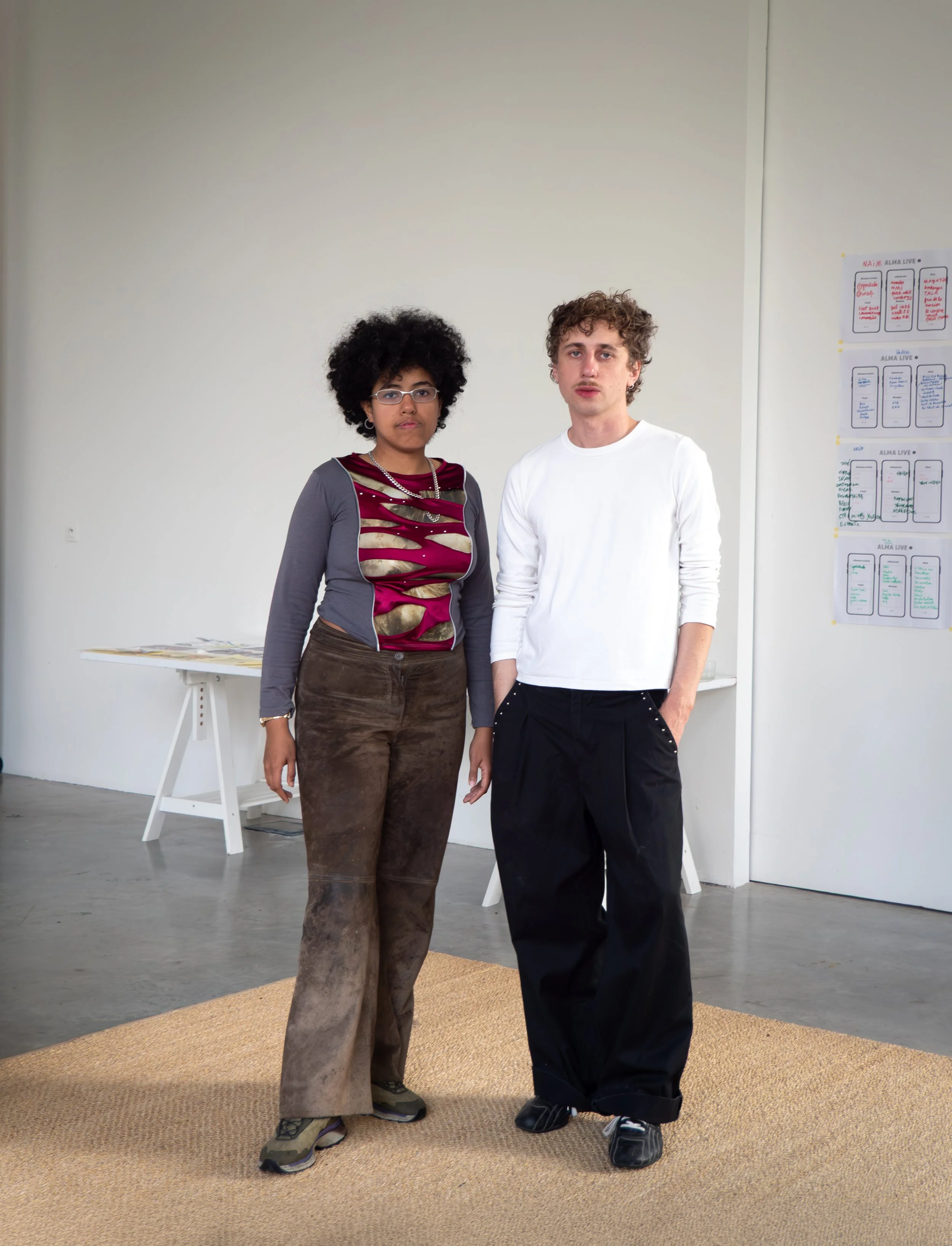
Anhar Salem & Matti Ullrich (Photo Credit: Lucien Bitaux)
The residency has four spaces: le Salon, la Cave, le Hangar and l'Atelier. The show uses all of them, and each has a completely different atmosphere. That turns out to be the point. The works haven't simply been distributed where they fit. They've been paired with rooms. Some were made on site during the residency and stay close to the town's geography and history. Others come from elsewhere and answer the site from a distance, like long-distance echoes. Moving between the spaces felt less like walking through a group show and more like going down through the layers Ullrich's text describes.
Le Salon is where you get your bearings. Lucien Bitaux's Bibémus (2025), in polished and printed aluminum with motors, sits alongside his Stones, Mountains, Skies, Stars (2023). The second piece is five prints on paper, brass, copper, bronze and aluminum, shown with an eleven-minute film. The materials alone read like a list of what comes out of the ground. Salem's films are here too: Love and Revenge (2021), Eyes (2015) and The Sleeping Sun Station (2021), along with Wudumedia (2026), made with Aram Abbas. It's the most composed room in the building, a place to sit and look before going further.

Lucien Bitaux, Stones, Mountains, Skies, Stars (2023), 5 prints on paper, brass, copper, bronze and aluminum, film, 11 min (Photo Credit: Lucien Bitaux)

Lucien Bitaux. Bibémus (2025), polished and printed aluminum, motors (Photo Credit: Lucien Bitaux)

Anhar Salem, Love and Revenge (2021), video, 30 min Eyes (2015), video, 5 minutes The Sleeping Sun Station 2021), film, 13 min (Photo Credit: Lucien Bitaux)
Then you go underground. La Cave is the show's heart and its most physical space: brick walls, low light, rubble stacked against the walls, a projector propped on a pile of old bricks. Putting this group of works in a cellar, in a former mining town, is the most direct decision in the exhibition, and it works. The cellar holds:
Antoine Granier's ceramic Papillon de ville minière (2026)
What is left to mine (2026), a thirteen-minute video by Salem, Ullrich and several other authors
Spoil Heaps Collective's Dip in oil (2026), in found metal and glass
Vera Hector's Voir les îles (2026) and Ainsi passe la douleur (2024), in charcoal, graphite and India ink
Mohammad Alfaraj's photographs The tongue of the street (2022/2023)
coyote's video New Centuries Are Rare (2023)

Anhar Salem & Matti Ullrich, What is left to mine (work in progress, 2026), various authors, video, 13 minutes (Photo Credit: Lucien Bitaux)

Mohammad Alfaraj, The tongue of the street (2022_2023), photographs (Photo Credit: Lucien Bitaux)

Mohammad Alfaraj, The tongue of the street (2022_2023), photographs (Photo Credit: Lucien Bitaux)
Down here the show's second thread comes through most clearly, and it's devotional. Mythical and religious references run through many of the works and are especially strong in Salem's practice. The story of the seven sleepers, shared by Muslim and Christian tradition, runs through the whole exhibition, alongside allegories of caves and mines, rave and faith. In the dark of the cellar, 1990s youth rave culture and Quran illustrations do the same work. Both turn the mine into a place where people gather and worship. Salem's practice is described as dealing with the contradictory access we have to private and public space, seen through neighborhoods and communities, whether familiar or strange. Surrounded by old mining infrastructure, every reference to sacred text, collective movement or myth gets louder.
Le Hangar changes the scale again. It's a looser, more open space, and it holds two films that both deal with distance. One is Salem's Looking at two cities with blurry vision (2026), with music by Shakeeb Abu Hamdan. The other is Lova Karlsson and Théo Audoire's Ovan Gruvan (2022), a fourteen-minute film whose Swedish title means "above the mine." Putting them together in a room built for storage and movement felt deliberate: both are about looking at a place from somewhere else.

Anhar Salem Looking at two cities with blurry vision (work in progress, 2026), video, 8 minutes Music: Shakeeb Abu Hamdan (Photo Credit: Lucien Bitaux)
L'Atelier is the working space of the residency, and it feels like it: a desk by the window, books left open, a screen glitching in pink and green. This is where the collaborations are. Signs (2026) is a 22-minute film made with Alice Brygo. It's performed by Hasna Herzi Soltys, Mia Soltys, Frank Soltys, Ewa Ramon, Thoraiya and Ibtisam, who are residents of Lens, not imported performers. There's also ALMA LIVE with Vadim Dumesh, and Ursula Bradley's six oil paintings, Sites of planning, progress and potential (2026).

Signs (2026) work in progress by Anhar Salem & Alice Brygo 2 (Photo Credit: Anhar Salem, Alice Brygo)
Ullrich writes that the collective dimension of the show lives in the labor of the mine, in worship and in underground raves. It's also how the exhibition itself came together, as a space shaped by a community that is partly local and partly from far away. In the Atelier, you can see it.
I left past what remains of the town's industrial past. Dirt and waste brought up from deep underground were piled into artificial mountains that became public monuments. In Ullrich's words, they are "a spoil heap of empty promises for a wealthy existence." The exhibition ends on a question that stayed with me on the train back to Paris. Once the machines of mass image production have gone quiet and all the data has been mined, what will be waiting underground, newly abandoned, for whoever comes next?

Spoil Heaps Collective, Dip in oil (2026), found metal metrial, glass (Photo Credit: Lucien Bitaux)
Words Copyright of Naso Art Journal
Images Courtesy of Pinault Collection Artist Residency
